Programming

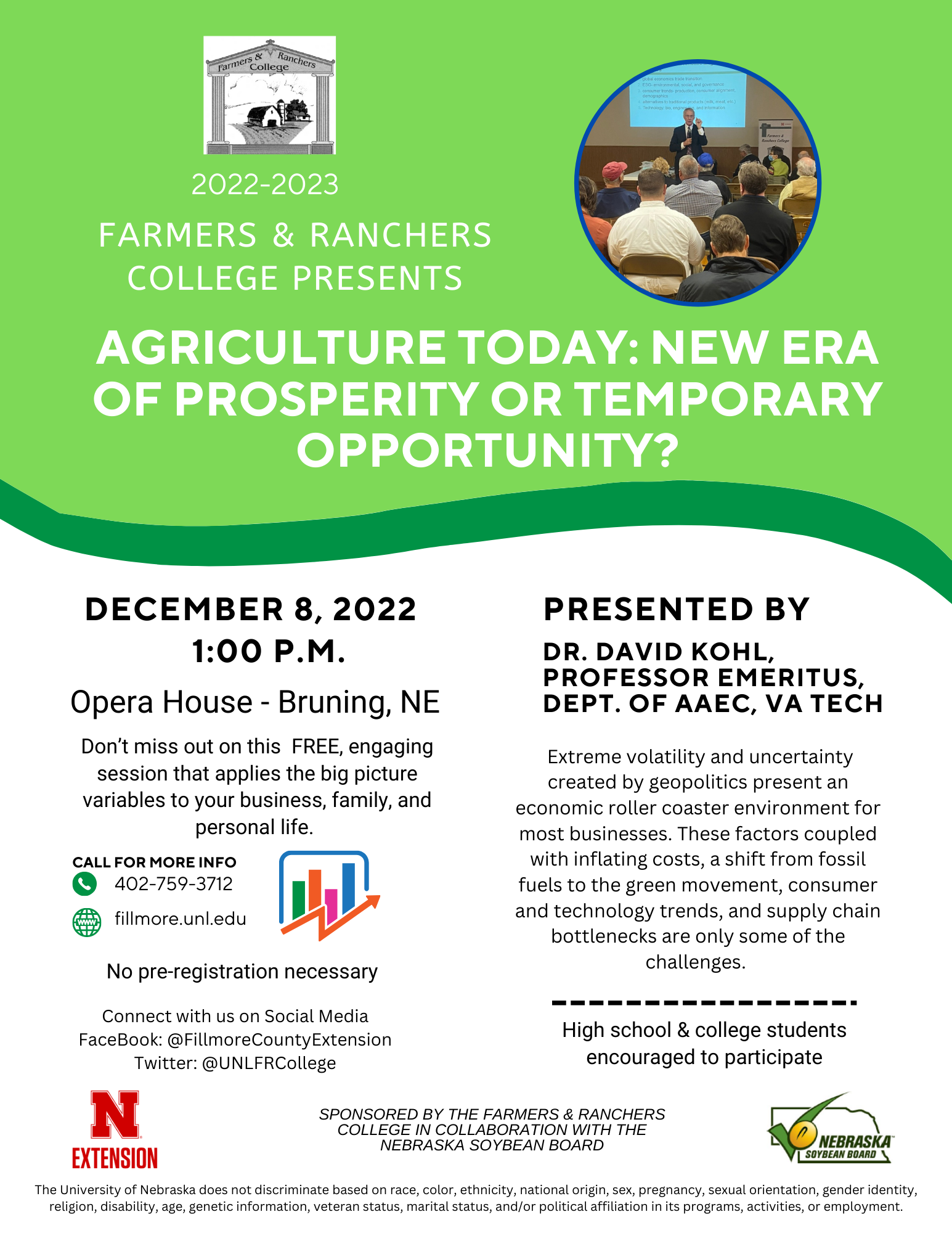
Agriculture Today: New Era of Prosperity or Temporary Opportunity?

The 2022-23 Farmers & Ranchers College will kick off December 8th featuring Dr. Dave Kohl. Registration will start at 12:45 p.m. and the program will start at 1:00 p.m. at the Opera House in Bruning, NE. The program is titled, “Ag Today: New Era of Prosperity or Temporary Opportunity.” The business and economic landscape of agriculture can be described in one word as “anxious.”  Global trade uncertainty and the shift from fossil fuels to the green movement coupled with inflation and supply chain bottlenecks are only a few o the challenges.  However, with these headwinds, opportunities exist for those who manage the business proactively despite all the economic megatrend shifts. 

The decade of the 2020s will be one of economic and financial divide. Stimulus checks from the government along with rising commodity prices in some industries have presented profits not seen since the Great Commodity Super Cycle.  Extreme volatility and uncertainty created by geopolitics present an economic roller coaster environment for most businesses. These factors coupled with inflating costs, a shift from fossil fuels to the green movement, consumer and technology trends, and supply chain bottlenecks are only some of the challenges.  Visionary CEOs must strategically analyze the challenges and opportunities.  They must conduct both an industry and business SWOT analysis to identify strengths, weaknesses, opportunities, and threats in their business plan, and a pathway to remaining on the positive side of the ledger.  Don’t miss out on this engaging session that applies the big picture variables to your business, family, and personal life.   

Many in the area are very familiar with Dr. Kohl, but if you are not, here are some details about him. Dr. Dave Kohl is an academic Hall of Famer in the College of Agriculture at Virginia Tech, Blacksburg, VA.  Dr. Kohl has keen insight into the agriculture industry gained through extensive travel, research, and involvement in ag businesses.  He has traveled nearly 10 million miles; conducted more than 6,500 presentations; and published more than 2,250 articles in his career. Dr. Kohl’s wisdom and engagement with all levels of the industry provide a unique perspective into future trends.

The following week on December 15th, the Farmers & Ranchers College will be hosting a hands-on training workshop that will teach producers about Extension’s Agricultural Budget Calculator. This program will be held at the Fillmore County Fairgrounds in Geneva from 1-3:00 p.m. Participants are encouraged to bring a laptop or tablet to the workshop but if they are unable to do so, they are still welcome to attend. Please register by December 13th for this program at cap.unl.edu/abc/training.

Questions on the Farmers & Ranchers College can be directed to the Fillmore County Extension Office at (402) 759-3712. To participate and register, go to the website: go.unl.edu/farmersrancherscollege.
Livestock, Programming

Nebraska Grazing Conference

Challenges from COVID-19 have required changes be made to many programs everywhere. This year’s 20th Nebraska Grazing Conference (NGC) will be held as a virtual event instead of the traditional in-person event.

close up photo of white and brown cattle
Photo by James Wheeler on Pexels.com

According to the website:
The online conference will be held from 11:30 AM to 5:00 PM on both Tuesday, August 11 and Wednesday, August 12. Organizers hope the online version of the conference will be a convenience to a broader audience who will be able to participate from their home or office. Opportunities for interaction among participants and to ask follow-up questions of speakers have been built in to the online event. Additionally, several watch parties have been organized around the state for groups of 25 or less to gather and participate in this virtual conference. This option may assist those who do not have stable Internet service in their area.

Watch party sites include:

  • Northeast Research & Extension Center, 1010 E Centre, Hartington, NE. Host, Ben Beckman, Beef Systems Assistant Extension Educator, Nebraska Extension, (402) 254-6821 or ben.beckman@unl.edu
  • Zion Lutheran Church, 318 E 4th Street, Ainsworth, NE. Host, Hanna Greenwell, Beef Systems Extension Educator, Nebraska Extension, (402) 387-2213 or hgreenwell2@unl.edu
  • Panhandle Research & Extension Center, 4502 Avenue I, Scottsbluff, NE. Host, Mitchell Stephenson, Panhandle, Forage Management Specialist/Extension Specialist, Nebraska Extension, (308) 632-1230 or mstephenson3@unl.edu
  • Fillmore County Fairgrounds, 641 N 5th Street, Geneva, NE. Host, Sydney O’Daniel, Beef Systems Extension Educator, Nebraska Extension, (402) 746-3417 or sydney.odaniel@unl.edu
  • Buffalo County Extension, 1400 E 34th Street, Kearney, NE. Host, Brent Plugge, Extension Educator, Nebraska Extension, (308) 236-1235 or brent.plugge@unl.edungc-schedule-2020.jpg


Programming, Youth

Collaboration and Teamwork

As we wrap up county fair related work and head back into other extension programming, I always reflect on the county fair experience. This year’s fair was definitely one that will go down in history.  This marks my fifteenth Fillmore County fair, although it definitely seemed like my first fair again. With the go and show livestock format and many modifications,  we started planning for many different versions of how the fair would look. Back in March, we weren’t even sure we’d be able to have county fairs. Then we had a virtual option and finally we were able to successfully have a face-to-face option.IMG_9669.jpeg

I’d like to give a huge “shout-out” to the Fair Boards for allowing us to have the youth component of the fair. This year, I relied heavily on 4-H Council members and superintendents to help us walk through a modified county fair to meet health department guidelines. This year’s fair went very well, mostly due to the amount of teamwork and collaboration observed. First of all, when it comes to putting together a fair, there are many small, behind the scenes tasks that occur. I’d like to give a lot of credit to the entire staff of Fillmore and Clay Counties. Weeks before the fair, data is entered into the computer system, stall assignments are created, awards ordered, reminders sent to exhibitors about completing quality assurance, registration deadlines, etc. All of this preparation allows for a much smoother fair during the actual week of fair.

Without the collaboration of staff, fair would not occur. Also, there is a lot of time spent from volunteers such as Council members and superintendents. From helping with winter weigh-ins to helping answer questions and attend meetings, volunteers are engaged year-round to make the program the best it can be.

An article adapted from Belgrad, W., Fisher, K., & Rayner, S. (1995) best summarizes that “collaboration and teamwork require a mix of interpersonal, problem-solving, and communication skills needed for a group to work together towards a common goal.” The best teams I have worked with put their own agenda aside and work towards the greater good for the team. This article also provides tips for how to develop a collaborative team environment. There are five themes that must be present.Screen Shot 2020-07-17 at 9.57.48 AM

The first is trust. Being honest with the team helps each other develop respect within a team. Give team members the benefit of the doubt and work to eliminate conflicts of interest. Secondly is to clarify roles. When teach team member knows their key roles, they are able to perform more effectively and can figure out ways to help each other. Next, it is important to communicate openly and effectively. Work to clear up misunderstandings quickly and accurately. Its best to over-communicate, rather than not communicate. Learn to be a good listener and recognize team member efforts. Fourth, is to appreciate diversity of ideas. Be open-minded and evaluate each new idea and remember that it is okay to disagree with one another, but learn how to reach consensus. Often times, much is learned from those who differ from you.  Finally, balance the team’s focus. Regularly review and evaluate effectiveness of the team. Assign team members specific tasks to evaluate and provide praise to other team members for achieving results.

I would certainly like to take some time this week to thank the entire Clay and Fillmore county staff for the hours of time spent. Without the entire staff working together, fair would be miserable.  Also, I’d like to thank the 4-H Council members who have so freely given of their time during the whole year with various tasks and take time away from their own family to help make the fair a success. Of course, livestock superintendents put in a large amount of time during the fair during check-in, the show, loading animals, etc. Special thanks to the fair board for their support of the 4-H program and the countless hours they spend setting up for events, etc. Businesses and financial donors help provide youth with incentives for their projects. There are so many other individuals and businesses who are helpful and do things without any recognition and to all of you, thank you!

I’d also like to thank everyone for allowing me the chance to be a “mom” on Fillmore County beef show day and help McKenzie get her three calves ready.  It was valuable time I was able to spend teaching her and being able to create memories. One of the best quotes someone once told me has stuck with me: “It’s better to be a part of the solution, rather than a part of the problem.” I saw a lot of sportsmanship being conducted in a positive manner this year which is refreshing at a time when so many people in our country, find things that are wrong and focus on those. Congratulations Clay and Fillmore County 4-H and FFA programs on a great county fair!

Source: Belgrad, W., Fisher, K., & Rayner, S. (1995). Tips for Teams: a Ready Reference for Solving Common Team Problems. McGraw-Hill: New York.

Programming, Youth

2020 Youth Crop Scouting Competition Virtual Competition

Nebraska Extension is pleased to present the 6th Crop Scout Design (1)annual Crop Scouting Competition for Nebraska youth. Youth interested in crops have the opportunity to learn about crop growth & development and basic crop scouting principles.

Don’t know a lot about crops?  Ask a local agronomist to assist by providing a short lesson on crop production. You can have the agronomist meet with youth a little during each meeting or outside of the meeting. This is one way to engage those youth interested in crops.

This contest will be held virtually this year on July 28, 2020. Teams of middle school thru high school students (those completing 7-12th grades) from across Nebraska are invited to participate. With the virtual option, there will be a limited space to the first ten teams who register.  Teams will compete in a fun, group online game instead of the written individual test. The scouting exercises will enable teams to work together via zoom. They will be given a scenario or task to complete and communicate their answers to the Nebraska Extension judge.

Clubs or other organizations may enter a team composed of three to five participants. An adult team leader must guide students through the process. Team leaders could be FFA advisors, crop consultants, extension staff, coop employees, etc.

Top-scoring teams win prizes: $500 for first, $250 for second, $100 for third place.   Teams are expected to know the basics of scouting corn and soybean fields. This includes crop staging; looking for patterns of crop injury; disease, insect and weed seedling identification; etc. Other topics many include but are not limited to, pesticide safety, nutrient disorders, and herbicide injury.

Two New Opportunities For Youth This Year

Free package of study materials will be mailed to each team that registers by the deadline! When teams register, we will send one package to every team sponsor that provides an address. Study materials will include

    1. Weed, Disease & insect guide
    2. Corn and soybean field guide
    3. A magnifier for your phone camera (if funding allows)
    4. Additional promotional items

We are also providing, “Office hours with an Agronomist”. Join us for several office hours with an Agronomist. Starting soon, different Nebraska Extension agronomist/specialists will share some scouting information and answer your questions. The office hours are open to all youth in grades 7-12. No registration required. A link will be posted on this webpage on the day of the office hours that will direct you to a zoom meeting to participate.

More information about the crop scouting competition and instructions on how to register a team are available online at cropwatch.unl.edu/youth. Register at: https://go.unl.edu/cropscoutingreg.

Teams must be registered by July 15. This program is sponsored by Nebraska Independent Crop Consultant Association and Nebraska Extension.

Programming, Youth

Fillmore County Fair Schedule

Nebraska Extension -Fillmore County staff have been working closely with the County Fair Board, local Health Department, and 4-H Council to make decisions that will best meet local needs while complying with state/regional/local guidelines and policies.  Decisions have been made keeping local, state and federal regulation and health guidelines in mind.

Nebraska Extension is operating under:

Shows are for only immediate family members/guardians of that exhibitor in attendance at the shows. All livestock shows will be available for online viewing to the best of our abilities.  Please be respectful of our youth and realize this face-to-face option will only happen with community support and being respectful of our youth and following of public health department guidelines.

Livestock shows will be streamlined through striv and can be accessed at go.unl.edu/fillmoreshows. Other updates, including the Fillmore County Static Exhibitor Showcase, livestock programs and Champions of Fillmore County video will be available on the county extension’s website and social media. Go to fillmore.unl.edu for all of the latest updates.

2020 Fillmore County Fair Schedule

Please be advised that all schedules and guidelines are subject to change based on local health department recommendations, etc..

Shows are for only immediate family members/guardians of that exhibitor in attendance at the shows. Wrist bands are required to enter the fairgrounds.  All livestock shows will be available for online viewing on Exeter-Milligan’s Striv channel and be accessed at https://go.unl.edu/fillmoreshows.

Fillmore County Static Exhibitor Showcase, livestock programs and Champions of Fillmore County video will be available on the fillmore.unl.edu website or Fillmore County 4-H’s Facebook page.FillmoreFairPublicSched2020

Crops, Programming, Youth

Youth Crop Scouting Competition

IMG_3105Looking for a fun club project? Want to unite your club members? Running out of ideas for club meetings?  If you answered, “yes” to any of these questions, help is on the way!  Nebraska Extension is pleased to present the 5th annual Crop Scouting Competition for Nebraska youth. Youth interested in crops have the opportunity to learn about crop growth & development and basic crop scouting principles.
Don’t know a lot about crops?  Ask a local agronomist to assist by providing a short lesson on crop production. You can have the agronomist meet with youth a little during each meeting or outside of the meeting. This is one way to engage those youth interested in crops.

This contest will be held at the ENREC near Mead, Nebraska on July 28, 2020, pending directive health measures at that time. If a live competition is unable to occur, a virtual option will be conducted.  Teams of middle school thru high school students (those completing 5-12th grades) from across Nebraska are invited to participate. This year, to comply with directive health measures, the event is limited to the first five teams who sign-up!

Clubs or other organizations may enter a team composed of three to five participants. An adult team leader must accompany each team of students. Team leaders could be FFA advisors, crop consultants, extension staff, coop employees, etc.

Top-scoring teams win prizes: $500 for first, $250 for second, $100 for third place. Unfortunately, there will not be a regional competition this year.

Teams will be expected to know the basics of scouting corn and soybean fields. This includes crop staging; looking for patterns of crop injury; disease, insect and weed seedling identification; etc. Other topics many include but are not limited to, pesticide safety, nutrient disorders, and herbicide injury.

More information about the crop scouting competition and instructions on how to register a team are available online at cropwatch.unl.edu/youth. Register at: https://go.unl.edu/cropscoutingreg.

Teams must be registered by July 15. This program is sponsored by Nebraska Independent Crop Consultant Association and Nebraska Extension.

Crops, Programming, Youth

Tractor safety course for teens

The Central States Center for Agricultural Safety and Health at the University of Nebraska Medical Center, College of Public Health and Nebraska Extension have announced new plans for the tractor safety training course that was originally scheduled to be held at 12 sites across Nebraska this spring and summer. The new plans are designed to protect the health of the students and trainers during the COVID-19 pandemic.  Students will take the first day of the course online through the eXtension Foundation Campus website. After successfully completing the online course and testing, the required driving test will be offered at five locations across Nebraska July 27-31, 2020.

green and yellow tractor on dirt
Photo by John Lambeth on Pexels.com

Teens 14 or 15 years of age who work on farms, or others who are interested in learning about safe farming practices, are encouraged to register for the Course. Anyone under age 14 is not eligible to take the class.

Federal law prohibits children under 16 years of age from using certain equipment on a farm unless their parents or legal guardians own the farm. However, certification received through the course grants an exemption to the law allowing 14- and 15-year-olds to drive a tractor and to do field work with certain mechanized equipment.

Susan Harris, University of Nebraska Extension Educator, reports that a common cause of agricultural-related injuries and deaths in Nebraska is overturned tractors and ATVs. She emphasized that this course is designed to train students how to avoid these incidents as well as many other hazards on the farm and ranch.

The online course will cover the required elements of the National Safe Tractor and Machinery Operation Program, including quizzes which students must pass to attend the driving portion of training. Once a student is registered, they will be sent a training manual, course paperwork and a link to the online course.

The onsite driving training and exam will include a driving test and equipment operation and ATV safety lessons. Students must demonstrate competence in hitching and unhitching equipment and driving a tractor and trailer through a standardized course. Instructors will also offer education about safe behaviors and laws for ATVs, utility-task vehicles (UTVs), and other off-road vehicles (ORVs).

In order to protect students and trainers, the number of students on site will be limited to allow proper social distancing. All students and trainers will be required to wear a mask at all times during instruction and driving. Masks will be provided along with instructions for proper use. Equipment, steering wheels, control knobs, hitches, will be disinfected before and after each student completes their testing. Students who have had a fever or persistent cough within 14 days of testing will be required to reschedule their driving test. Additional driving tests may be added in August to accommodate students who are unable to attend the 5 scheduled trainings.

Instructors for the course are members of the Central States Center for Agricultural Safety and Health: Aaron Yoder, Ellen Duysen; UNMC graduate student Alyssa Damke; and Nebraska Extension educators Troy Ingram, Randy Saner, and John Thomas.

Cost of the modified course is $40 and includes educational materials, online learning link, and supplies. More information on the 2020 Tractor Safety Course can be found at kearney.unl.edu.

Driving dates, site locations, and site coordinator contact information is below:

  • July 27 – Akrs Equipment, 49110 US Hwy 20 in O’Neill, contact Debra Walnofer, 402.336.2760, dwalnofer2@unl.edu
  • July 28 – Legacy of the Plains Museum, 2930 Old Oregon Trail #8500 in Gering, contact Stacy Brown, 308.632.1480, sbrown7@unl.edu
  • July 29 – West Central Research & Extension Center, 402 West State Farm Rd., North Platte, contact
  • Randy Saner or Vicki Neidhardt 308.532.2683, saner@unl.edu
  • July 30 – Hall County Extension, 3180 W. Hwy 34, Grand Island, contact Nancy Usasz, 308.754.5422, usasz@unl.edu
  • July 31 – Cass County Fairgrounds, 8420 144th St, Weeping Water, contact Sandy Prall, 402.267.2205, sprall2@unl.edu

For more information or to register, contact the appropriate Extension staff member above.  Visit kearney.unl.edu for a registration form.

Horticulture, Programming

Online Gardening Program

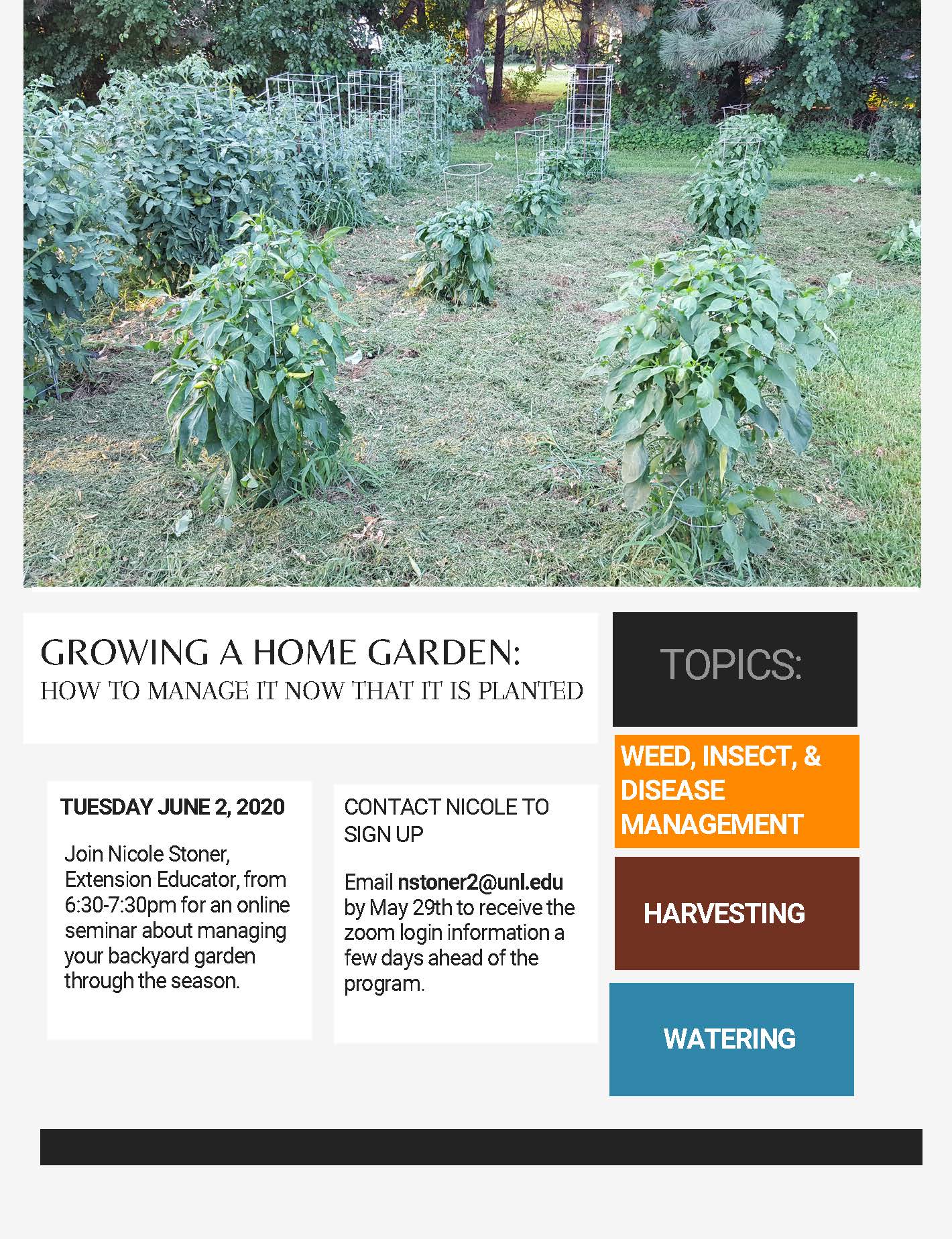
There has been a huge interest in gardening during this time period. For some people, this might be their first time with a garden and for some, we’ve been gardening for years, but are always looking for tips to improve productivity. If you fit into one of those categories, join Nicole Stoner, Gage County Extension Educator, for an online seminar about managing your backyard garden on Tuesday, June 2, 2020, 6:30 PM – 7:30 PM.  To receive the Zoom login, contact Nicole by Friday, May 29, 2020 at nstoner2@unl.edu.

Gardening Online Program Flyer, 2020

Programming, Youth

Nebraska Extension Showcasing 4-H’ers at County Fairs

Nebraska Extension is working to make sure all 4-H’ers across the state have the opportunity to showcase their hard work come county fair time this summer. Since COVID-19 hit, rest assured Nebraska 4-H faculty and staff have been diligently working on numerous plans and options to celebrate our youth and showcase their hard work. Recently, our Dean and Director, Chuck Hibberd released an article which also describes our efforts.4h_mark1

County fair boards and agricultural societies in Nebraska’s 93 counties are determining what their county fairs will look like – or whether to have them at all — as the state responds to COVID-19. Nebraska Extension is working with these groups to design in-person or virtual 4-H experiences or a combination of both appropriate for each county.  Recommendations of both the governor’s office and Nebraska’s district health departments will determine what strategies will work best on a county-by-county basis.

“We are absolutely committed to making sure all youth who take part in 4-H across Nebraska have the opportunity to exhibit their hard work at a fair,” said Chuck Hibberd, dean and director of Nebraska Extension. “We are equally committed to protecting the health and safety of our youth, volunteers, judges and spectators.

Nebraska has one of the highest 4-H participation rates in the nation, with one in three – a total of over 140,000 — youth engaged in the program. Nebraska Extension began adapting 2020 4-H programming to virtual formats back in March, when social distancing and other directed health measures were first put in place. Locally, I’m proud to say that Clay and Fillmore Counties actually reach one in two – youth engaged in the program.

“Fairs may look different than they have in the past with social distancing, different arrangements for livestock shows, and the possible option for virtual shows; we also know that the fair experience is an important part of a 4-H’ers summer,” Hibberd said. “We are excited to be able to make that happen.”

Additional information for county fairs will be available as details are finalized.  Please be patient with our staff and council members as we work through options.