Crops, Irrigation, Livestock, Youth

Disaster Anniversaries

Birthdays, anniversaries and holidays are days to celebrate annually with joy and happiness. If you are like me, I’m sure there are also dates that might bring feelings of anxiety, stress and sadness. For example, I’ll never forget where I was when September 11, 2001 happened. I’ll never forget days that various people in my life were impacted by serious illnesses or passed away. Many Nebraskans will never forget March 15, 2019 when the ‘bomb cyclone’ hit causing massive and historic flooding in the state. This date forever changed the lives of many and will take years for many to recover. As March 15, approaches, our Nebraska Extension team put out resources which I decided to share in my column this week.

gray scale photo of trees
Photo by Ian Turnell on Pexels.com

The Substance Abuse and Mental Health Services Administration (SAMHSA) has the following tips for how to cope with these trigger events.

  • Be aware that special days may be difficult. It’s common for some stress and other emotional reactions to happen around the anniversary of an event. Simply recognizing that your feelings are normal will help. Dealing with some of your losses and the new realities you’re facing after a disaster can be challenging. Try not to be too hard on yourself.
  • Be gentle with yourself. Show yourself the same kindness and patience you’d give to others during this time. Allow yourself to feel angry or sad and recognize that these emotions are natural.
  • Participate in activities that you enjoy. This may be different depending on the individual. Some people like to reflect in solitude while others may prefer spending time with family and friends for support. Some of these activities may include: singing, prayer, meditation, attending a spiritual service, going to the movies, or just getting together with loved ones to share a meal.
  • Talk about your losses if you need to. If you want to talk about your losses since the disaster, you can. If you want to talk about the future, you can do that, too. Be sure to share your thoughts and feelings with someone you trust. That can be a friend or family member or a health care professional.
  • Draw on your faith/spirituality. For many, faith and other spiritual beliefs are a source of strength and comfort every day, and most especially during difficult times. Reach out to your faith adviser, spiritual community, or anyone that you feel comfortable talking with about your beliefs to support and console you.
  • Accept kindness and help from others. Support from family and friends is essential to healing. It’s often difficult for people to accept help because they don’t want to be a burden to others, or don’t want to appear weak. Allow the people in your life to show their care and concern.
  • Help others. For some people, volunteering is a healthy way to heal and they get a great deal of satisfaction from helping others. Some activities can be as simple as donating food, clothing, and other items.

    beach depression sad tattoo
    Photo by Pixabay on Pexels.com

While it is hard to cope with these trigger dates, know that you are not alone and you are cared about, especially by Nebraska Extension. Nebraska Extension, along with numerous other partners has recently created the “Nebraska Needs You” campaign and is working to support others in times of difficulty. We have the Rural Family Stress & Wellness Team, that I am a part of which participates in activities supporting the wellness of rural Nebraska communities by working with community partners and the University of Nebraska. Resources can be found at ruralwellness.unl.edu.

(Source: The Substance Abuse and Mental Health Services Administration)

Crops, Uncategorized, Youth

Innovative Youth Corn Challenge

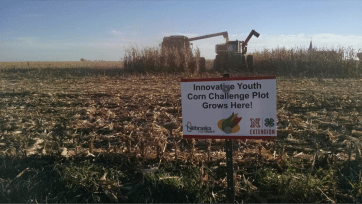
Science, technology, engineering, and math (STEM) careers are in high demand and will continue to be in future years. To engage youth in crop science based education, the Innovative Youth Corn Challenge (IYCC) was created as a partnership between the Nebraska Corn Board and Nebraska Extension.  Since the Innovative Youth Corn Challenge program’s inception in 2012, 53 teams have participated in the program with 32 teams successfully harvesting and analyzing their plot data. A total of 148 youth have participated. This contest, open to 4-H or FFA members, guided participants through all aspects of corn production, as well as agricultural careers related to corn production.IYCC brand.png

The winning team from the 2019 growing season was the Kornhusker Kids 4-H Club which included Kaleb and Landon Hasenkamp,  Matthew and James Rolf, Levi Schiller, Ian and Payton Schiller. They worked with the UNL Project SENSE on an in-season nitrogen management program comparing using in-canopy sensors, a drone MZR treatment, or their standard grower treatment. Their results showed that the grower strips had the highest yield of 256.6 bu/acre but cost the most.  The MZR treatment yielded 238.67 bu/acre. The Project SENSE treatment yielded 245.5 bu/acre and had the best return on investment. Also, it is important to note is that this team randomized their treatments and had 3 replications of the plots which is important in figuring out the statistical significance. Their project sponsor was Chris Schiller.

Receiving second place was the Allen-Wakefield FFA Chapter which consisted of Katie Bathke and Ashley Kraemer with Jeff Geiger as their sponsor and Josh Batenhorst as their advisor. They wanted to test a polymicrobial solution for bulk fertilizers called Nachurs Rhyzo-Link LF. The hypothesized that the treated plants would yield better due to the five Bacillus strains creating a better environment for the roots. They found that the Rhyzo-Link plot had a yield of 243 bu/acre compared to 240 bu/acre for the control, with five replications.
C1AD11B5-CA53-4FA1-B59E-8D2F39FF43A8_1_105_c.jpeg

Third place went to the Rising Stars 4-H Club from Platte County which consisted of Kade and Isaac Stromberg with Brad Stephens as their sponsor. They tested seeding a blend of two hybrids compared to each planted separately. They had two replications and found that the blend of Pioneer 1197AM with Dekalb DKC60-88RIB yielded 245.48 bushels/acre, while the 1197 by itself yielded 243.99 and the 60-88 yielded 240.29 by itself. This team also took advantage of an offer from Crop Metrics to have a free soil water sensor placed in their field to monitor irrigation scheduling.

Other teams who completed their plots were the Oakland-Craig FFA team of Joe Monson, Aiden Jorgensen, Ryan Smith, Cole Buress, Hannah Mosemen with Kylie Penke as their sponsor. They tested Envite seed treatment, which is supposed to help non-legume plants fix nitrogen to see if there would be an increased yield when the nitrogen rate on the entire plot was reduced by 40%. They found that the Envite plot had a yield of 232 bu/acre compared to 229 bu/acre for the control.

Also finishing their project was Shelton FFA with Jacob Synder and Andrew Rayburn and Hannah Horak as their advisor. The main topic of their research was a starter fertilizer with a microbial catalyst called Nachur’s Rhyzo-Link 9-15-3. They had 2 reps and found that the Nachur’s Rhyzo-Link yielded 230.25 bu/acre at a cost of $9.95 per acre and no treatment yielded 224.4 bu/acre.

CornPlotPic16.png

Other teams that participated but due to various circumstances were unable to finish their project included Adams Central FFA Chapter, Ord FFA Chapter and the Golden Gate Clever Clovers 4-H Club of Washington County.

As a team, youth worked with an adult mentor throughout the process. Mentors can be extension faculty, ag teachers, or other qualified agronomy professionals.

Other awards handed out during the banquet held on UNL’s East Campus included:

  • The Extra Mile Award went to the Rising Stars 4-H Club.
  • The Innovation Award was presented to the Kornhusker Kids 4-H Club.
  • The Sustainability Award went to the Rising Stars 4-H Club. They utilized the Field to Market tool which is a leading multi-stakeholder initiative that is working to unite the agricultural supply chain in defining, measuring and advancing the sustainability of food, fiber and fuel production in the United States.

To participate in 2020, youth must complete and return an entry form by March 15th to the Fillmore County Extension Office in Geneva, NE. Forms can be downloaded at https://cropwatch.unl.edu/youth/cornchallenge. For more information, contact Brandy VanDeWalle at brandy.vandewalle@unl.edu.

Programming

Strategies For Family Farming Success In The Shark Tank

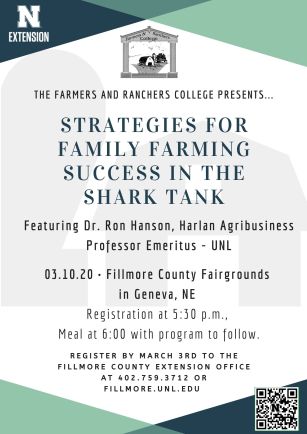
Developing and implementing a business management contingency plan to overcome unexpected changes to the organizational structure and/or management leadership to a family farm is crucial for the continued success of a farming operation.  This is an important step in preventing potential misunderstandings between farm family members as well as helping to avoid possible family disputes.  Can a farm business survive a potential shark attack (unexpected change) and still prosper?  An effective management strategy is to put yourself in the ‘shark tank’ and begin addressing the difficult questions and situations that might arise from these uncertainties in farming.Hanson20flyer.jpg

To aid farmers and ranchers with a business management plan, the Farmers & Ranchers College will be offering the final program of the 2019-2020 programming year on March 10th. This program will take place at the Fillmore County Fairgrounds in Geneva, NE featuring Dr. Ron Hanson, UNL Harlan Agribusiness Professor Emeritus. Registration starts at 5:30 p.m. with a meal to start at 6:00 p.m., followed by the program, Strategies For Family Farming Success In The Shark Tank.

Hanson points out that few farming operations ever survive an unexpected change to the organizational management structure of their farming business, let alone a crisis situation within the family.  Most farm families realize the importance of implementing a contingency business plan for if and when something ever happens, but few families ever accomplish this management goal. No one wants to be in the shark tank and be faced with a stressful situation.  These issues (unexpected death, sudden illness, family dispute, loss of a key employee) are often never discussed and usually avoided. But what if it does happen?  What might actually happen next?  What impacts could result to the farm?  To family members?

This presentation will identify the importance of implementing a business contingency planning process so that a farming operation continues when and if the unexpected actually happens. Striving to find answers as well as solutions is an effective strategy for a success when initiating a business contingency plan in case an unexpected change happens to the farm or family or even both at once.

Please pre-register by March 2nd, to the Nebraska Extension Office in Fillmore County or call (402) 759-3712 to assure a seat and meal. Walk-ins are accepted, but may not get a meal. You may also complete your registration online on fillmore.unl.edu or http://go.unl.edu/farmersrancherscollegePre-registration will also save you time at the door!


Crops, Irrigation, Livestock

2020 Crop & Cow-Calf Budgets

Two decision-making tools created by Nebraska Extension for agricultural producers across the state have been updated for the new year. The 2020 Nebraska crop budgets (https://cropwatch.unl.edu/budgets) and representative cow-calf budgets (https://go.unl.edu/cow-calfbudgets) are now available to provide producers with cost-of-production estimates.  Both sets of budgets are available as PDFs and Excel files, which feature tools that allow users to enter information into worksheets to calculate estimated production costs.

black calculator near ballpoint pen on white printed paper
Photo by Pixabay on Pexels.com

Both the crop and livestock budget files are made available online so producers can download, then modify, production and expense figures to more closely match their various enterprises. Glennis McClure, a Nebraska Extension educator in the Department of Agricultural Economics takes the lead on completing the budgets and reminds producers that understanding enterprise cost of production in agriculture is important in product mix decision-making, pricing, marketing and financial analysis.

The crop budgets include 82 production budgets for 15 crops produced in Nebraska, along with cost data for power, machinery and labor. They were compiled by a team led by Robert Klein, an extension crops specialist, and McClure, utilizing a template created by Roger Wilson, a retired extension farm and ranch management analyst.

There are five cow-calf budgets that offer representative herd data for different regions of the state. Background stories are included to assist producers with information relevant to each budget, which may guide producers in determining their own costs. McClure led the cow-calf budget effort, which was compiled from information gathered from producer panels that have met as part of the university’s multidisciplinary Beef Systems Initiative.


Crops, Programming

Risk and Reward Workshops 

An upcoming Nebraska Extension workshop will help farmers develop marketing plans for 2020. “Risk and Reward: Using Crop Insurance and Marketing to Manage Farm Survival” will be presented in Clay Center on February 5th. Extension economists will discuss the role of farm location and yield/price relations in making informed grain marketing and crop insurance decisions.

green field during sunset
Photo by VisionPic .net on Pexels.com

“This is a unique opportunity to think about grain marketing differently,” said Jessica Groskopf, a regional economist with Nebraska Extension.  “Often, we think of marketing and crop insurance as two separate decisions. This workshop will show the importance of how these tools work together to help farms survive.”

“Understanding production risk becomes especially important as farm locations move farther from the center of the corn belt,” said Cory Walters, associate professor in the Department of Agricultural Economics. “These workshops are designed to assist Nebraska farmers improve their decision-making and understand the role of production risk considerations in their marketing plans.”

Participants will learn how to use crop insurance and pre-harvest marketing together. The workshops will encourage producers to focus on specific risks to evaluate the balance between these two tools, which will vary from operation to operation.

“The role of crop insurance and marketing is not the same for everyone,” said Walters. “Farm location matters.”

Attendees should leave the workshops with a strategic plan of farm survival, focused on the role and use of crop insurance and pre-harvest marketing specific to their location and crop.

Schedule for “Risk and Reward: Using Crop Insurance and Marketing to Manage Farm Survival

Clay Center, Feb. 5, 9 a.m.-2 p.m., at the Clay County Fairgrounds, 701 N Martin Ave. To register, call 402-762-3644.

Crops, Irrigation

Ag Winter Programming Updates

Chemigation Certification

Applying fertilizer through pivots is becoming more popular due to the hybrids we are planting today and the opportunity for nitrogen efficiency savings. If your certification has expired in 2020 or taking the class for the first time, please pre-register.

Nathan Mueller, Saline Co. based educator will be providing the following trainings that run from 9:00 am to 12:00 Noon at the following dates and locations: Beatrice on Tuesday, January 28 at the Gage County Extension Office, Tecumseh NRD office on Tuesday, March 17, or on Wednesday, May 20 at the Lancaster County Extension Office. Register for those by calling the Saline County Extension office at 402-821-2151.

Steve Melvin, Merrick based extension educator will be providing the following trainings that start at 1:30 p.m. at the following dates and locations: January 24 at the Courthouse Meeting Room in Hebron or March 4 at the Hamilton County Fairgrounds in Aurora. Register for those by calling the Merrick County Extension officeat 308-946-3843.

For initial certifications, getting materials in advance from one of the offices listed above is suggested or view online at: water.unl.edu/article/agricultural-irrigation/chemigation (scroll to the bottom of the page). For more detail on Chemigation, go to https://go.unl.edu/2020chemigation.

Private Applicator Restricted Use Pesticide Training

There are over many applicators in the area that need to renew their private applicator pesticide license to purchase and/or use and apply restricted use pesticides. If you only purchase and use 2,4-D and glyphosate those are general use products and of course no license is required. If you have questions give us a call. Michael Sindelar, Clay County-based educator (who covers Clay, Fillmore, Thayer, & Nuckolls counties) will be offering a series of private pesticide safety education programs January 23 – March. I will still be helping with the Fillmore County programs and to see the full list of trainings, view https://go.unl.edu/2020pat or call our office at 402-759-3712.

Livestock, Programming

Cow/Calf College – January 28

Farmers and Ranchers Cow/Calf College – January 28

The annual Farmers and Ranchers Cow/Calf College “Partners in Progress – Beef Seminar” will be held at the U.S. Meat Animal Research Center and Great Plains Veterinary Educational Center near Clay Center on January 28, 2020 with registration, coffee and donuts starting at 9:30 a.m. The program will run from 9:55 a.m. until 3:30 p.m. This program is sponsored by Nebraska Extension’s Farmers and Ranchers College and will feature several outstanding speakers discussing issues and management strategies that can affect the profitability of all beef producers. There is no cost for the event and the public is invited. It does include a noon meal, which means that early registration is necessary to reserve materials and a meal. 1-15 F&R College.jpg

The “Cow/Calf College” will begin at 10:00 a.m. with a welcome by Dr. Mark Boggess of USMARC. Dr. Mary Drewnoski will kick off the program with “Do Your Herd & Your Bank Account a Favor – Test Your Hay”.  She will discuss the benefits and proper techniques for testing your hay and the advantages that can serve in your operation. Mary is part of an interdisciplinary team evaluating economic systems for integrated crop and livestock production in Nebraska.

Glennis McClure, Nebraska Extension Agricultural Economist will present on annual cow costs and provide updates on basic beef economics. Her responsibilities include publishing livestock and crop enterprise budgets, surveying and publishing the Farm Custom Rates Guide, and assisting with special economic analyses in the department.

Lunch is provided and will be handled with a rotation system featuring a session on: “Questions to Ask Your Vet Before Calving Season Begins” with Dr. Halden Clark, veterinarian with the Great Plains Veterinary Educational Center (GPVEC).  Dr. Clark’s duties at GPVEC include teaching veterinary students, engaging in research projects at GPVEC and providing extension service to beef producers and veterinarians.

The afternoon session will start with “Blockchains: Connecting Consumers with their Food” by a representative from IMI Global. IMI Global specializes in verification and certification program for the livestock industry to enable producers, feeders, growers, packers and processors to meet the ever changing needs of both domestic and international consumers.  Wrapping up the program will be a presentation by Dr. Alison L. Van Eenennaam on “Alternative Meats and Alternative Statistics: What do the data say”.  We’ve heard a lot in the news about alternative meats, how they are produced and how the nutrition compares to real meat, but what does the research really show?  Dr. Van Eenennaam from the Dept. of Animal Science at the University of California, Davis will join us via the web to provide insight on her work in this arena. Alison is an animal geneticist who discovered it is possible to splice the “hornless” gene from Aberdeen Angus cattle into the widespread black-and-white Holstein dairy cows so they are born without protrusions.

All presenters will then pull everything together, give their final thoughts and considerations and provide a coffee-shop style panel discussion during which participants can ask questions and get answers on questions that came to them during the day’s sessions. A chance for door prizes will be awarded to those that stay for the entire event.

Please pre-register by January 21st, to the Nebraska Extension Office in Fillmore County or call (402) 759-3712 to assure a seat and lunch. Walk-ins are accepted, but may not get a lunch. You may also complete your registration online on fillmore.unl.edu or http://go.unl.edu/farmersrancherscollege.  Remember, your contact information is required to be on the U.S. MARC property, so pre-registration is helpful and will save you time at the door!

Crops, Livestock

Characteristics of a Successful Producer

A new year often brings a sense of hope for new opportunities and bright beginnings. For many Nebraskans, the year 2019 brought many challenges and hardships so a new year is welcomed. Last month, the Farmers & Ranchers College conducted a program with Dr. David Kohl titled “Agriculture Today: It Is What It Is… What Should We Do About It”. He provided many insights on key economic indicators that will impact agriculture. What I also appreciate about his message is how he points out key characteristics of what makes a farm or ranch successful. Goal setting is so important and also so under-utilized. I’ve heard and presented the importance of goal setting for years and it was refreshing to hear him emphasize some key points. Dr. Kohl pointed out that 80% of Americans don’t have any goals and of those who have goals, 4% that have written goals obtain more money and success than others who do not write their goals down.

marketing school business idea
Photo by Gerd Altmann on Pexels.com

In any business, it is important to be proactive rather than reactive. Those who pre-market their grain are generally more successful than those who do not. Kohl mentioned that the culture of a workplace or farm is also important. Many leadership development speakers and researchers emphasize the importance of culture in the workplace. For example, in her book, Dare to Lead, Brene Brown points out the importance of a daring leader to cultivate a culture of belonging, inclusivity and diverse perspectives. She states that, “Only when diverse perspectives are included, respected and valued can we start to get a full picture of the world: who we serve, what they need and how to successfully met people where they are.” For years, Dr. Kohl has pointed out that farmers and ranchers need their own advisory board that involves people who will challenge you and differ from your thinking. If we only hear from people who always agree with us, you won’t be challenged to improve your operation.

With a passion for leadership development, I appreciated Dr. Kohl’s message that interpersonal skills will continue to be critically important. He also noted the importance of having a positive attitude and the need to invest as much in human capital as in technology. Effective communication and being able to interpret data with critical thinking skills are also critically important for the future generation.

Finally, I’ve leave you with a checklist of business IQ management factors and critical questions for crucial conversations that Dr. Kohl has created. In the checklist, the most successful producers have the following written down: cost of production, cost of production by enterprise, goals (business, family & personal), record keeping system, projected cash flow, financial sensitivity analysis and understanding financial ratios and break evens. Also, those who regularly work with an advisory team and lender have strong management skills. Successful producers have a marketing plan written and execute it, in addition to a risk management plan. Successful managers have modest lifestyle habits and a family living budget. Progressive businesses also have a written plan for improvement with strong people management, have a transition plan, attend educational seminars such as extension programs and also have a proactive attitude.

For more information about the next Farmers & Ranchers College program which will be the Cow/Calf College on January 28th go to fillmore.unl.edu.

Crops, Horticulture, Irrigation, Livestock, Youth

New Year’s Resolutions

If you are like many nearly half of the American population, you probably have a New Year’s Resolution set for 2020, while 38% of Americans absolutely never make New Year’s Resolution according to research by University of Scranton, 2016. A majority of those resolutions are self-improvement or education related resolutions (47%), weight related (38%), money related (34%) or relationship related (31%).  University of Southern California’s John Monterosso who is an expert on psychology and neuroscience of self-control offers insight on how to achieve setting those resolutions.

pexels-photo-3401900.jpeg
Photo by cottonbro on Pexels.com

Monterosso suggests thinking of a resolution as a special kind of plan and visualizing your future-self. If you have already made that resolution or still working to tweak it, he suggested keeping the following in mind:

  • Failed resolutions are not harmless. Most people don’t like to fail; in fact it hurts our confidence and can actually lead to worse behavior. Keeping this in mind and accepting the fact that one might not have accomplished all that was planned is important. If you get off track, you can always start again and don’t have to wait until a new year.
  • Resolutions work by linking single decisions to a bigger picture. For example, if you have a goal of quitting smoking or eating unhealthy foods and let a craving lead to poor decisions, you might think, “it’s just one cigarette or just one meal of fried foods” which may or may not lead to the continuation of a bad habit. If one takes a resolution seriously, think about the health consequences and the potential “relapse” that could occur.
  • Consider being less ambitious in your resolutions. We tend to be overly confident when making a resolution and think we can change our behavior overnight. While it is good to be confident with your goals, be careful not to make overly ambitious goals. For example, if you plan to work out one hour/day every day of the week and have an already packed life with a career, community obligations and a family, consider starting at 20 minutes/day and work up to more minutes if time allows. Setting a good resolution requires being realistic.
  • Resolutions should not be vague. If you set a resolution of “eating healthier.” What does that mean?  Does it mean drinking 64 oz. of water/day?  Does it mean to include a fruit or vegetable at every meal?  Write down a SMART goal that is Specific, Measurable, Achievable, Realistic, and Time-based.
  • The New Year is a fresh start. Setting resolutions/goals at the first of the year helps us “clean the slate” and put past failures away. It gives us a sense of confidence and optimism. Capitalize on that.
  • Even successful resolutions can be mistakes. If you set restrict your diet to the point of starvation or over-exercise to the point of hurting yourself, you must be able to adapt, know yourself and use common sense and wisdom to correct the resolution.

In summary, Monterosso suggests that done correctly, “resolutions play a role in great human achievements.”

Extension’s Help with Resolutions

As stated above, almost half of resolutions made include education or self-improvement. If you need any educational resources or materials on nearly any subject, Extension has resources. Whether it is information on a website, talking with an extension professional, utilizing an app from your smart-phone, attending a face-to-face program, participation in a webinar or many other avenues, Extension works to solve complex problems for clients. If you haven’t been to Extension’s website recently, I encourage you to go to extension.unl.edu. There you will find an abundance of resources on topics such as food, nutrition and health, cropping & water systems, community vitality, community environment, learning child, beef systems and 4-H youth development. Consider attending a program or utilizing a resource to help you achieve a resolution or goal you may have.

For a list of extension programs in the area, visit our website or call our office at (402) 759-3712.

Uncategorized

New Year’s Resolutions

If you are like many nearly half of the American population, you probably have a New Year’s Resolution set for 2020, while 38% of Americans absolutely never make New Year’s Resolution according to research by University of Scranton, 2016. A majority of those resolutions are self-improvement or education related resolutions (47%), weight related (38%), money related (34%) or relationship related (31%).  University of Southern California’s John Monterosso who is an expert on psychology and neuroscience of self-control offers insight on how to achieve setting those resolutions.

Monterosso suggests thinking of a resolution as a special kind of plan and visualizing your future-self. If you have already made that resolution or still working to tweak it, he suggested keeping the following in mind:

Photo by Oleg Zaicev on Pexels.com
  • Failed resolutions are not harmless. Most people don’t like to fail; in fact, it hurts our confidence and can actually lead to worse behavior. Keeping this in mind and accepting the fact that one might not have accomplished all that was planned is important. If you get off track, you can always start again and don’t have to wait until a new year.
  • Resolutions work by linking single decisions to a bigger picture. For example, if you have a goal of quitting smoking or eating unhealthy foods and let a craving lead to poor decisions, you might think, “it’s just one cigarette or just one meal of fried foods” which may or may not lead to the continuation of a bad habit. If one takes a resolution seriously, think about the health consequences and the potential “relapse” that could occur.
  • Consider being less ambitious in your resolutions. We tend to be overly confident when making a resolution and think we can change our behavior overnight. While it is good to be confident with your goals, be careful not to make overly ambitious goals. For example, if you plan to work out one hour/day every day of the week and have an already packed life with a career, community obligations and a family, consider starting at 20 minutes/day and work up to more minutes if time allows. Setting a good resolution requires being realistic.
  • Resolutions should not be vague. If you set a resolution of “eating healthier.”  What does that mean?  Does it mean drinking 64 oz. of water/day?  Does it mean to include a fruit or vegetable at every meal?  Write down a SMART goal that is Specific, Measurable, Achievable, Realistic, and Time-based.
  • The New Year is a fresh start.Setting resolutions/goals at the first of the year helps us “clean the slate” and put past failures away. It gives us a sense of confidence and optimism. Capitalize on that.
  • Even successful resolutions can be mistakes. If youset restrict your diet to the point of starvation or over-exercise to the point of hurting yourself, you must be able to adapt, know yourself and use common sense and wisdom to correct the resolution.

In summary, Monterosso suggests that done correctly, “resolutions play a role in great human achievements.”

Extension’s Help with Resolutions

As stated above, almost half of resolutions made include education or self-improvement. If you need any educational resources or materials on nearly any subject, Extension has resources. Whether it is information on a website, talking with an extension professional, utilizing an app from your smart phone, attending a face-to-face program, participation in a webinar or many other avenues, Extension works to solve complex problems for clients. If you haven’t been to Extension’s website recently, I encourage you to go to extension.unl.edu. There you will find an abundance of resources on topics such as food, nutrition and health, cropping & water systems, community vitality, community environment, learning child, beef systems and 4-H youth development. Consider attending a program or utilizing a resource to help you achieve a resolution or goal you may have.

For a list of extension programs in the area, visit our website at fillmore.unl.edu or call our office at (402) 759-3712.