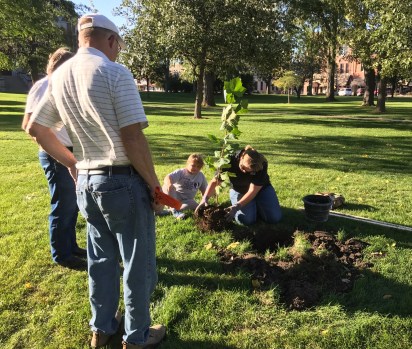
 Nebraska Extension- Fillmore County received a grant for ten free trees through the ReTree Nebraska program. This grant was funded by Trees for Nebraska Towns and the Sustainable Schoolyard Partnership programs by the Nebraska Statewide Arboretum and the Nebraska Environmental Trust and the Nebraska Forest Service’s Community Marketing of Trees grant funded by the U.S. Forest Service. As part of the grant, educational outreach to increase public awareness of the benefits of trees and proper tree care was done with a workshop conducted by Nicole Stoner, horticulture extension educator in which I assisted. Seven trees were planted at the courthouse lawn and three trees were planted at the Extension Office and Fillmore County East Building.
Tree Planting & Care Workshop

Need a new tree in your landscape? Then come to the tree planting workshop to learn how to properly plant it. Planting a Tree is essential to the life and health of the tree. Nebraska Extension Educator Nicole Stoner, from Gage County Extension will give a hands-on presentation of proper tree planting. The workshop will be held at 5:00 pm on Thursday, October 12th at the Fillmore County Courthouse in Geneva. Ten trees were donated to Fillmore County Extension from ReTree Nebraska to help renew the trees at the Courthouse and Extension Office. We will be planting these 10 trees at the workshop. The workshop will cover how to properly plant a tree, staking needs and methods, and general management for newly planted and established trees including watering, mulching, and winter protection. Registration is not required and the program is free.
If you have any additional questions you can contact Nicole Stoner at Gage County Extension (402)223-1384 or by email at nstoner2@unl.edu
Celebrate National 4-H Week
For the 75th consecutive year, millions of youth, parents, volunteers and alumni across the country will be celebrating National 4-H Week during the first full week of October.
4-H alumni around the country are always the first to acknowledge the significant positive impact 4-H had on them as young people; the opportunities and experiences that 4-H provides youth empowers them to become true leaders. In fact, research has shown that young people in 4-H are almost four times as likely to contribute to their communities, and are twice as likely to engage in Science, Technology, Engineering andMath (STEM) programs in their free time.
In Nebraska, more than 25,000 youth are enrolled in 4-H and 12,000 volunteers are involved in 4-H. In addition, approximately 56,000 youth participate in Nebraska 4-H school enrichment experiences. One of the most anticipated events of National 4-H Week every year is 4-H National Youth Science Day, which sees hundreds of thousands of youth across the nation taking part in the world’s largest youth-led science challenge. The exciting theme for this year’s challenge is Incredible Wearables.
On Wednesday, Oct. 4, youth will use the engineering design process to build a prototype wearable technology that will gather data to help solve a real-world problem. Wearable technologies are now used in industries around the globe, from education and sport, to health, fashion, entertainment, transportation and communication. To learn more about National Youth Science Day, please visit http://www.4-h.org/nysd/.
About 4-H: 4-H, the nation’s largest youth development and empowerment organization, cultivates confident kids who tackle the issues that matter most in their communities right now. In the United States, 4-H programs empower six million young people through the 110 land-grant universities and Cooperative Extension in more than 3,000 local offices serving every county and parish in the country. Outside the United States, independent, country-led 4-H organizations empower one million young people in more than 50 countries. National 4-H Council is the private sector, non-profit partner of the Cooperative Extension System and 4-H National Headquarters located at the National Institute of Food and Agriculture (NIFA) within the United States Department of Agriculture (USDA).
Learn more about 4-H at www.4-H.org, find us on Facebook at www.facebook.com/4-H and on Twitter at https://twitter.com/4H. For Nebraska 4-H, go to 4h.unl.edu.
Fall Pests

This time of year, we often receive questions on a variety of pests, especially “bugs” entering homes or around the house. Extension horticulturalist, Elizabeth Killinger provides great information how to prepare your house to keep these invaders from living in your house.
Some of the more common nuisance pests include occasional invaders like boxelder bugs, multicolored Asian Lady Beetles, millipedes, and crickets. These pests don’t do any harm once inside the home; they are just looking for a cozy place to spend the winter.
Proper identification of the insect will assure the proper control method. Boxelder bugs are black and orange true ‘bugs’ that can be found in large numbers around foundations sunning themselves or trying to find their way inside. Multicolored Asian Lady Beetles are the orange ‘lady bugs’ with black spots. Their distinct smell and ability to bite makes them even more of a nuisance once inside the home. Millipedes are often misidentified as ‘wire worms.’ These skinny, brown critters have two legs per body segment and will curl up when disturbed. Crickets hop their way into homes and provide ‘music’ in the night with their chirping. Commonly it’s the black field cricket that migrates inside, but there are others that follow right behind.
Wolf spiders may look scary, but they are more bark than bite. These large, hairy spiders can be found both outdoors and occasionally inside the home. They are not poisonous nor do they want to disturb people. They are hunting spiders, so they don’t spin a web or a trap, but prefer to chase down their prey. They often find their way into homes in the fall following their favorite food source the cricket.

The saying “an ounce of prevention is worth a pound of cure” has never been more true. Discouraging occasional invaders from entering the house is going to take a little work, but it will be worth it in the long run. Start by finding and sealing up any cracks or spaces they could enter through with silicone caulk or expanding foam. Make sure that window screens are in good repair and that doors are tight fitting. Also remove any dead plant debris from window wells.
Pests can be discouraged from entering the house in a number of ways. The most common way is by applying an outdoor perimeter insecticide treatment. These insecticides are labeled for various pests and often times have residual effects to help protect the house for longer. Read and follow the label instructions on how and where these products should be applied. Ideally, try to apply these insecticides out from the foundation about five to ten feet around the perimeter of the home. The insecticides will help to decrease the numbers of pests that make it inside the house, but don’t expect it to stop all of them.
Monitor the home regularly to see what pests have made their way inside. Glue boards are sticky boards used to catch and hold pests as they try to move throughout the home. Be sure to use sticky boards in locations where non-target animals, like pets, won’t get stuck in them. If something other than the target pest does happen to get ‘caught’ in the trap, use an oily material, like vegetable or mineral oil, to dissolve the sticky substance on the trap. When properly placed, these traps will allow you to see which pests are inside the home and their approximate numbers.
Once pests are found inside the home, there are a few techniques that you can use. The handy broom and dust pan or the vacuum are two techniques; they are also very environmentally friendly and very cost effective. Be careful when selecting insecticides for use inside the home. Read and follow instructions carefully as many of these products have to come into contact with the insect themselves and don’t offer much residual protection.
With a little prevention and monitoring you can ensure that you are sharing your home with wanted house guests this fall and winter.
Elizabeth Killinger is the Horticulture Extension Educator with Nebraska Extension in Hall County. For more information contact Elizabeth at elizabeth.killinger@unl.edu.
Harvest Safety
It is hard to believe that harvest is starting and just as a reminder that with harvest comes more traffic on the county roads and other stresses for farmers. It never fails, that equipment can break, there can be delays at the elevator and those extra-long hours can all add extra stress to farmers. That being said, it is important to carefully slow down and realize the many hazards you are being exposed to during harvest.
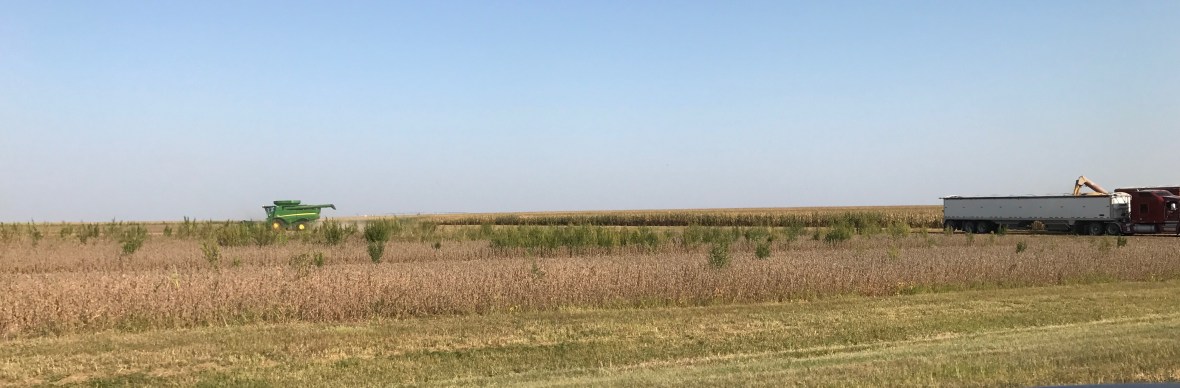 An Iowa State Extension publication, Harvest Safety Yields Big Dividends points out that injuries can occur by taking shortcuts to perform routine tasks, not getting enough sleep or regular breaks, or failing to follow safety practices. Some injuries occur when operators are pulled into the intake area of harvesting machines, such as balers, combines, or corn pickers, and many injuries occur from slips or falls around these machines. Exposure to powerful machinery is highest during the harvest season. The equipment must be powerful to effectively handle large amounts of agricultural commodities. When equipment plugs, NEVER try to unplug it with live equipment, instead always disengage power and turn off the engine before trying to manually clear a plugged machine. Regular maintenance of these machines can also make harvest go smoother. Also, lots of accidents actually happen by the operator slipping and falling off equipment.
In the same publication listed above, there are several tips for reducing fall hazards:
- Always keep all platforms free of tools or other objects.
- Frequently clean the steps and other areas where workers stand to service, mount and dismount, or operate the machine.
- Wear well-fitting, comfortable shoes with non-slip soles.
- Use grab bars when mounting or dismounting machinery.
- Be sure your position is stable before you work on a machine.
- Recognize that fatigue, stress, drugs or alcohol, and age may affect stability.

Other helpful tips during harvest are to keep kids away from machinery. Tell them the dangers that can occur and not to play near the equipment, even when it is shut off; you never know when they will be playing in hidden areas of the equipment. Operators should double check where kids are before moving the equipment. Too many accidents can occur when youth are in the path of equipment out of the operator’s view. Operators of all equipment should check in regularly and let someone know where you are. Keep all guards on equipment; it is there for a reason!
It is also important for the public to understand the increased traffic on public roads and be patient. The greatest threat raised between farm equipment and passenger vehicles is the difference in speed. Farm equipment runs at an average speed of 20 miles per hour while passenger vehicles average 60 miles per hour. If the motor vehicle overtakes a tractor, the impact is comparable to a passenger vehicle hitting a brick wall at 40 miles per hour. If the tractor and a car, mini-van or pickup collides head on, the impact is the same as hitting a brick wall at 60 miles per hour.
Farmers can reduce the chances of an accident by using warning lights, reflectors and reflective tape on their machinery to keep passenger vehicle operators aware of their presence on roads. Some farmers may choose to install supplemental lights to increase visibility. It also is a good idea for producers to keep off heavily traveled roads as much as possible and avoid moving equipment during the busiest part of the day.
Some farm equipment, such as combines, can take up more than half of the road. Even so, it is up to both drivers to be aware of their own limitations and adjust accordingly. Farmers should not take up more space than is needed, but other drivers should try to provide as much room as possible. It is a good idea for passenger vehicles to turn off onto side or field roads until larger machinery has passed. Whenever possible, farmers should use an escort vehicle such as a pickup to precede or follow large machinery and equipment on public roads. More than one escort may be necessary. Ideally, the escort vehicle would have extra warning lights and a sign indicating oversized or slow equipment ahead or following.
Have a safe harvest!
Making One Agronomist at a Time
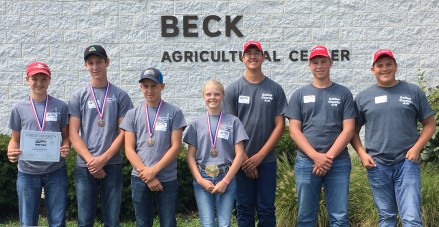

In late August, seven Nebraska youth traveled to Indiana to participate in the 2nd Annual Regional Youth Crop Scouting Competition held at Purdue University’s Beck Ag Center near West Lafayette, Indiana. These youths scouted six fields for diseases, insects, abiotic/biotic disorders, weed identification and crop growth stage and development. Teams from Iowa and Indiana also competed. Nebraska teams ranked 3rd and 6th respectably. Between all three state competitions, 195 youth competed from Nebraska, Iowa and Indiana. Top two teams from each state competed at the regional competition. Congrats to all of the youth who not only networked with agronomic professionals, but also gained the most by improving life skills related to a potential career path. Next year’s regional competition will be hosted by Nebraska Extension.
While this is one program, which impacts a very small percentage of youth, it is very important to start training the next generation of ag leaders to feed our growing population. In fact, globally there is an effort to encourage youth in agricultural positions. According to the U.N. International Labor Organization (a specialized agency of the United Nations), globally there will be about 74.2 million unemployed young people (ages 15-24) in 2017 which is an increase of 3.8 million since 2007. While it is troublesome that those graduating high school and/or college are unemployed, this could present an opportunity for those in the agricultural industry. If we can create programs which spark an interest in agriculture, there is potential to attract youth to the agricultural industry.
Getting over the stigma that agriculture is a back-breaking with little room for advancement, while in fact it is quite the opposite. As educators, we should be promoting agricultural careers as “intellectually stimulating and economically sustainable” according to foodtank.com. Programs designed to encourage young people into agriculture are in numerous countries across the world including the New Entry Sustainable Farming Project in the U.S., a variety of USDA initiatives and programs like Farm Africa for youth in Ethiopia, Kenya, South Sudan, Tanzania and Uganda or the International Fund for Agricultural Development Rural Youth Talents Program in South America. If you know of a young person undecided in his/her career path or a youth who is passionate about agriculture, let them know of the bright future and opportunities available in agriculture.
For more information on how to engage youth in crops, visit our UNL CropWatch site at http://cropwatch.unl.edu/cropwatch-youth.
Husker Harvest Days
Don’t forget to visit the University of Nebraska-Lincoln’s IANR building at Husker Harvest Days! “Small Changes, Big Payback: Strengthening Nebraska’s Agricultural Economy” is the theme for the Institute of Agriculture and Natural Resources exhibits at the farm show Sept. 12-14 near Grand Island.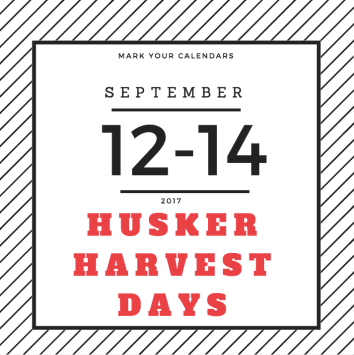
Exhibits inside IANR’s Husker Red building will provide information on:
- Strategies for managing family budgets during challenging economic times;
- The relationship between cost, nutritional value and impact of various feed sources for cow/calf operations;
- Understanding the county-by-county differences in the risk factors that affect crop insurance rates and how they impact profitability and management decisions;
- How farmers can better utilize the Farm Bill safety net;
- Benchmarking the costs of pumping irrigation water to better control input costs and make decisions related to pump efficiency and energy usage;
- Crop production strategies that can have a positive impact on cost per acre and profit margin;
- Using crop budgets to analyze the operating costs for a farm to become a low-cost producer;
- The university’s annual survey of agricultural land value and rental rates in Nebraska.
Hurricane Harvey’s Impact on Agriculture

If you are connected with social media, you might have seen the video or pictures of cattle being moved by horses down the streets of Texas to higher ground. You might have seen pictures of destroyed cotton crops, grain bins and flooded farm houses. Prior to Hurricane Harvey, farmers worked around the clock to harvest their cotton and ranchers worked to move livestock to safety. For many cotton farmers, they were looking at record yields and Texas A&M AgriLife Extensionreported that at least 1.2 million beef cows graze in the 54 counties on the disaster list as of this article. Texas rice producers had already harvested about 75 percent of their rice, but wind and water likely damaged storage bins leading to more crop losses.
Of course, time will tell how the actual economic impact of this storm, not to mention the impact of fuel prices. The great thing about the agricultural community is that we stick together and help one another during these difficult times. Many local people gave money to assist our Kansas neighbors following widespread fires. Now, farmers and ranchers in Texas could use assistance. There will be a lot of fence to repair, buildings, bins, and just help restore these farm and ranch family’s lives. So how can you help? There are many options. A close and local option is to give blood! Some other ways to help include:
Texas A&M AgriLife Extension agents have set up the following Animal Supply Points and are requesting square bale horse quality hay, various types of hay for cattle in round or square bales, all-stock feed and range cubes/protein supplements at this time. They are not currently taking donations for fencing supplies. Before collecting or delivering donations, contact the AgriLife Animal Supply Point Hotline at 979-845-7800 to confirm needs and delivery.
A New Day: Texas Agricultural Education Disaster Relief Fund
This fund will help FFA chapters and agricultural education programs rebuild following natural disasters such as Hurricane Harvey. Donations to this fund will be dispersed via an application process directly to the programs and chapters affected by the storm. More more information, go to https://www.texasffa.org/NewDay.
Texas 4-H Relief Support Campaign for 4-H Programs Affected by Hurricane Harvey
The Texas 4-H Youth Development Program and the Texas 4-H Youth Development Foundation are facilitating a monetary campaign to directly support 4-H clubs and county programs in the hurricane zone. The website is https://texas4hfoundation.org/.

STAR Fund
The STAR Fund is used to assist farmers and ranchers in rebuilding fences, restoring operations and paying for other agricultural disaster relief. If you’d like to help farmers and ranchers impacted by floods, wildfires, tornadoes or other natural disasters. To donate to the STAR Fund, go to https://www.texasagriculture.gov and search for the STAR fund.
Of course, there are many other organizations and ways to help. This will take a long time for all of the victims to rebuild their lives. Keep them in your thoughts and do what you can to make a difference.
Fall Tree Update
 Extension Educator, Kelly Feehan provided some good tips regarding trees which is listed below. The first is a question we usually receive on trees in fall/winter is yellowing of needles on evergreens. Kelly reminds us that this is a natural occurrence and we will soon see natural needle yellowing and dropping on evergreens like white pines and spruce. This is a process where 2- to 4-year-old interior needles turn yellow, then brown, and eventually drop off. Needle yellowing occurs throughout the interior of an evergreen from top to bottom. For tree owners, not familiar with natural needle drop, this sudden yellowing is a concern. However, this is as natural for evergreens as fall coloring is for shade trees. The only difference is it only occurs heavily every 3 to 5 years in evergreens instead of yearly. It is natural and does not harm the tree. Check that only older, inner needles are affected. If needles on branch tips are affected, or needles that are dropping have spots or red bands on them, this could be a sign of a disease and a sample could be brought to the local Extension office for diagnosis and determine if a fungicide application might be needed next spring.
Also, if the leaves of shade trees and shrubs are off-color or have leaf spots, browning, or holes chewed into them; and you’re thinking about applying a pesticide for control, think again. Keep in mind the leaves of shade trees and shrubs will soon be naturally dropping from plants; so, is it necessary to apply a pesticide now to protect leaves that will soon be dead? Tree and shrub leaves have basically done their photosynthesis job for the year. Leaf buds for next year are formed; and photosynthetic products are stored in woody tissue for next year’s growth. Other than aesthetics, minor leaf diseases and insect chewing is not very harmful to trees and shrubs this late in the season; but a pesticide application can kill beneficial insects such as pollinators. If the damage is unacceptable, or has occurred more than one year in a row, positively identify the cause of damage to help determine if and when control may be needed next season.
State Fair Update

The 148th Nebraska State Fair is underway and will run through Sept. 4 in Grand Island. and celebrate the people, products and talent of the state. Thousands of youth who participate in Nebraska 4-H – sponsored by Nebraska Extension will share what they’ve learned throughout the year. Note this year some of the grand marshals in the parades are from our area. On Aug. 31, Dick and Deb Hoarty from Fillmore County will be serving as Grand Marshals. Deb is a long-time Fillmore County Fair Board member. Dewey Lienemann is the grand marshal for the Sept. 1st parade. Dewey is a long-time educator, both as an ag teacher and extension educator in Webster County. Congratulations to these local folks!
The static exhibits are already judged and on display. To review state fair results, go to http://www.nebraska4hresults.com/. Congratulations to all of the youth for the fine job they did with their exhibits! Good luck to all of the animal exhibitors Labor Day weekend!
Visitors can download the 4-H at Nebraska State Fair app to keep track of events, results and exhibit maps. The app can also be used to play the Seek and Scan game, which allows visitors to scan symbols on signs next to static exhibits to display videos.
For more information on the Nebraska State Fair, including schedules, visit http://4h.unl.edu or http://statefair.org.
 Views from VanDeWalle