Crops, Uncategorized, Youth

Innovative Youth Corn Challenge Results

One of the statewide projects I coordinate engages youth in crop production so I decided to share the results of this program. Nebraska Extension and the Nebraska Corn Board teamed up to offer the fourth Innovative Youth Corn Challenge contest. This contest, open to 4-H members or FFA members, guided participants through all aspects of corn production, as well as agricultural careers related to corn production.IMG_4693 - Version 2.JPG

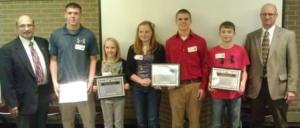
The 2015 winning team was Kornhusker Kids 4-H Club from Cuming County. The team with the highest percent yield increase over their local county average is the winner. In earning the $1,000 first-place award, Kornhusker Kids 4-H Club decided to test the effect of Procidic with two different application timings to see the effect against Goss’s Wilt and if there were additional plant health benefits. The three treatments were: control, Procidic applied in furrow at planting at 2 oz/ac and Procidic applied in furrow at planting followed by another 2 oz applied post prior to tasseling. Also, important to note is that this team had randomized and replicated plots which is important in figuring out the statistical significance. Their check yielded the highest at 226.7 bushels/acre with the challenge plots yielding 225.4 & 223.7 bushels/acre.

Second-place team overall was the Palmyra FFA Chapter, earning $500 for their efforts. Team members tested the impact of corn sweetener being applied to the corn plant between the V-6 and V-12 stage of development. They sprayed a foliar application of corn sweetener on the growing corn plant with the challenge plot yielding 214.2 bu/acre and check plot yielding 205.3 bu/acre.

Third place went to the Fillmore Central FFA Chapter. They tested nitrogen application rates and tried to push for a higher yield in order to reach the highest potential of their corn variety. They learned that 29.8 pounds of more nitrogen resulted in 14 more bushels per acre with 207.3 pounds of N on their challenge plot yielding 278.2 bu/acre and the check plot with 177 pounds of N yielding 264.2 bu/acre.

Other teams who completed their plots were:

Norfolk FFA did a two pass system, the first pass putting on 65 pounds of nitrogen and the second pass putting on 75 pounds of N and a nitrogen stabilizer to minimize nitrogen loss due to leaching in sandy soils. The main innovation testing was comparing early season fungicide application to no fungicide application. Their challenge plot yielded 191.5 bushel/acre and check at 183.3 bu/acre.

Osceola FFA tested nitrogen application with the check plot of 210 lbs of N at planting and the challenge plot of 210 lbs/acre in addition to 45 pounds of N applied at pre-tassel. Their check plot was 243.5 bushels/acre and challenge was 244.7 bu/acre.

The Stuart FFA Chapter’s goal was to improve the yield of corn by adding the AEGIS ESR plant growth stimulator. The product was applied to corn at V-6. They also measured the amount of water in the cornfield using watermark sensors. They determined that the growth stimulator did increase yield as anticipated, as the challenge plot with AEGIS yielded 5 bushels higher at 230 bu/acre compared to 225 for the check plot.

As a team, youth worked with an adult mentor throughout the process. Mentors can be extension faculty, ag teachers, or other qualified agronomy professionals. Other awards handed out during the banquet held on UNL’s East Campus included:

  • The Extra Mile Award, worth $200, went to the Kornhusker Kids 4-H Club.
  • The Innovation Award, worth $200, was presented to the Palmyra FFA Chapter.
  • The Sustainability Award went to both Kornhusker Kids 4-H Club and Fillmore Central FFA Chapter, which will split the $200 award.

The Sustainability award which uses Field to Market’s Field print Calculator was added this year, led by Randy Pryor, Extension Educator in Saline County. Field to Market, the alliance for sustainable agriculture has grown to 87 members. This group contains multiple fortune 500 companies involved in the nation’s food chain, national farm groups, conservation groups and Nebraska Extension is a new affiliate member. The diverse group is all about defining, measuring and advancing sustainability in the food sector from the farm field to the retail level. The current version of the Fieldprint Calculator is free to use, and these youth were the first 4-H and FFA students in Nebraska to ever use the Fieldprint Calculator for sustainability measures.

The metrics used were:

  • Land use efficiency
  • Soil conservation
  • Soil carbon
  • Irrigation Water Use Efficiency
  • Water Quality Index
  • Energy Use Efficiency
  • And Greenhouse Gas Emissions.

To participate in 2016, youth must complete and return an entry form by March 15th to the Fillmore County Extension Office in Geneva, NE. Forms can be downloaded .

Crops, Youth

Youth Crop Scouting Results

Nebraska Extension is pleased to announce eight teams from across Nebraska competed in the second annual Crop Scouting Competition for Nebraska youth. It was held in at the ARDC near Mead, Nebraska on August 4, 2015. Teams of students (those completing 7-12th grades) participated by completing a written knowledge test and eight crop scouting exercises in field plots.IMG_0078_2

The purpose of the competition was to provide students an opportunity to learn crop scouting and principles of integrated pest management (IPM) for corn and soybeans in Nebraska, to obtain knowledge and skills that will be helpful in future careers and to demonstrate newer crop scouting technologies.

Results from the 2015 competition were as follows:

First place- Colfax County 4-H

Second place – Humphrey FFA IMG_0084_2

Third place – Amherst FFA

Also participating were

  • Ashland-Greenwood FFA
  • Sumner/Eddyville/Miller FFA with two teams
  • Pawnee City FFA with two teams

Top-scoring teams won prizes: $500 for first, $300 for second, $100 for third place.

Teams were expected to know the basics of scouting corn and soybean fields. This included crop staging; looking for patterns of crop injury; disease, insect and weed seedling identification; etc.IMG_0077

More information about the crop scouting competition are available online at cropwatch.unl.edu/youth. Click on the link that says, “Crop Scouting Competition”. Next year’s competition will be held August 2nd, 2015 at UNL’s ARDC again.

This program was sponsored by DuPont Pioneer, the Nebraska Soybean Board, in collaboration with Nebraska Extension.

Programming, Youth

Big Red Crops Camp: Youth Discover Crop Science

Are you interested in science, agriculture, plants, crops, insects, or diseases? If so, join our team of detectives to solve crop-related problems in the Crop Science Investigation (CSI) Big Red Camp! Become a detective while participating in hands-on sessions to learn about and increase your knowledge of crops, science, and agricultural careers. Youth detectives will interact with agronomic professionals across Nebraska to solve experiments in: nutrient management; managing disease, insect and weed problems; water management; crop production, and much more! Do you have what it takes to become a CSI detective?

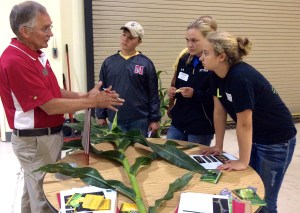
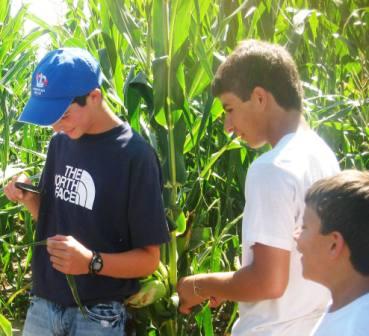
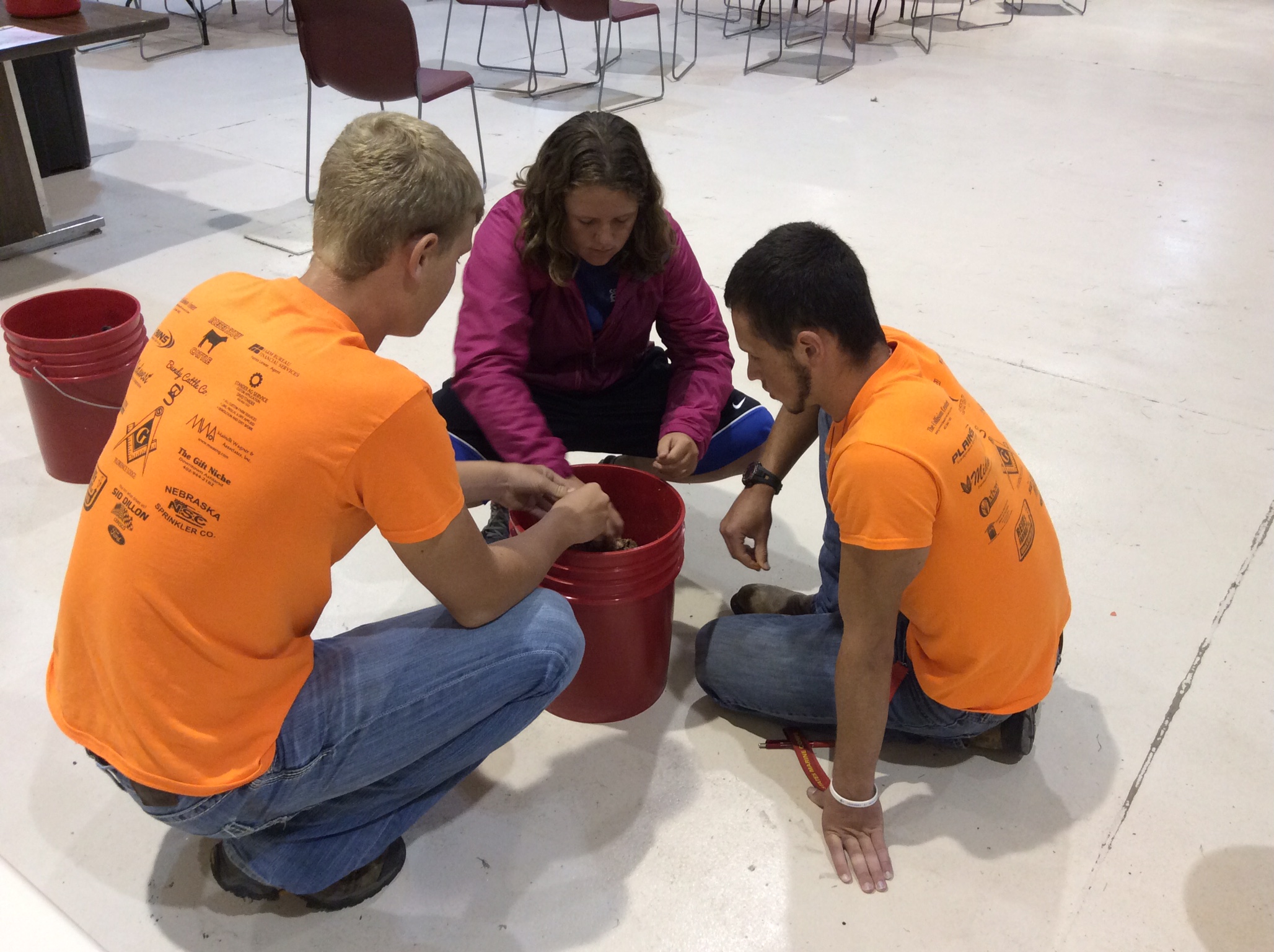
Youth in Crop Sciences Investigation (CSI) workshops learn about crop production and have the opportunity in investiage what pests might be present in the field.
Youth who attend Big Red Camp – Crop Science learn about crop production and have the opportunity in investigate what pests might be present in the field.

There are a variety of careers related to plant sciences such as: Agricultural Communicator; Agronomist; Crop Consultant; Crop Insurance Adjuster; Educator; Co-op Manager; Farmer or Rancher; Farm Credit Banker; Field or Lab Researcher; Plant Breeder; Soil or Water Conservationist; Seed, Fertilizer, or Chemical Sales; or Technical Representative.

This program was held two years and one participant said, “It (the camp) let me see all of what an agronomy career is made up of.” All youth said they would recommend this camp to their friends. As I write this, there are several spots already taken, so be sure and get your registration form in soon to ensure a spot at this year’s camp.

To register or download a camp brochure, visit BIGREDCAMPS.UNL.EDU. Final registration deadline of May 1st! Scholarships are available for crops camp. If you have questions about the camp or the required essays, please feel free to contact me at brandy.vandewalle@unl.edu or 402-759-3712.

Youth

Innovative Youth Corn Challenge

Today’s agricultural world faces several challenges, one of them being the decline of our most valuable resource, the future workforce. Keeping youth in rural communities and involved in production agriculture is important to the agricultural industry. With the global population expected to reach 9 billion by 2050, there is and will be the need for more young people to engage in agricultural careers to feed the world.

CornYieldChallenge

The University of Nebraska-Lincoln Extension and the Nebraska Corn Board have teamed up to offer the second Innovative Youth Corn Challenge contest. This contest, open to 4-H members (age 10 & older as of Jan. 1st) or FFA members (in-school members), will guide youth through all aspects of corn production, as well as agricultural careers related to corn production.  As a team, youth will be challenged to implement a production practice different than normal to determine if they increased their yield. Economics and sustainability of the practice will also be considered. Yields, cropping history, and production information will be collected in the Corn Yield Challenge management sum

Goals of the contest are:achieve new, innovative, and economically feasible crop production methods to improve yields; provide research data for producers to implement in their operations; distribute data to corn producers, researchers, and agri-businesses for decision making purposes; introduce youth to a variety of agronomic professionals, including corn producers. mary.

As a team, youth will work with an adult mentor throughout the process. Mentors can be extension faculty, ag teachers, or other qualified agronomy professionals.  Cash prizes and plaques will be given to the first, second, and third place teams. First place will receive $1,000, second place will receive $500, and third place will receive $250.  A data completion and innovation award will also be given. Faced with a persistent drought, an addition this year will be a “limited resource” award which will be based on participants achieving a higher yield with limited inputs. This could be limited water, management practices, fertilizer, other inputs, etc.

To participate, youth must complete and return an entry form by March 1st to the Fillmore County Extension Office in Geneva, NE. For more information, contact me at brandy.vandewalle@unl.edu.

Crops, Youth

Innovative Youth Corn Challenge Banquet

Today’s agricultural world faces several challenges, one of them being the decline of our most valuable resource, the future workforce. Rural communities, including agricultural producers, can benefit from expanding youth into leadership opportunities, therefore mentoring youth leaders.   With this in mind, the Innovative Youth Corn Challenge was born which involves 4-H or FFA members, challenging them to produce the most economical, highest yielding corn. The team with the highest percent yield increase over their local county average is eligible for cash awards to further their 4-H or FFA plant science or leadership based programs. Both irrigated and dryland fields are eligible and will be scored accordingly. In addition awards are given to the team who has completed excellent production and economic records and an innovation award.

The Innovative Corn Challenge is designed to encourage youth to pursue an agricultural career and return to rural Nebraska. This program is implemented through UNL Extension with financial assistance from the Nebraska Corn Board. Extension faculty, agriculture education instructors and crop consultants may serve as harvest supervisors and assist with data collection.

 In 2012, the pilot year, ten teams signed up with six completing the project proposal and five completing the program.  Each team received $50 for their efforts and a copy of the Hybrid Maize CD, which is a computer program that simulates the growth of a corn crop under non-limiting or water-limited (rainfed or irrigated) conditions based on daily weather data.

The participants and their sponsors are listed below:

Banquet12WebPic

Super Strong H’s from Osceola consisted of Rob Buhl and Bennett Nelson with Tim Pallas as their supervisor. This team focused on planting populations in dryland conditions with populations at 26K and 30K. Yields of 49.05 bushels/acre with 30K and 52.65 bushels with the 26K respectively. This team did well on explaining the importance of increased yield to feed our growing population and also explained the important role of drought tolerant hybrid technology.

Humphrey FFA members, Spencer Beller and Lynn Slama tested strip till with a starter and nitrogen in the furrow vs. a perplant application of starter and nitrogen 15” from the row. They exceled with crop scouting records and their rainfall report. Their challenge plot yield was 217.5 bushels. Their project sponsor was Robyn Graham, FFA Advisor.

The Wranglers 4-H Club from Platte County tested the use of a foliar fungicide to early-stage corn (V5) to help corn reach its yield potential by protecting the corn plant from early-season diseases. Their challenge plot using Headline was 250 bushels and without was 254.8 bushels. Detailed crop scouting reports were completed with production information and a very complete budget. Their sponsor was Alex Labenz.

Austin Tatro and Trevor Birky, members of the Strang 4-Bar-H club in Fillmore County tested planting populations. On irrigated

ground they tested 34K and 30K per acre compared to a check plot of 32K seeds per acre. Their economic analysis was complete and showed the difference in costs between treatments. Planting population at 30K yielded 223 bushels, while 34K yielded 216 bushels and their check was 226 bushels/acre. Project sponsor was Brandy VanDeWalle.

The Pioneers 4-H Club from Madison County consisted of Kaylyn Kucera, Sidney Kucera, and Andy Zessin. They tested a higher population (30 vs. 38K), increased nitrogen rate (200 vs. 250# N) and a biological growth enhancer. Their challenge plot yielded 249.1 bushels while their check yielded 237.5 bushels. In addition to great production records, they documented visual differences in their report. Regan Kucera was their sponsor.

AWARDS

The data completion award was awarded to the team who demonstrated excellent record-keeping. The 2012 Data completion award went to the Strang 4-Bar-H club from Fillmore County with Austin Tatro and Trevor Birky. They received $200 for their efforts.

The Innovation Award was given to the team with the most innovative challenge plot and thorough explanation why it was innovative. This team also received $200 and went to the Super Strong H’s 4-H Club of Polk County with Rob Buhl and Bennett Nelson.

The teams with the highest percent yield increase over their local county average were the winners of the 1st, 2nd and 3rd place awards. The winning teams also completed their harvest report form and were presented to:

1st Place Corn Challenge Team receiving $1,000 was the Wrangler’s 4-H Club from Platte County with Elizabeth Blaser & Reid Fullner.
2nd Place Corn Challenge and receiving $500 was the Pioneers 4-H Club of Madison County with Sidney Kucera, Kaylyn Kucera, and Andy Zessin3rd Place Corn Challenge with $250 was Humphrey FFA with Spencer Beller & Lynn Slama

Project coordinators were Brandy VanDeWalle and Aaron Nygren, UNL Extension Educators. The 2nd Annual Innovative Youth Corn Challenge is planned for 2013 with the addition of another award. The limited resources award will be given to the team that achieved the highest yield per inch of water. Entry forms to participate in this program  are due March 1st. For more information, contact Brandy VanDeWalle at brandy.vandewalle@unl.edu or (402)759-3712.

Crops, Youth

Youth Discover Crop Science

Are you interested in science, agriculture, plants, crops, insects, or diseases? If so, join our team of detectives to solve crop-related problems in the Crop Science Investigation (CSI) Big Red Camp! Become a detective while participating in hands-on sessions to learn about and increase your knowledge of crops, science, and agricultural careers. Youth detectives will interact with agronomic professionals across Nebraska to solve experiments in: nutrient management; managing disease, insect and weed problems; water management; crop production, and much more! Do you have what it takes to become a CSI detective?

There are a variety of careers related to plant sciences such as: Agricultural Communicator; Agronomist; Crop Consultant; Crop Insurance Adjuster; Educator; Co-op Manager; Farmer or Rancher; Farm Credit Banker; Field or Lab Researcher; Plant Breeder; Soil or Water Conservationist; Seed, Fertilizer, or Chemical Sales; or Technical Representative.

Scholarships are available in the amount of $300 to participants who enroll in the Crop Science focus area and submit the following:

  • A short (< 300 words) essay that highlights past crop or plant science related experience and/or interest in pursuing a degree in agronomy or plant-science related areas.
  • A brief essay (< 100 words) on the topic, “What do I hope to learn in the Crop Science Investigation camp?” application can be found at bigredcamps.unl.edu.

To apply for a scholarship, complete the 2012 Big Red Summer Academic Camp Scholarship Application and submit it along with your completed registration materials and a check for the full registration fee, postmarked by April 1, 2012. Winners will be notified by April 19 and will receive a refund when they arrive at camp this summer. Scholarships are for camp registration fees only and do not cover the cost of transportation or other expenses.

To register or download a camp brochure, visit BIGREDCAMPS.UNL.EDU. If you have questions about the camp or the required essays, please feel free to contact Brandy VanDeWalle at bvandewalle2@unl.edu or 402-759-3712.