Uncategorized

Uninvited House Guests (Mice)

You are sitting at home and all of a sudden a little gray rodent with relatively large ears and small black eyes scurries across the room!   It is about 1/2 ounce in weight and if an adult 5 1/2 to 7 1/2 inches long, including its 3 – 4 inch tail. Of course, you must know by now that I am describing a house mouse. The house mouse is considered one of the most troublesome and economically important rodents in the United States. They can cause damage to property and transmit diseases such as salmonellosis and swine dysentery. You will know you have mice if you see small droppings, fresh gnaw marks and mouse nests made from fine shredded paper or other fibrous material. They are active mostly at night, but can occasionally be seen during daylight hours. Mice are excellent climbers and can jump up 12 inches from the floor to a flat surface; they can squeeze through openings slightly larger than 1/4 inch in diameter.

Sanitation, mouse-proof construction, and population reduction allow for effective control of mice. Mice cannot survive in large numbers if they have few places to rest, hide, or build nests; however a few mice can survive with limited amounts of food and shelter. Proper sanitation is an important step to control mice. Most buildings that handle food will have problems with mice not matter how clean they are, but the house should be mouse-proofed.   To mouse-proof a house, eliminate all openings larger than 1/4 inch. Steel wool can be used as a temporary plug; cracks in building foundations and openings for water pipes, vents, etc. can be sealed with metal or concrete. Doors and windows should fit tightly. Cover doors and windows with metal to prevent gnawing. Latex, plastic, rubber, and wood are unsuitable for plugging holes.

Once you find mice in your house, traps can be used to control the population. The advantages of traps are 1) it does not rely on hazardous rodenticides, 2) it permits the user to view his/her success, and 3) it allows for disposal of trapped mice therefore eliminating dead mouse odors that may occur when poisoning is done. Peanut butter works great to put on traps because it is easy to use and very attractive to mice. Simple inexpensive wood-based snap traps are effective, as well as glue traps. Glue traps must not be in extreme temperatures and can lose their effectiveness over time with dust collecting on them. Whatever traps, you decide to use, be sure to set them behind objects, in dark corners, and in places where evidence of mouse activity is seen.

For more information on mouse control, refer to NebGuide, Controlling House Mice which can be accessed online or through your local extension office.

Uncategorized

Harvest Safety

It is hard to believe that harvest will soon be in full swing! With harvest comes more traffic on the county roads and other stresses for farmers. It never fails, that equipment can break, there can be delays at the elevator and those extra-long hours can all add extra stress to farmers. That being said, it is important to carefully slow down and realize the many hazards you are being exposed to during harvest.Harvestweb

An Iowa State Extension publication, Harvest Safety Yields Big Dividends points out that injuries can occur by taking shortcuts to perform routine tasks, not getting enough sleep or regular breaks, or failing to follow safety practices. Some injuries occur when operators are pulled into the intake area of harvesting machines, such as balers, combines, or corn pickers, and many injuries occur from slips or falls around these machines. Exposure to powerful machinery is highest during the harvest season. The equipment must be powerful to effectively handle large amounts of agricultural commodities. When equipment plugs, NEVER try to unplug it with live equipment, instead always disengage power and turn off the engine before trying to manually clear a plugged machine. Regular maintenance of these machines can also make harvest go smoother. Also, lots of accidents actually happen by the operator slipping and falling off equipment.

In the same publication listed above, there are several tips for reducing fall hazards:

  • Always keep all platforms free of tools or other objects.
  • Frequently clean the steps and other areas where workers stand to service, mount and dismount, or operate the machine.
  • Wear well-fitting, comfortable shoes with non-slip soles.
  • Use grab bars when mounting or dismounting machinery.
  • Be sure your position is stable before you work on a machine.
  • Recognize that fatigue, stress, drugs or alcohol, and age may affect stability.

Other helpful tips during harvest are to keep kids away from machinery. Tell them the dangers that can occur and not to play near the equipment, even when it is shut off; you never know when they will be playing in hidden areas of the equipment. Operators should double check where kids are before moving the equipment. Too many accidents can occur when youth are in the path of equipment out of the operator’s view. Operators of all equipment should check in regularly and let someone know where you are. Keep all guards on equipment; it is there for a reason!

It is also important for the public to understand the increased traffic on public roads and be patient. The greatest threat raised between farm equipment and passenger vehicles is the difference in speed. Farm equipment runs at an average speed of 20 miles per hour while passenger vehicles average 60 miles per hour. If the motor vehicle overtakes a tractor, the impact is comparable to a passenger vehicle hitting a brick wall at 40 miles per hour. If the tractor and a car, mini-van or pickup collides head on, the impact is the same as hitting a brick wall at 60 miles per hour.

Farmers can reduce the chances of an accident by using warning lights, reflectors and reflective tape on their machinery to keep passenger vehicle operators aware of their presence on roads. Some farmers may choose to install supplemental lights to increase visibility. It also is a good idea for producers to keep off heavily traveled roads as much as possible and avoid moving equipment during the busiest part of the day.

Some farm equipment, such as combines, can take up more than half of the road. Even so, it is up to both drivers to be aware of their own limitations and adjust accordingly. Farmers should not take up more space than is needed, but other drivers should try to provide as much room as possible. It is a good idea for passenger vehicles to turn off onto side or field roads until larger machinery has passed. Whenever possible, farmers should use an escort vehicle such as a pickup to precede or follow large machinery and equipment on public roads. More than one escort may be necessary. Ideally, the escort vehicle would have extra warning lights and a sign indicating oversized or slow equipment ahead or following.

Have a safe harvest!

Crops, Programming

Nebraska Veteran Opportunity

We are so blessed to live in the United States of America for numerous reasons and I give my gratitude to those who are serving in the military or have served. Both of my grandpas served and I have three cousins who have or are serving. Thank you so much to all of the servicemen and women for the sacrifices they have made. This week’s column will focus on a national organization that helps veterans who are in agriculture or are interested in pursing a career or business in agriculture. Eric WilliamsFVClogo, Fillmore County Veterans’ Service Officer provided the following information about the Farmer Veteran Coalition (FVC), which helps place veterans in agriculture.

According to the FVC website, the mission of the Farmer Veteran Coalition is “to mobilize veterans to feed America. We cultivate a new generation of farmers and food leaders, and develop viable employment and meaningful careers through the collaboration of the farming and military communities. We believe that veterans possess the unique skills and character needed to strengthen rural communities and create sustainable food systems for all. We believe that food production offers purpose, opportunity, as well as physical and psychological benefits.”

There are 3,000+ members of the FVC in the country, and 48 are in Nebraska. As an ag state, there is an opportunity for many more Nebraska veterans to participate in this program. To bring awareness of FVC in Nebraska, an event is being held on September 18 in Seward, NE. The event features an educational session open to veterans and anyone interested in exciting, new, innovative, niche agricultural opportunities. That night there will be an amazing celebration of NE Ag Vets at the Seward Ag Pavilion. 

Space is limited so reserve your spot today by calling Del Ficke at (402) 499-0329 or email fickecattle@outlook.com. If you are a veteran and cannot afford to attend, but are still interested, let Del know as there are some funds available for cases such as this. If you purchase a $30 ticket to the evening celebration, your entry is free to the day seminars. If you would like to attend the day portion only, the cost is $10.

The evening event is a fundraiser so services can be expanded to NE veterans. Here is a link to the event registration.

Programming

“Agvocacy”

Last week I had the opportunity to present at the AgChat Foundation Conference held in Austin, Texas. Along with 3 other colleagues, we shared with the other 140 people in attendance on how UNL Extension is able to reach a large audience through collaboration and reaching beyond our own areas of expertise and programming. Through the use of Facebook, Twitter, LinkedIn, Pinterest, YouTube, blogs and websites, we reached nearly 3 million people!
AgChatGroupPic

Extension educators, Lindsay Chichester, Alice Henneman, Jenny Rees and myself shared some tips on how to manage social media so it doesn’t become burdensome on one’s time, but rather enhance or create personal relationships and networking opportunities. For those unaware of AgChat, the mission is “empowering farmers & ranchers to connect communities through social media platforms”. The AgChat Foundation is a non-profit organization designed to empower farmers and ranchers to leverage social media as a tool to tell agriculture’s story. It equips and educations farmers with skills needed to effectively engage on social media and is a grassroots effort led by farmers & ranchers. AgChat has Tuesday night “chats” which discuss agricultural issues or current events.

This was one of the best conferences I’ve had the opportunity to attend! It not only helped make personal connections with others from across the U.S. who have a passion for agriculture, but opened my eyes on the best ways to communicate with people who have different views on agriculture than me. Speakers were dynamic and had an overall message, “engage with people first, and then educate”. In Extension, our role is to provide research-based information and educate people so when people are passionate about something based on misinformation, I want to educate them instantly. After hearing from a mom in favor of “organic, local & natural” type foods, a chef who purchases from “sustainable and local” farmers and another blogger against GMO’s, it made me realize that when we go into “educate mode” and tell them they have misinformation, what we are implying to them is that they are uneducated and forcing them to conform to our views. While they might not have the right information, we need to engage them in a conversation first and seek to understand where they are coming from. They just want their voices and concerns heard. After engaging in a conversation in a non-confrontational manner we can explain our thoughts and educate on the facts and research. Ultimately it is up to each individual to make up their own mind how they feel about various types of foods.

The great thing about the United States is that we have the option to choose! If people want to pay more for organic food, they have that right, but in order to feed the growing population, conventional agricultural practices must continue in order to prevent famine and starvation. One thing I encourage farmers and ranchers to do is invite people to their farms or ranches so people can see the excellent job you do to provide people with a safe, wholesome and nutritious product. Some of the farmers at the conference agreed that is one of the best ways to engage people in the agriculture and food discussions. By showing others the efficient, humane, and sustainable practices you do everyday, others can see the great work you do and then make an informed decision on their food choices.

One thing is clear, we live in the best nation in the world because we have an abundance of food and the ability to make decisions for ourselves.

Crops, Programming

Extension Field Days – Precision Ag & Water/Soils Clinic

Precision Ag Clinic

     UNL Extension is hosting a precision ag clinic Aug.27 and a clinic on the physical, chemical, and biological properties of soil and water Aug. 28, both at the UNL’s Agricultural Research and Development Center near Mead. A Precision Ag Clinic will be held on August 27th at the ARDC near Mead aimed at providing a clearer understanding of how technologies such as unmanned aerial vehicles (UAVs), crop canopy sensors, soil mapping systems and spraying technology can be utilized and their value in crop production.FieldDay14

Topics will include:

  • Evaluating Crop Stress with Aerial Sensing Platforms;
  • Crop Canopy Sensors for In-Season Nitrogen Management;
  • Soil Conductivity, pH, and Organic Matter Mapping;
  • Overlap and Turn Compensation Control for Sprayers and Ammonia Application with Capstan’s PinPoint® Technology; and
  • Improving Farm Productivity with Agricultural Technologies.

     Certified Crop Adviser credits (6.5) have been applied for and are pending approval for this clinic. Check-in begins at 8 a.m. Training begins at 8:45 a.m.

 Soil and Water Clinic Aug. 28

     Improving and maintaining soil quality is essential to the productivity of land for current and future use. UNL Extension’s physical, chemical and biological properties of soil and water clinic on Aug. 28 will provide hands-on training. The in-field training is ideal for agribusiness professionals and those who work with soil and water management.

Topics will include:

  • Physical, Chemical and Biological Properties of Soil and Water: The Cornerstone of the Human Race;
  • Cover Crops for Improving the Soil;
  • Infiltration Test and Organic Matter;
  • Soil Health’s Impact on Soil Water;
  • Using Laboratory Tests to Determine Soil Health;
  • Soil Characteristics, Productivity and Landscape Position; and
  • Management Considerations to Improve the Physical, Chemical and Biological Properties of Soil.

     Certified Crop Adviser credits (7.5) have been applied for and are pending approval for this clinic. Check-in begins at 8 a.m. Training begins at 8:45 a.m.
     Pre-registration is required for these clinics. All registrants will be sent a confirmation letter, receipt, and finalized schedule. Space is limited; your registration is not guaranteed unless payment is received.
     Registration for a single day is $160 before Aug. 21 and $210 after that date.  Registration fee for both days is $280 by Aug. 21 and $320 after that date. Fees include training, lunch, and reference materials.

For more information or to register, call 800-529-8030, email cdunbar2@unl.edu or visit the web.

Crops, Uncategorized, Youth

Crop Scouting Contest- Engaging Youth in Agronomy

Developing youth as leaders in the agricultural industry is crucial to the success of agriculture and feeding our growing population. I like the quote, “Thank a farmer three times a day. ” It really gets the point across how important agriculture, most importantly famers areIMG_4445 in our society. Whether you prefer conventional, organic, or other labeled products, all of them are produced by a farmer or rancher and provide you with a delicious, safe and nutritious product. Growing up on a farm and being a farmer’s daughter, I appreciate the hard work, dedication and risk involved in production agriculture. While I am not a farmer I work with farmers and have a great appreciation for them. My husband is an agricultural education instructor and FFA adviser and was also a raised on a farm.

As an extension educator for the University Of Nebraska – Lincoln Extension, I have focused my area on educating youth and youth professionals on related agronomic topics. The overall goal is to encourage youth to pursue a degree in agronomy or related fields, since there is a tremendous career opportunity waiting for them. Whether they return back to the farm or work with farmers in production agriculture, the need for bright, talented and hard working people in agricultural careers is more important now then ever.

Sally Mackenzie, Ralph & Alice Raikes Chair for Plant Science in the Center for Plant Science Innovation provided insight on this challenge at a UNL Heuermann Lecture last year, where she said, “The continued debate over genetically modified crops is a “sociological and psychological discussion,” not a scientific one and it’s a distraction from the reality: The world’s population, now about 7 billion, is expected to top 9 billion by 2050. There’s not enough water or arable land to feed those people using current agronomic practices.” Mackenzie told UNL students “these challenges are your challenges.”

Recently I coordinated the first Nebraska Youth Crop Scouting Competition at the Ag Research & Development Center near Mead, NE. Six FFA and 4-H teams competed by taking a written test and completing eight crop-scouting exercises. The goal of this contest was to engage youth in agronomic principles, gain an interest in crop-related careers and ultimately pursue a career related to crop production. The 25-question exam tested their knowledge on basic integrated pest management strategies. Eight field exercises focused on general scouting procedures including topics in entomology, pathology, taking stand counts, weed resistaIMG_4473nce management, crop growth & development and soil residue management.
This contest was sponsored by DuPont Pioneer and provided cash prizes to the top performing teams. Plans are to continue this program for future years. More details about the program can be found on the CropWatch- Youth webpages.

Another program for youth interested in crops is the Innovative Youth Corn Challenge that is in its third year. In this program, youth work with a project advisor to test a novel management practice or product with the goal of increasing yield in an economic manner. Entry forms for this contest are due March 15th of each year.

Crops, Programming

Soybean Management Field Day

Each year Soybean Management Field Days is held at 4 different locations across Nebraska. This year, Fillmore County is fortunate to host one of these programs. On August 13, 2014 at the Stengel farm near Shickley, with registration at 9:00 a.m. and the program running from 9:30 – 2:30 p.m. this educational event will occur. One hour presentations will occur aimed at providing important research based data to soybean producers.MussmanField 003

Specifically, topics will include:

  • Herbicide applications, water quality and resistance management (demonstrations of herbicide drift with discussion on how to mitigate drift with new herbicide-resistant traits, how weed growth affects herbicide performance, etc.)
  • Growth development and growth enhancement products (soybean growth and development, how yield is made and soybean responses to plant density and planting date)
  • Multiple soybean input study that includes row spacing, fungicides, insecticides and nutrient management (soil fertility management for soybeans, seed treatment products, risks associated with application of “insurance” application of insecticides, etc.)
  • Irrigation management for soybeans (scheduling based on soil moisture and crop water use, variety impact on water use efficiency and irrigation timing impact on yields)
  • Grain marketing/ag policy/risk management (understanding the global soybean market, farm program decisions, fine tuning your marketing plan, etc.)
  • Your soybean checkoff investment
  • How to handle, store and use biodiesel in your farming operation

This program is sponsored by the Nebraska Soybean Board in partnership with the University of Nebraska-Lincoln Extension. The Fillmore County program will be held at the Stengel farm northwest of Shickley (from Shickley, go west on hwy. 74 for 4 miles, go north on county road 2 for 2 miles; it is located just west of of intersection of county roads 2 & R).

If you are unable to attend August 13th, the program will be held near Auburn on August 12th, near Belgrade on August 14th and near Synder on August 15th.  For more information go to ardc.unl.edu/soydays or call 1-800-852-BEAN. Hope to see you there!

Programming

FSA County Committee Nomination Deadline

It is important for one to stand for what they believe in and takes an active role in one’s community. Effective leadership is crucial to any community or organization.  An effective leader understands the issues at-hand, is knowledgeable in his/her area, knows the proper ways to motivate others, embraces change, can work in a variety of settings and with a variety of personalities, and involves the group or followers in important decision-making. That being said, remember that a leader is not only a political figure or someone that is well known, but a leader can be a farmer, local businessmen/women, or anyone in a community or organization.  For those individuals desiring to take on leadership roles, consider serving on the FSA County Committee. Details for how to step into this role follow.

Committee members are a critical component of the day-to-day operations of FSA. They help deliver FSA farm programs at the local level. Farmers who serve on committees help decide the kind of programs their counties will offer. They work to make FSA agricultural programs serve the needs of local producers.  Committee members are local agricultural producers responsible for the fair and equitable administration of FSA farm programs in their counties and are accountable to the Secretary of Agriculture.  If elected, you become part of local decision-making that helps deliver many FSA programs.  Nominations begin June 15, 2014 and must be submitted by August 1, 2014.  Committee members serve a 3-year term for their county committee.  Nominating forms can be obtained from the Fillmore County FSA Office or online.  If you need further information about the Committee system please contact Ryne Norton CED Fillmore County FSA, Geneva Nebraska, (402) 759-4463.

Youth

Sportsmanship starts with Adults!

Webster’s Third International Dictionary defines sportsmanship as “conduct becoming to an individual involving fair and honest competition, courteous relations and graceful acceptance of results”.  Sportsmanship starts with parents teaching their youth how to accept a win or a loss, although in the 4-H youth development program, even if the youth receives a red ribbon, nothing is lost as long as some basic knowledge and skills were gained. Too often in our society we focus on the tangible results of a ribbon or trophy and don’t think about the process that youth went through to achieve the end results and what was learned from that process.

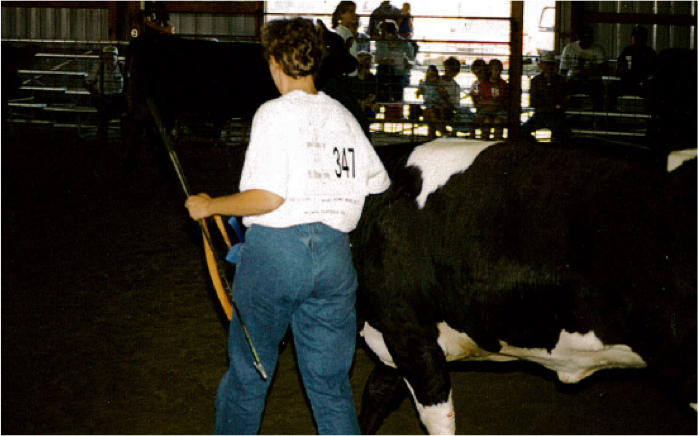
I enjoyed showing cattle and while purples were exciting to receive, the ribbon placing didn't matter; it was the learning experience and fun had with friends!
I enjoyed showing cattle and while purples were exciting to receive, the ribbon placing didn’t matter; it was the learning experience and fun had with friends!

I often use the example that as a youth, I’ll never forget receiving a red ribbon for a market heifer; I was frustrated, but will never forget my dad asking me, what the judge said in the comments.  After we talked it over, I realized his reasoning and was able to understand the type of animal I should select for the following year. That was a lesson I’ll never forget.  My dad and mom also told my sister and me that if we wanted a trophy that badly, instead of spending a large amount of money on an animal just to win or using unethical practices, they’d go out and buy us our own trophy.  For these reasons, it is really rewarding to work with youth who are happy with any ribbon placing.

Three reasons adults and teen leaders should be concerned with developing sportsmanship are:

1. Youth programs are easier to conduct and are more positive experiences for everyone involved if good sportsmanship is demonstrated.

2. The development of sportsmanship is an important part of youth development. Youth and adults who develop and show good sportsmanship get along better, and are much more successful on a long-term basis in becoming self-directing, productive, contributing, competent, caring, capable adults, than are those whose behavior is un-sportsmanship-like.

3. Sportsmanship is one of the key elements of civilized society. Those who think of the “big picture” know the reasons for developing sportsmanship extend beyond an individual, a community, or a program. When societies allow sportsmanship to decline, their civilizations also decline.

As we get ready for another Fillmore County Fair, let’s be reminded that the end result is not the ribbon placing, but the skills that each youth learned!

Source: Kathryn J. Cox, Ohio Extension 4-H Specialist, Youth Development, Developing Sportsmanship- A Resource For Preparing Youth And Their Families For Participation in Competitive Programs and Events, 2006

Irrigation

Irrigation Apps Available

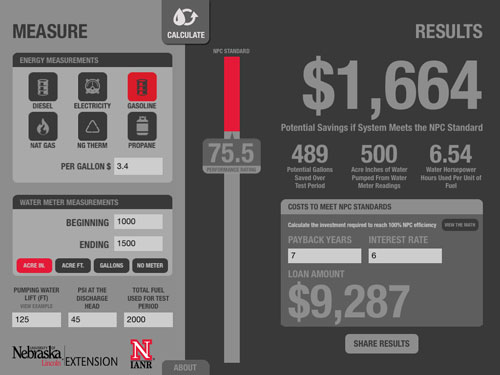
As I write this, we’ve been blessed with some rainfall and hopefully the need to irrigate will be minimal later this growing season. If you irrigate, UNL Extension just release two new appirrigatepumps to help you manage your irrigation. The first is an app to help measure irrigation pumping plant efficiency. This app uses existing records to help determine when pumping plants should be tested by a professional. It can help you identify irrigation pumping plants that are underperforming and need to be adjusted, repaired, or replaced with a better design. This app allows the user to enter six numbers related to pumping lift, pressure at the discharge, acre-inches of water pumped, fuel price, and total fuel used; it then calculates a pumping plant performance rating. It also provides an estimated cost to bring the pumping plant up to standard and the number of years necessary to pay back the investment at various interest rates.

Survey results in the past have shown many pumping plants used 30-50% more energy than expected by the Nebraska Pumping Plant Performance Criteria. Surveys of relatively new pumping plants indicate they’re operating at 82%-92% of the NPC. Results are anonymous but can be captured and emailed to yourself.

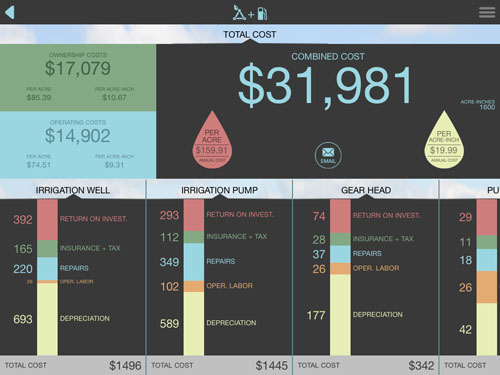
The second app comes from a decision-making spreadsheet that I’ve used with producers every year. Every year I receive questions related to the costs involved with irrigating a neighbors’ field or how to figure the irrigation operating costs versus ownership costs. Now, this can be easily done in the palm of your hands using a smartphone or iPad. Tom Dorn, former extension educator created this tool which calculates ownership and operating costs for your irrigation system. IrrigateCost models center pivot and gated pipe irrigation systems and the most commonly used energy sources. The user inputs information such as acres irrigated, pumping lift, system PSI, pump and pivot life, and inches applied as well as related costs such as for the well and engine, labor, energy, district fees, and taxes. The app then calculates total irrigation cost as well as total ownership and total operating costs.  It also breaks down costs by irrigation well, pump, gear head, pump base, diesel engine and tank and system and calculates per acre annual cost and per acre-inch annual cost. Results for different energy sources are displayed on separate tabs, allowing you to make side-by-side comparisons between energy options.irrigatecost

The calculator is also helpful when computing a fair crop-share rental agreement. Parties often will list all the contributions required for crop production in a table (land, irrigation system, machinery, labor, crop inputs, etc.). By using two columns (one for the landowner and one for the tenant) costs can be determined for each on the inputs. The columns are totaled and a percentage is determined for the landowners and tenants contributions. The “fair” rental arrangement would be to divide the crop on the same percentage as the contributions that each party has made.

The costs of owning and operating the irrigation system are some of the most difficult to identify when analyzing irrigated crop share arrangements. Much of the total cost of irrigation results from ownership costs and a large percentage of ownership costs are not annual out-of-pocket costs but rather hidden costs, such as return on capital investment, depreciation, taxes, and insurance. This app calculates ownership costs for each irrigation system component such as the well, pump, gear head, power unit and the irrigation distribution system.

Additional uses include:

  • Knowing what to charge for watering a portion of a neighbor’s field. This app can help you determine the ownership costs the neighbor should pay in addition to the operating costs for each acre-inch of water pumped.
  • Estimating costs to pump an acre-inch of water to help you determine how many additional bushels of a crop are needed by applying one more inch of water at the end of the irrigation season.

Both apps are available at the Apple Store and Google App Store for Android for $1.99/app.

Source: UNL Extension’s CropWatch