Crops, Irrigation

Final Irrigation

The ETgage reading south of Geneva dropped 0.8 inches for the week of Aug. 9 – 16th. For corn and soybeans in our area it time to start thinking of the last irrigation. Producers with watermark sensors should be checking them to see how many inches they have to carry plants through to physiological maturity.  Corn that hasn’t approached full dent and soybeans in the R5 stage has a coefficient of 1.1. To estimate crop water use we multiply 0.8 times 1.1 for a total crop ET of 0.88 inches a week or about 0.13 inches a day.

As the crop begins to reach maturity, the crop water use slows. For example, corn at ¼ milk line requires 3.75 inches until maturity, while corn at ½ milk line only needs 2.25 inches. Soybeans at R5 (beginning seed enlargement) need 6.5 inches while soybeans at R6 (end of seed enlargement) need 3.5 inches.

Generally speaking, a silt loam soil can hold 2.2 inches per foot or 8.8 inches in the top 4 feet. The target is to have 60% available soil moisture depleted at the end of the season.  My colleague from York, Gary Zoubek provided a good example which relates to most soils in the area. His example uses a silt loam soil. If we draw down the available soil water to 60%, we would have 0.88 inch of water per foot of soil or 3.5 inches remaining in the top four feet of soil. Even though you have 3.5 inches remaining, if you draw the soil water past 60%, it can affect yields; therefore, our target is to have 60% depleted at the end of the season. This will leave room to capture 5.28 inches of water during the off season from rain or snowfall.

For more information on the last irrigation, Predicting the Last Irrigation of the Season is available online.

Crops, Irrigation

Crop ET Weekly Report

Hopefully producers won’t have to irrigate as much this year as they did in 2012, but I’d like you to consider joining a program that can not only improve your irrigation efficiency, but reduce nutrient loss and save you money!  I’ve been in Extension for nearly eight years and a program I’ve been involved with that has been a very rewarding program and made a positive impact for many is the Nebraska Agricultural Water Management Network, or NAWMNWatermark Sensors. My colleague, Gary Zoubek tracks the evaluation results and shared that in 2005 only a few producers in the Upper Big Blue NRD, (shortly followed by the Little Blue NRD) were participating, but this program has now grown to over 800 producers across the state and I’m sure we’ll add another 100 or 200 more this season!

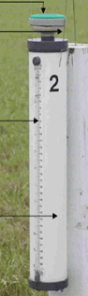
A couple of the tools we use are ETgages® or Atmometers which mimic crop evapotranspiration or ET and Watermark soil matrix sensors which measure soil matric potential or the energy required to remove water from the soil. These two tools have really worked well and have made irrigation management much easier than those gut feelings.  The more information you have the better decisions you can make!

If you would like to participate in this dynamic program, let me know and I’d be happy to help and get you started! If you are in the NAWMN, consider installing your ETgage soon and once done with planting, start the soaking/drying cycle on your Watermark sensors to be sure they work! It’s also important to replace the #54 alfalfa canvas covers and wafers on a regular basis at the start of each season.

As I have done the past couple of years, I plan to report the weekly ET in my weekly columns. The ETgage I check is in the center of the county, just south of Geneva; hopefully it will help others become aware or have an idea what the local ET is.

The ETgage I check outside of Geneva changed 1.4 inches for the week of May 31-June 7th. Corn in the V-4 stage has a coefficient of .18”. To calculate how much water, corn at V-4 stage used you simply multiply .18” x 1.4” for a weekly use of .25” or .04 inches/day. Corn approaching V-6 would have used .49”/week or .07” per day.

Producers with Watermark sensors, which monitor the amount of water available in the soil profile should get them installed soon. Watermark sensors are installed early in the growing season at 1’, 2’, 3’ and in some case 4’ depths!

For more information about ETgages and Watermark sensors, check out the NAWMN website.

Crops, Irrigation

Crop ET/Final Irrigation Weekly Report

The ETgage reading south of Geneva dropped 1.1 inches for the week of Aug. 3 – 10th. Corn and soybeans in our area is ready to start thinking of the last irrigation. Those producers with watermark sensors should be checking them to see how many inches they have to carry plants through to physiological maturity.  Corn that hasn’t approached full dent and soybeans in the R5 stage has a coefficient of 1.1. To estimate crop water use we multiply 1.1 times 1.1 for a total crop ET of 1.2 inches a week or about 0.17 inches a day.

As the crop begins to reach maturity, the crop water use slows. For example, corn at ¼ milk line requires 3.75 inches until maturity, while corn at ½ milk line only needs 2.25 inches. Soybeans at R5 (beginning seed enlargement) need 6.5 inches while soybeans at R6 (end of seed enlargement) need 3.5 inches.

Generally speaking, a silt loam soil can hold 2.2 inches per foot or 8.8 inches in the top 4 feet. The target is to have 60% available soil moisture depleted at the end of the season.  My colleague from York, Gary Zoubek provided a good example in a recent CropWatch article which relates to most soils in the area. His example uses a silt loam soil. If we draw down the available soil water to 60%, we would have 0.88 inch of water per foot of soil or 3.5 inches remaining in the top four feet of soil. Even though you have 3.5 inches remaining, if you draw the soil water past 60%, it can affect yields; therefore, our target is to have 60% depleted at the end of the season. This will leave room to capture 5.28 inches of water during the off season from rain or snowfall.

For more information on the last irrigation, read Predicting the Last Irrigation of the Season.

Expected Yields

With the drought conditions, I’ve been getting questions on thoughts about yields. Fortunately, several of my colleagues have recently written a great article on UNL CropWatch which uses UNL’s Hybrid-Maize, a model to simulate expected yields based on historical data, etc. Here are the highlights from their article:

  • Projected 2012 end-of-season corn yields are, on average, 30% (dryland) and 8% (irrigated) below the long-term averages.
  • There is very high probability (near 100%) of below-average dryland yields and also a high probability (3 out of 4) of below-average irrigated yields at all locations except dryland corn at Brookings, S.D. and irrigated corn at O’Neill.
  • If dry hot conditions persist for the coming weeks, we expect that projected yields would drop further under both dryland and irrigated condition
Crops, Irrigation, Youth

Tree Health & Other Updates

Crop ET Weekly Report

The ETgage I check outside of Geneva changed 1.7 inches for the week of June 16-22nd.   Corn at V-10 would have used 1.23”/week or .18” per day and corn at V-12 used 1.5”/week or .21 inches/day. We were fortunate to receive .80” of rainfall. There have been some producers who use watermark sensors concerned they aren’t working or getting a good enough seal. If that is the case, get another one to place next to the one in question, but remember for most pivot systems in our county, waiting until the sensors average 90-100 for readings is the trigger point.  

 Tree Health

In Nebraska, trees can have a tough time staying healthy. Drought, storm damage, insects and diseases often damage and shorten the life of valuable shade trees. Along with natural stressors, there is man-made damage that can be avoided. Most common is lawn mower and weed trimmer damage to tree trunks. Trees add so much economic and environmental value to our landscapes that care should be taken to prevent trunk damage. It’s easy to do. Just don’t hit trees when mowing the lawn. To prevent this, and improve tree health, remove sod from around a tree trunk and replace it with organic mulch. This will eliminate the need to trim grass around tree trunks. If this is not desirable in a landscape, then hand trim the grass around trees instead of mowing close to the trunk or using a weed trimmer.  Reducing this man-made stress will greatly improve the vigor and life span of valuable trees vigor.

(Source: Kelly Feehan, UNL Extension , 2012)

 Fillmore County 4-H Pre-Fair Events

The Fillmore County Fair is quickly approaching. While county fair is the most visible part of the 4-H program, don’t forget that some 4-H’ers have been hard at work participating in multiple workshops, other contests and practicing community service and leadership projects.

Come and support 4-H’ers with some pre-fair activities  as listed below:
July 10th – Fillmore Co. 4-H Clothing Day, 8:30 a.m. – Ag Hall
July11th – Fillmore Co. 4-H Small Animal Pet Show, 9 a.m. – Ag Hall
July 11th – 4-H Dog Skillathon, following pet show – Ag Hall
July 11th – Horticulture Contest, 1 p.m. – Ag Hall
July 12th – Public Style Review & Talent Show, 7 p.m. – Rialto Theater, Geneva
July 11th – Fair Clean-Up Day, 9 a.m. – Fillmore Co. Fairgrounds
July 14-19th –Fillmore County Fair!

Crops, Horticulture, Irrigation

Crop ET Weekly Report

The ETgage I check outside of Geneva changed 2.1 inches for the week of June 1-8th. Corn in the V-6 stage has a coefficient of .36”. To calculate how much water, corn at V-6 stage used you simply multiply .36” x 2.1” for a weekly use of .75” or .11 inches/day. Corn at V-8 would have used 1.07”/week or .15” per day.

I did not estimate the crop use for soybeans, since for our area; we typically don’t recommend irrigating them until they reach R3 stage.  Watering too early causes taller beans that use more water but don’t yield more, so it’s important to hold off and apply it when it is need! For more information about ETgages and Watermark sensors, check out the NAWMN website.  

 Alfalfa Update

I’ve been wondering how alfalfa fields are holding up with the lack of moisture we’ve received and noticing alfalfa blooming already without a lot of growth. Just in time, Bruce Anderson, UNL Forage Specialist sent his news article answering some of my questions with the following information.
If you grow dryland hay you probably are hoping and praying for rain.  Let’s talk about this year’s hay crop and moisture in a moment.  Bruce reports he’s heard a lot lately about folks cutting alfalfa once, sometimes twice and then not getting hardly any regrowth.  What does come back isn’t very vigorous but it starts blooming in just a few weeks.  What’s going on?

Here’s what Bruce believes happened: it’s a combination of temperatures last winter and spring and moisture.  Winter temperatures were mild, to say the least.  So mild, in fact, that he doesn’t think alfalfa ever went fully dormant.  So all winter long its root system slowly depleted the nutrient reserves it had accumulated during fall winterization.  At the same time, unfrozen soil was slowly drying out.

All this didn’t hurt – at first.  Then the super early warm spring started alfalfa to grow rapidly, which left root reserves at lower than usual levels following first cutting.  That’s why some noticed that regrowth wasn’t as vigorous as expected.

Then he adds the final piece of the puzzle.  Dryland alfalfa fields more than about three years old have extracted most of their available subsoil moisture.  With winter drying out the surface soil, high early season water use to support the first growth, and relatively little spring rain, these fields are becoming exhausted for moisture needed to support growth, which also is needed to replenish nutrient reserves in the roots.  As a result, these fields may struggle to produce much more hay all year, even if they receive average summer precipitation. The take home message Bruce offers is that hay production could be short this year.  Get what you can, while you can.

 Horticultural Updates

Kelly Feehan, UNL Extension horticulturalist reported that if a number of small fruit suddenly drop from healthy fruit trees in June, this is most likely a natural thinning or due to poor pollination. Fruit trees sometimes produce more fruit than the tree can mature. Weather conditions may allow production of more fruit than a tree can support. For example, if late spring frosts that often damage flower buds do not occur, the tree may produce an over-abundance; and a number of tiny fruit may drop in June. This is referred to as natural thinning. Poor pollination can result in fruit drop. If a flower is not pollinated or only partially pollinated, fruit may develop to a pea sized or slightly larger and then drop. In either case, healthy fruit trees usually retain enough fruit to mature to a good size crop. Natural thinning also prevents fruit trees from going into alternate year bearing, where one year the tree has a heavy crop and the next year there is little or no fruit.

I’ve also received questions about chrysanthemums responding to our early season and unusual weather by already developing flower buds. If it is preferred that mums bloom later in the season, early blooming can be delayed by cutting mums back now. This will not harm Chrysanthemums and it will result in bushier plants with more flowers later this summer. Not only this year, when mums are setting buds early; but in all years it is recommended to pinch mums by removing the top two to three inches of grow one to three times early in the growing season. Pinching needs to stop by late June, or blooming of mums could be delayed too late into the season and increase the risk of frost damage this fall. Mums are pinched by snipping off the top two to three inches of each stem. Use your fingers or a snipping shears. Try to make the cut right above a leaf to eliminate a brown stub forming
Crops, Irrigation

Updates

Crop ET Weekly Report
Today I helped install an ETgage and Watermark Sensors for a couple producers with the assistance of an Intern who will be assisting me with irrigation tasks and working with area producers. Jordan Wachal started in our office after Memorial Day and will be specifically working with producers to help evaluate irrigation system efficiencies and offer any suggestions for improvement. Jordan comes from Schuyler, Nebraska and is working on his Bachelor of Science in Civil Engineering from the University of Nebraska-Lincoln.
The ETgage I check outside of Geneva changed 1.4 inches for the week of May 26-June 1st. Corn in the V-6 stage has a coefficient of .36”. To calculate how much water, corn at V-6 stage used you simply multiply .36” x 1.4” for a weekly use of .49” or .07 inches/day. Corn at or approaching V-8 would have used .71”/week or .10” per day. Producers with Watermark sensors, which monitor the amount of water available in the soil profile should get them installed soon. Watermark sensors are installed early in the growing season at 1’, 2’, 3’ and in some case 4’ depths! For more information about ETgages and Watermark sensors, check out the NAWMN website.

Forecasting Stalk Borer Growth Stage

Bob Wright, Extension Entomologist provided a short update on UNL’s CropWatch website on stalk borer development. Wright estimated stalk borer development indicates that growers from southwest to northeast Nebraska should be making treatment decisions based on field scouting. He pointed out that, based on research at Iowa State University, stalk borer egg hatch begins at about 575 DD and ends at 750 DD. Scouting should begin when 1,300-1400 DD have accumulated. This corresponds with the beginning of larvae moving out of grassy hosts. Determine the need for treatment when 1,400-1,700 DD have accumulated.

As I write this, Fillmore County accumulated a range of 1800-1900 degree days. For more information on stalk borer life cycle and scouting recommendations, see the May 11, 2012 CropWatch article, Timetable for Common Stalk Borer Scouting Moves Up.

Average Crop Revenue Election (ACRE) Production Certifications

Farms that are enrolled in ACRE must provide their 2011 production certification to FSA by July 15, 2012. A benchmark yield must also be established for farms that elected ACRE in 2011, or if this was the first year a certain commodity was planted since the farm elected ACRE in 2009. Establishment of the benchmark yield requires a certification of historic production for the 2006 thru 2010 crop years. Failure to certify 2011 actual production and applicable 2006-2010 benchmark production by July 15, 2012, will result in ineligibility for all 2012 ACRE payments, including the direct payments.

Irrigation

Irrigation Update/Water for Food Conference

Last week, I reflected on the Rural Futures Conference I attended. This week I have my first Crop ET report to publish and found it only fitting to then talk about the Water for Food Conference quickly approaching.

First, the ETgage I have just outside of Geneva changed 1.9 inches for the week of May 11-18th. Producers using the ETgage should remember this doesn’t mean crops used this much water since corn in the V-4 stage has a coefficient of .18”. To calculate how much water, corn at V-4 stage used you simply multiply .18” x 1.9” for a weekly use of .34” or .05 inches/day. Corn approaching V-6 would have used .67”/week or .10” per day. 

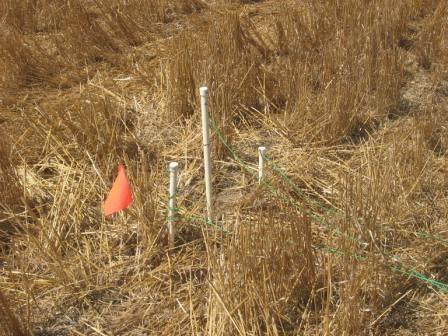
As I write this column, later today I will be helping a producer who is new to the Nebraska Ag Water Management Network install his ETgage and Watermark sensors, which are the second tool we use which monitor the amount of water available in the soil profile. Watermark sensors are installed early in the growing season at 1’, 2’, 3’ and in some case 4’ depths!  The sensors are glued to plastic pvc pipe so we can remove them at the end of the season and use them for several years. 

 Just a reminder to producers with sensors, before we install them, they need to be soaked in water, dry for 24 hours, soak and dry them again twice.  Then install the sensors wet; which improves the response time for the sensors.  By installing them early in the season in a representative part of the field, you will have another tool to make irrigation management decisions with! 

For more information about ETgages and Watermark sensors, check out the NAWMN website. 

Global Water for Food Conference

The fourth global Water for Food Conference, May 30-June 1, will bring together international experts to explore how advances in science, technology and policy can help rain fed and irrigated agriculture feed the world. “Blue Water, Green Water and the Future of Agriculture” is the theme of this year’s conference, hosted by the Robert B. Daugherty Water for Food Institute at the University of Nebraska and the Bill & Melinda Gates Foundation, at the Cornhusker Hotel in Lincoln, Neb.

An IANR news release reports that the conference fosters international dialogue on key issues related to the use of water for agriculture and provides opportunities to learn from speakers with extensive experience and perspectives from diverse cultures. Last year’s conference drew more than 450 participants from 24 nations, including representatives from universities, agriculture, industry, government and nongovernmental organizations worldwide. The conference theme focuses on “blue water” drawn from aquifers, rivers and lakes to fuel irrigated agriculture, and “green water” that falls as precipitation and is stored in fields to sustain rain fed crops. To meet the growing global food demand, agriculture will need to find ways to use less water and boost both rain fed and irrigated crop yields.

The Water for Food Conference is the preeminent event of the university’s Robert B. Daugherty Water for Food Institute, a research, policy and education institute established in 2010 and committed to efficiently using the world’s limited freshwater resources to ensure a reliable food supply.

Crops, Irrigation

Crops Update & NRD Partnerships

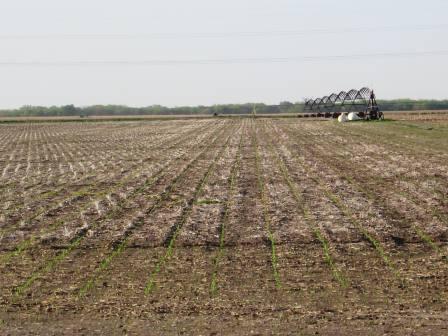
As I drive across the area, I’ve noticed that corn is emerged and planting appears to be going well for producers. As I write this a thunderstorm is brewing so hopefully we’ll continue to receive adequate moisture and you won’t have to irrigate much this year, but I’d like you to consider joining a program that can not only improve your irrigation efficiency, reduce nutrient loss and save you money! I’ve been in Extension for nearly six years and a program I’ve been involved with that has been a very rewarding program and made a positive impact for many is the Nebraska Agricultural Water Management Network, or NAWMN.

My colleague, Gary Zoubek tracks the evaluation results and shared that in 2005 only a few producers in the Upper Big Blue NRD, (shortly followed by the Little Blue NRD) were participating, but this program has now grown to over 700 producers across the state and I’m sure we’ll add another 100 or 200 more this season! A couple of the tools we use are ETgages® or Atmometers which mimic crop evapotranspiration or ET and Watermark soil matrix sensors which measure soil matric potential or the energy required to remove water from the soil. These two tools have really worked well and have made irrigation management much easier than those gut feelings. The more information you have the better decisions you can make!

 If you would like to participate in this dynamic program, let me know and I’d be happy to help and get you started! If you are in the NAWMN, consider installing your ETgage soon and once done with planting, start the soaking/drying cycle on your Watermark sensors to be sure they work! It’s also important to replace the #54 alfalfa canvas covers and wafers on a regular basis at the start of each season. For more information, check out our website.

Natural Resource Districts Celebrate 40 years!
Speaking of Extension collaborating with NRDs, did you know that according to NRD staff, 2012 marks the 40th Anniversary of Nebraska’s unique Natural Resources District system. NRDs are local government entities with broad responsibilities to protect our natural resources. Major Nebraska river basins form the boundaries of the 23 NRDs, enabling districts to respond best to local conservation and resource management needs. NRDs rely on locally-elected conservation board members who have the ability, the heart, and the motivation to care for our natural resources.

According to Alyssa Smola, NARD, Nebraska’s natural resources districts protect lives, property and the future of Nebraska’s natural resources through a variety of projects, programs and partnerships. Projects and programs range from flood control structures, cost-share funding, tree plantings, and water quality and quantity management. Many of these would not be possible without strong partnerships with other organizations; partnerships that provide opportunities for land owners and provide protection and conservation of Nebraska’s natural resources.

Crops, Irrigation, Programming

Nebraska On-Farm Research Network

Several area Extension Educators and I have been involved with on-farm research for several years.  I’ve shared many of our Quad County On-farm Research results at meetings, in my columns and on the web.  These results are also posted on the CropWatch Website.

This year we’ve combined efforts across Nebraska and are working to investigate topics in three general areas:

1)  Irrigation – water application management in corn production

2)  Nitrogen management in corn production – both irrigated and dryland

3)  Corn population study in irrigated and dryland

If you’d be interested in any of these topics, give Gary Zoubek a call at: 402-362-5508 or email him at: gzoubek1@unl.edu or contact Keith Glewen, Extension Educator at: 402-624-8030 or email him at:  kglewen1@unl.edu. They are the statewide contacts for this statewide effort.


Crops, Irrigation, Programming

Farmers Overcoming Challenges to Increase Profit

 This week, I’m highlighting an article from Daryl Andersen from the Little Blue NRD promoting an upcoming event. Producers deal with challenges every day from weather concerns, plant conditions and fertilizer applications and costs. Today’s technology and current knowledge can help in easing these concerns. Representatives from UNL or the NRD are always available to assist producers in utilizing the technology and gaining the knowledge to increase the producer’s bottom line.

On January 4, 2012 the Little Blue NRD will be hosting a Soil and Water Conference in Davenport, NE. at the Community Building from 10 am to 3 pm. This is the second year of this type of conference in which producers can learn new ideas from presenters and also get a chance to talk to local exhibitor’s booths set up for the day. This conference is designed for everyone from rural to urban residents and attendance is strongly encouraged, as topics could affect everyone’s way of life.

A presenter from the EPA will talk about fertilizer applications on lawns and cropland and why this is becoming a national issue. Knowledge of these topics is necessary as what we do here does have a major effect on the river systems and groundwater. Learning how to cope with these topics will help in improving best management practices, gain knowledge on how weather patterns are affecting your farming practices and what you can do to protect yourself.

Other topics include predicting your corn yield with UNL Hybrid-Maize and interpreting the soil sample. Producers are always wondering what their corn yield will be and with this computer program this can be done during the season. Ever wondered how the fertilizer recommendations are formulated or what micro-nutrients should I be soil sampling for? Presenters will be explaining what is needed and what could be unnecessary tests.

Come see the map on a recently completed water study conducted by JEO for the Little Blue NRD. The LBNRD Board has changed the rules on well permitting utilizing these maps and a risk analysis point system is being used on each well permit. Staff will show how the point system works and you can even get your property analyzed.

The NRD and UNL-Extension have been working with cooperators within the area to improve irrigation management. Producers have been using crop ET (evaporation-transpiration) information, soil moisture sensors and data loggers to assist in making timely irrigation decisions. Information and cost-share sheets will be available at this conference.

Everyone is invited and a free lunch will be served. If you plan on attending, it is requested that you RSVP to the NRD office at 402-364-2145 or email dandersen@littlebluenrd.org by December 27, 2011 for a meal count. If you are interested in exhibiting your products at this conference, you can get more information by contacting the Little Blue NRD.