Horticulture, Uncategorized

Fall Insect Pests

This time of year, we often receive questions on a variety of pests, especially “bugs” entering homes or around the house. Extension horticulturalist, Elizabeth Killinger recently wrote an article on how to prepare your house to keep these invaders from living in your house.

Some of the more common nuisance pests include occasional invaders like boxelder bugs, multicolored Asian Lady Beetles, millipedes, and crickets. These pests don’t do any harm once inside the home; they are just looking for a cozy place to spend the winter.

millipedex450
Millipedes are harmless; however they can be a nuisance.

Proper identification of the insect will assure the proper control method. Boxelder bugs are black and orange true ‘bugs’ that can be found in large numbers around foundations sunning themselves or trying to find their way inside. Multicolored Asian Lady Beetles are the orange ‘lady bugs’ with black spots. Their distinct smell and ability to bite makes them even more of a nuisance once inside the home. Millipedes are often misidentified as ‘wire worms.’ These skinny, brown critters have two legs per body segment and will curl up when disturbed. Crickets hop their way into homes and provide ‘music’ in the night with their chirping. Commonly it’s the black field cricket that migrates inside, but there are others that follow right behind.

Wolf spiders may look scary, but they are more bark than bite. These large, hairy spiders can be found both outdoors and occasionally inside the home. They are not poisonous nor do they want to disturb people. They are hunting spiders, so they don’t spin a web or a trap, but prefer to chase down their prey. They often find their way into homes in the fall following their favorite food source the cricket.

The saying “an ounce of prevention is worth a pound of cure” has never been more true. Discouraging occasional invaders from entering the house is going to take a little work, but it will be worth it in the long run. Start by finding and sealing up any cracks or spaces they could enter through with silicone caulk or expanding foam. Make sure that window screens are in good repair and that doors are tight fitting. Also remove any dead plant debris from window wells.

Pests can be discouraged from entering the house in a number of ways. The most common way is by applying an outdoor perimeter insecticide treatment. These insecticides are labeled for various pests and often times have residual effects to help protect the house for longer. Read and follow the label instructions on how and where these products should be applied. Ideally, try to apply these insecticides out from the foundation about five to ten feet around the perimeter of the home. The insecticides will help to decrease the numbers of pests that make it inside the house, but don’t expect it to stop all of them.

Monitor the home regularly to see what pests have made their way inside. Glue boards are sticky boards used to catch and hold pests as they try to move throughout the home. Be sure to use sticky boards in locations where non-target animals, like pets, won’t get stuck in them. If something other than the target pest does happen to get ‘caught’ in the trap, use an oily material, like vegetable or mineral oil, to dissolve the sticky substance on the trap. When properly placed, these traps will allow you to see which pests are inside the home and their approximate numbers.

Once pests are found inside the home, there are a few techniques that you can use. The handy broom and dust pan or the vacuum are two techniques; they are also very environmentally friendly and very cost effective. Be careful when selecting insecticides for use inside the home. Read and follow instructions carefully as many of these products have to come into contact with the insect themselves and don’t offer much residual protection.

With a little prevention and monitoring you can ensure that you are sharing your home with wanted house guests this fall and winter.

Elizabeth Killinger is the Horticulture Extension Educator with Nebraska Extension in Hall County. For more information contact Elizabeth at elizabeth.killinger@unl.edu, her blog at http://huskerhort.com/, or HuskerHort on Facebook and Twitter.

Livestock, Uncategorized, Youth

Animal Enthusiasts Take Note

This past week, South Central Cattlewomen and Nebraska Extension coordinated the 19th Annual “AgVenture” Day for 169 area fourth grade youth. In short, youth learned how important agriculture is and how everyone is impacted daily by agriculture. At this program, livestock are present which is always a highlight for some youth. For some youth, this is their first close encounter with a beef animal, lamb, goat or horse. For some youth, their passion for livestock and all animals runs deep and as a farm kid, I remember wanting to be a veterinarian or work in the animal science field as lots of livestock kids do at one point. Youth without livestock might have a passion for companion animals such as dogs or cats and also consider a career working with animals.

For those youth or parents/grandparents who have a child with a passion for animals, read on!

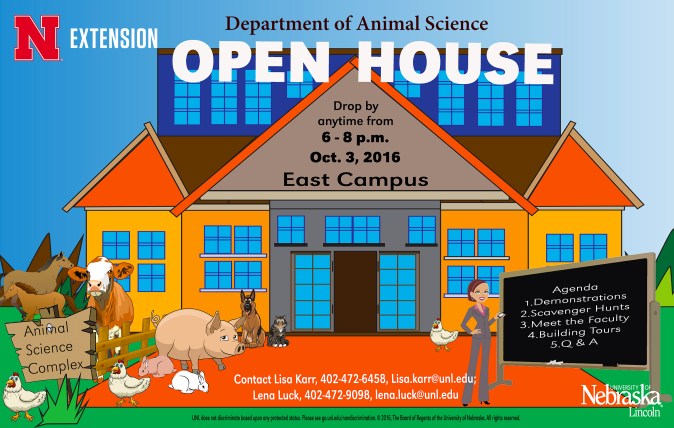
open-house-flyer-10

Did you know you could attend the University of Nebraska and get a degree focused on companion animals, horses or livestock? Or maybe you just want to take a few classes to learn more about these? You need to come to the University of Nebraska Animal Science Open House on October 3, 2016 from 6 – 8 p.m. to learn more. You can get questions answered and find out more about the vast opportunities, classes that are offered, careers and much more. During this Open House you will get some hands-on experiences, view demonstrations and meet with faculty and students involved in UNL’s equine, companion animal and livestock programs. Also you will get to find out more about the various animal-related organizations such as Equestrian team, Livestock and Horse Judging teams, SEECA (Students for the Education of Exotic and Companion Animals), Pre-Vet club, and Block and Bridle.  During the open house, you will get to travel through the Animal Science building on a bit of a “scavenger hunt” to seek out facts related to our classes and majors. Be sure to mark your calendars to not miss this night at the UNL Animal Science Complex, UNL East Campus!

A flyer, map and more details can be obtained at our Extension Office or by contacting Dr. Lisa Karr (lisa.karr@unl.edu) or Dr. Lena Luck (lena.luck@unl.edu).

Crops, Uncategorized

Harvest Safety

It is hard to believe that harvest will soon be in full swing! With harvest comes more traffic on the county roads and other stresses for farmers. It never fails, that equipment can break, there can be delays at the elevator and those extra-long hours can all add extra stress to farmers. That being said, it is important to carefully slow down and realize the many hazards you are being exposed to during harvest.

An Iowa State Extension publication, Harvest Safety Yields Big Dividends points out that injuries can occur by taking shortcuts to perform routine tasks, not getting enough sleep or regular breaks, or failing to follow safety practices. Some injuries occur when operators are pulled into the intake area of harvesting machines, such as balers, combines, or corn pickers, and many injuries occur from slips or falls around these machines. Exposure to powerful machinery is highest during the harvest season. The equipment must be powerful to effectively handle large amounts of agricultural commodities. When equipment plugs, NEVER try to unplug it with live equipment, instead always disengage power and turn off the engine before trying to manually clear a plugged machine. Regular maintenance of these machines can also make harvest go smoother. Also, lots of accidents actually happen by the operator slipping and falling off equipment.

In the same publication listed above, there are several tips for reducing fall hazards:

  • Always keep all platforms free of tools or other objects.
  • Frequently clean the steps and other areas where workers stand to service, mount and dismount, or operate the machine.
  • Wear well-fitting, comfortable shoes with non-slip soles.
  • Use grab bars when mounting or dismounting machinery.
  • Be sure your position is stable before you work on a machine.
  • Recognize that fatigue, stress, drugs or alcohol, and age may affect stability.

Other helpful tips during harvest are to keep kids away from machinery. Tell them the dangers that can occur and not to play near the equipment, even when it is shut off; you never know when they will be playing in hidden areas of the equipment. Operators should double check where kids are before moving the equipment. Too many accidents can occur when youth are in the path of equipment out of the operator’s view. Operators of all equipment should check in regularly and let someone know where you are. Keep all guards on equipment; it is there for a reason!

slow-downIt is also important for the public to understand the increased traffic on public roads and be patient. The greatest threat raised between farm equipment and passenger vehicles is the difference in speed. Farm equipment runs at an average speed of 20 miles per hour while passenger vehicles average 60 miles per hour. If the motor vehicle overtakes a tractor, the impact is comparable to a passenger vehicle hitting a brick wall at 40 miles per hour. If the tractor and a car, mini-van or pickup collides head on, the impact is the same as hitting a brick wall at 60 miles per hour.

Farmers can reduce the chances of an accident by using warning lights, reflectors and reflective tape on their machinery to keep passenger vehicle operators aware of their presence on roads. Some farmers may choose to install supplemental lights to increase visibility. It also is a good idea for producers to keep off heavily traveled roads as much as possible and avoid moving equipment during the busiest part of the day.

CornEarWebSome farm equipment, such as combines, can take up more than half of the road. Even so, it is up to both drivers to be aware of their own limitations and adjust accordingly. Farmers should not take up more space than is needed, but other drivers should try to provide as much room as possible. It is a good idea for passenger vehicles to turn off onto side or field roads until larger machinery has passed. Whenever possible, farmers should use an escort vehicle such as a pickup to precede or follow large machinery and equipment on public roads. More than one escort may be necessary. Ideally, the escort vehicle would have extra warning lights and a sign indicating oversized or slow equipment ahead or following.

Have a safe harvest!

Crops, Uncategorized, Youth

Making One Agronomist at a Time

Last week, eight Nebraska youth traveled to Iowa to participate in the 1st Annual Regional Youth Crop Scouting Competition held at Iowa State University’s Field Extension Education Location near Boone, IA. These youth scouted six fields for diseases, insects, abiotic/biotic disorders, weed identification and crop growth stage and development. Teams from IIMG_6290.JPGowa and Indiana also competed. Nebraska teams ranked 4th and 5th respectably. Between all three state competitions, 111 youth competed from Nebraska, Iowa and Indiana. Top two teams from each state competed at the regional competition. Congrats to all of the youth who not only networked with agronomic professionals, but also gained the most by improving life skills related to a potential career path.

While this is one program, which impacts a very small percentage of youth, it is very important to start training the next generation of ag leaders to feed our growing population. In fact the USDA’ National Institute of Food and Agriculture (NIFA) believes so strongly in the future of agricultural career pathways, they are funding $3.1 million through a Food and Agricultural Sciences National Needs Graduate and Postgraduate Fellowship Grants Program (NNF). This fellowship will aid in supporting the next generation of scientists and innovators who will be key to the future of our food and agricultural systems.

The NNF program is for graduate degree (masters and doctoral) programs and postgraduate training. The Nebraska Farmer website says it well, “the purpose of this program is to develop intellectual capital to ensure the preeminence of U.S. food and agricultural systems. This funding invests in experiential learning, including international experiences, for individuals who demonstrate their potential to successfully complete graduate degree programs in disciplines relevant to NIFA’s mission.”

There are eight targeted expertise shortage areas in which applicants should target their projects which include:  animal production; plant production; forest resources; agricultural educators and communicators; agricultural management and economics; food science, human nutrition and human sciences; sciences for agricultural biosecurity; veterinary sciences; food and agriculture data analytics and tools; and integrative biosciences for sustainable food and agricultural systems. Applications are due September 22, 2016. For more information go to the NIFA – NNF website.IMG_6287.JPG

While this program is for graduate and postgraduate degree programs, it all starts by sparking the interest in youth, one at a time with the goal of “making on agronomist at a time.”

For more information on how to engage youth in crops, visit our UNL CropWatch site at http://cropwatch.unl.edu/cropwatch-youth.

Crops, Uncategorized

Saline County Wind Association

The Saline County Wind Association (SCWA) Inc. has voted to enter into negotiations on a wind lease agreement with APEX Clean Energy of Charlottesville, VA. APEX has indicated it plans to build a 300 M/W wind energy facility in the following Townships of Saline and Fillmore Counties: Atlanta, Olive, Turkey Creek, Belle Prairie, Chelsea, Franklin and Glengary.windturbine

APEX has renewable energy projects in 25 states. Most of those projects being wind energy facilities. This will be their first project in Nebraska.

SCWA’s role in this project is: 1) Educate the landowners in the project area about wind farms; 2) Help determine the level of interest in this type of project; 3) If there is sufficient level of interest, to negotiate a wind lease agreement for the landowners that choose to participate in the project.

SCWA Board Chairman, David Vavra, said, “The mission of the Wind Association is to Protect the Land Owners. Not to be for or against wind development, but to educate the landowners so they can make an informed decision as whether or not to sign a wind lease agreement.”

Wind Lease agreements can be 50 to 60 pages long. The SCWA has identified over 20 points of concern that land owners need to be made aware of when signing a lease of this type. These agreements can be in place for up to 50 years.

To help inform and educate the landowners in the proposed area, SCWA will be holding 2 landowner informational meetings in Ohiowa, at 1PM in the Ohiowa Auditorium on Saturday, August 13th, and in Tobias at 7PM in the Tobias Fire Hall on Sunday, August 14th.

Anyone who has land or interest in the project area is encouraged to attend. Even if you are not interested in wind development, you owe it to yourself to be informed.

For more information please call 402-526-0018.

(Source: David Vavra, SCWA Chairman)

Uncategorized, Youth

Reflections from the Road

This past week, I was fortunate to serve as a voting delegate for Nebraska Ag Educators and attend the National Association of County Agricultural Agents Professional Improvement Conference in Little Rock, Arkansas. At this conference agricultural extension professionals gathered from across the nation to gain leadership development and increased knowledge of agricultural issues. The presentations and networking with colleagues across the nations sparks ideas, concepts and programs to bring back home. There were several excellent programs and concepts I am excited to implement in Nebraska and locally, which will not only be a benefit to Nebraskan’s and the clients I serve, but make me a better educator. From agricultural literacy initiatives to youth development programs to new and emerging trends in production agriculture, this is always a highlight of my professional career.

rice field
At the NACAA Professional Improvement Conference, an Arkansas Extension Specialist shared with us how rice is grown. It is always interesting to learn about different types of agriculture outside of Nebraska. 


Also, this conference provides a renewed sense of purpose and reminds me what it is that I do. To some, all the county extension office does is conduct a county fair. It always amazes me how one week out of the year, extension is judged on the quality of work conducted. Don’t get me wrong, county fair is important, as it is one of the culminating activities in a youth’s project and allows them to showcase their hard work and dedication that is important. I enjoy seeing projects, both livestock and static exhibits, that youth have been describing to me and talking about for months. Seeing the pride in their eyes as they exhibit their project is awesome! The volunteers we have in Fillmore County are amazing and greatly appreciated. It is great having volunteers that have ownership in the 4-H program and we have countless volunteers who contribute many hours of hard work for the greater good of the 4-H program. To those, I cannot thank you enough!

At my conference, Walt Coleman resonated to me quite well, especially after coming off county fair. Coleman is a fifth-generation businessman in the dairy industry and currently serves as controller for Hiland Dairy. Coleman has also officiated NFL games for 25 years. You can probably guess as an NFL referee, he has experienced his share of negativity! One of the quotes that stuck with me includes, “All we can be is the best we can be” and reminded us to focus on the positive, not negative.

We often will never quite know the impact we’ve had on one’s life. I went into Extension in order to make a positive difference in the lives of those I serve. While it is not usually visible, I sure hope that what I do is making a positive difference and that I leave this world a better place. My parents instilled in me the importance of giving thanks to those whom have made a difference or went out of their way to do something that didn’t have to be done. Let’s reach out to others in a positive manner and be thankful what we have, rather than tearing others down with needless “put-downs” and poor sportsmanship.

In conclusion, with all of the negativity and challenges our world faces, let’s strive to work together, rather than against each other. Let’s be a part of the solution, not the problem and display positive character traits for our youth’s sake. I’d like to end this column with a quote by Henry Ford that sums up what I’m trying to express, “Coming together is a beginning; keeping together is progress; working together is a success.” We have so much to be thankful for and let’s not loose sight of that. Thanks again to all whom have contributed positive youth development to the 4-H and FFA programs!

Uncategorized, Youth

Sportsmanship & Youth Development

Webster’s Third International Dictionary defines sportsmanship as “conduct becoming to an individual involving fair and honest competition, courteous relations and graceful acceptance of results”. Sportsmanship starts with parents teaching their youth how to accept a win or a loss, although in the 4-H youth development program, even if the youth receives a red ribbon, nothing is lost as long as some basic knowledge and skills were gained. Too often in our society we focus on the tangible results of a ribbon or trophy and don’t think about the process that youth went through to achieve the end results and what was learned from that process.   It is your response to winning and losing that makes you a winner or a loser.- Harry Sheeny

I often use the example that as a youth, I’ll never forget receiving a red ribbon for a market heifer; I was disappointed, but will never forget my dad asking me, what the judge said in the comments. After we talked it over, I realized his reasoning and was able to understand the type of animal I should select the following year. That was a lesson I’ll never forget. My parents instilled the value of hard work into my sister and I and any animal we showed we bought with our own money to build a small cow/calf herd or they came from our own herd. We rarely had the award-winning animal and were extremely excited to even receive a purple ribbon. The learning that occurred, memories and fun we had were just as valuable than if we would have received a trophy or plaque. For these reasons, it is really rewarding to work with youth who are happy with any ribbon placing- white, red, blue or purple. It really is just one person’s opinion on one particular day!

The 4-H Program focuses on providing positive youth development and developing young people as future leaders. A ribbon or plaque placing does not achieve this; rather it is the process, skills and effort that went into the project. It is also important to mention that the entire 4-H program extends beyond the county fair and is done through educational workshops, career portfolios, leadership experiences and much more and is a year round program.

MeShowing
I enjoyed showing cattle and while purples were exciting to receive, the ribbon placing didn’t matter; it was the learning experience and fun had with friends!

Three reasons adults and teen leaders should be concerned with developing sportsmanship are:

  1. Youth programs are easier to conduct and are more positive experiences for everyone involved if good sportsmanship is demonstrated.
  2. The development of sportsmanship is an important part of youth development. Youth and adults who develop and show good sportsmanship get along better, and are much more successful on a long-term basis in becoming self-directing, productive, contributing, competent, caring, capable adults, than are those whose behavior is un-sportsmanship-like.
  3. Sportsmanship is one of the key elements of civilized society. Those who think of the “big picture” know the reasons for developing sportsmanship extend beyond an individual, a community, or a program. When societies allow sportsmanship to decline, their civilizations also decline.

As we get ready for another Fillmore County Fair, let’s be reminded that the end result is not the ribbon placing, but the skills that each youth learned!

Source: Kathryn J. Cox, Ohio Extension 4-H Specialist, Youth Development, Developing Sportsmanship- A Resource For Preparing Youth And Their Families For Participation in Competitive Programs and Events, 2006

Crops, Programming, Uncategorized, Youth

Youth Crop Scouting Competition

Connecting Youth with Crops…

Looking for a fun club project? Want to unite your club members? Running out of ideas for club meetings? If you answered, “yes” to any of these questions, help is on the way! Nebraska Extension is pleased to present the 3rd annual Crop Scouting Competition for Nebraska youth. Youth interested in crops have the opportunity to learn about crop growth & development and basic crobrandy vandewalle slide on crop scout clinicp scouting principles.

Don’t know a lot about crops? Ask a local agronomist to assist by providing a short lesson on crop production. You can have the agronomist meet with youth a little during each meeting or outside of the meeting. This is one way to engage those youth interested in crops.

This contest will be held at the ARDC near Mead, Nebraska on August 2, 2016. The event will include both indoor and outdoor events. Teams of junior high and high school students (those completing 7-12th grades) from across Nebraska are invited to participate.

Clubs or other organizations may enter a team composed of three or four participants. An adult team leader must accompany each team of students. Team leaders could be FFA advisors, crop consultants, extension staff, coop employees, etc.

Top-scoring teams win prizes: $500 for first, $250 for second, $100 for third place.

Teams will be expected to know the basics of scouting corn and soybean fields. This includes crop staging; looking for patterns of crop injury; disease, insect and weed seedling identification; etc. Other topics many include but are not limited to, pesticide safety, nutrient disorders, and herbicide injury.

More information about the crop scouting competition and instructions on how to register a team are available online at cropwatch.unl.edu/youth.  Top two teams will be eligible for regional competition in late August at Iowa.

Teams must be registered by July 18. Registration is $50/team; the fee will be refunded when the team attends the competition. Payment by check is due along with the registration form by July 18. This program is sponsored by DuPont Pioneer, the Nebraska Soybean Board, Nebraska Independent Crop Consultant Association and Nebraska Extension.

Crops, Programming, Uncategorized

Weed Management Field Days

weedmgmtdayGrowers, crop consultants and educators are encouraged to attend Nebraska Extension’s Weed Management Field Day from 8 a.m. to 1 p.m. June 29 at the South Central Agricultural Laboratory near Clay Center. The field day will include on-site demonstrations of new technology and new herbicides for corn, soybean and sorghum. An early morning tour will focus on weed management in soybeans followed by a tour of weed management in corn and sorghum. Field experiments will provide information for weed control options using several herbicide programs.

“Several new herbicides and technologies are coming to the market, including Enlist Corn and Soybean, Roundup Ready 2 Xtend Soybean, Balance Bean and INZEN sorghum” said Extension Weed Management Specialist Amit Jhala. The field day will provide an opportunity to identify several broadleaf and grass weeds commonly found in corn and soybean fields in Nebraska.

Three Certified Crop Advisor (CCA) Continuing Education Units are available in the integrated pest management category. There is no cost to attend the field day, but participants are asked to register at http://agronomy.unl.edu/weedresistmgt. The South Central Agricultural Laboratory is five miles west of the intersection of Highways 14 and 6, or 13 miles east of Hastings on Highway 6.amaranthGrowers, crop consultants and educators interested in management of herbicide-resistant Palmer amaranth are encouraged to attend Nebraska Extension’s Field Day, supported by the Nebraska Corn Board, from 8:30 a.m. to 1:30 p.m. July 12 near Shickley.  Palmer amaranth is a member of the pigweed family and is one of the most troublesome weeds in seed cornfields because of its resistance to atrazine and HPPD inhibitors. Greenhouse dose-response studies have confirmed resistance when atrazine and HPPD inhibitors were applied post-emergence. Palmer amaranth is of particular concern in south-central Nebraska because of its proximity to intense seed corn production, which is heavily reliant on these herbicides for weed.

At the field day, experiments will demonstrate how to control Palmer amaranth in field and seed corn production fields in Nebraska. Keynote speaker, Jason Norsworthy will share his experiences for management of glyphosate-resistant Palmer amaranth. Norsworthy is a professor and endowed chair of weed science at the University of Arkansas.

Three CCA credits will be available. There is no cost to attend the field day. However, pre-registration is required before 3 p.m. on July 11. To register, visit http://agronomy.unl.edu/weedresistmgt.

Directions to the Field Day: From Geneva, go south on Highway 81 for seven miles. Turn west onto Highway 74 for 12 miles. Turn north on Road 2 for three miles. Turn west on Road Q for 0.1 mile. The farm field is on the north side of Road Q.

For more information, contact Amit Jhala at 402-472-1534 or amit.jhala@unl.edu.

Horticulture, Uncategorized

Emerald Ash Borer in Nebraska

A couple of years ago, I hosted Nicole Stoner, Extension Horticulturist for a program on Emerald Ash Borer and she reminded attendees that it’s not a matter of if it will happen, but when it happens. Guess what? The Nebraska Department of Agriculture announced recently that the emerald ash borer (EAB) has found in soutEABheast Omaha. This is the first confirmation of the insect in Nebraska. EAB has killed hundreds of millions of ash trees in 26 states. It is projected that Nebraska’s taxpayers and homeowners will spend over $961 million on ash tree removal, disposal and replacement. The following information was take from the Nebraska Forest Service’s press release.

Deputy State Forester John Erixson reminds people that now is a good time for residents in and around Omaha—and municipalities throughout the state—to take proactive steps to deal with EAB as once EAB is found in an area, most ash trees are killed within 10-15 years. Residents with ash trees in the Omaha area may want to begin treatments. “The best candidates for treatments are healthy, high-value trees that are in a good location,” said Mark Harrell, Forest Health Program Leader with the Nebraska Forest Service. “Trees in poor condition or located under wires or too close to sidewalks or buildings generally should be removed rather than treated.”EAB 15miletreatment

Professionally applied trunk injections are the most effective treatments, especially for large trees. Their main drawback is the damage they cause to the tree and therefore are best applied by certified arborists well-trained in the procedure. The most common products available to the homeowner are soil applications, but they are somewhat less effective than injections and have a greater chance of harming beneficial insects, such as bees.

Treatments need to be applied every one to two years and must be done for the remaining life of the tree,” said Harrell. “For this reason, many trees will not be worth saving.” Owners of ash trees outside of the Omaha area may be anxious to begin treatments, but the recommendation is still to wait until EAB has been found within 15 miles of your trees. The chances that your tree will be the first one infested is very low, especially if it is being well cared for.

The current treatment consideration zone extends from Fort Calhoun to Plattsmouth and from Gretna to east of Council Bluffs. Municipalities and anyone else managing large numbers of ash trees even if they are outside of the Omaha area should take steps now to prepare for EAB. “Upwards of 80% of the ash trees will die within 8 years after EAB is found in a community if nothing is done to manage the pest,” said Eric Berg, Program Leader for Community Forestry and Sustainable Landscapes. “This can put a strain on city budgets and staff and create liability issues if dead trees are left standing. Nebraska municipalities need to be proactive in dealing with EAB.”

“Municipalities should gain an understanding of the number, locations, sizes and conditions of their ash trees and develop a management plan,” Berg added. “Removing poor quality trees in a community even before EAB is discovered will help spread removal costs over more years.” As trees are removed, they should be replaced with a diverse selection of trees, not just a few species. This will help avoid another significant loss of the urban tree canopy when the next serious pest arrives.

More information about the emerald ash borer, finding an arborist, and recommendations for municipalities can be found at www.eabne.info.

An educational program on Emerald Ash Borer program will be held June 30th at 5:30 p.m. free to the public. This will be held at the Fillmore County Extension Office in Geneva, Nebraska and taught by Extension Horticulturist, Nicole Stoner.