Crops, Programming, Youth

Does Science & Research Even Matter?

What is science? What is research? Why does science and research matter? Do they even matter anymore? According to Merriam-Webster, science is defined as, “knowledge about or study of the natural world based on facts learned through experiments and observation.” It also goes on to say, “the state of knowing: knowledge as distinguished from ignorance or misunderstanding” or “knowledge covering general truths or the operation of general laws especially as obtained and tested through scientific method.” Merriam-Webster defines research as, “careful study that is done to find and report new knowledge about something” or “the activity of getting information about a subject.”apple

In this article, I’ve decided to write a two-part series focusing on concerns regarding how decisions of large companies and even consumer decisions are made. First of all, I do not claim to be a scientist or researcher, but my role in Extension requires me to provide clientele research-based, scientific driven information. This is one of the great things about all Extension systems! We do not get paid from companies, so we are non-biased and have access to some of the best researchers in their field who are working on cutting-edge research. When a client calls and needs information, I have access to a whole network of researchers or others with higher education in that particular subject. I can provide my client with solid, data-driven information so he/she can make the best decision possible to solve their problem.

For example, if a client has a horticultural question, I might know the answer based on experience of the topic, but if not, I have a network of horticulturists who have been trained in that area to answer the question. If a client has a question related to food safety, we have a great website with reliable information I can direct them or again, a network of educators focused in nutrition and food-science to refer them. The United States is the envy of many countries for having such a system!

You might be wondering where I am going with this and how does this relate to my definition of science and research at the beginning of this article. The point is, University and even industry scientists have an important role in solving important issues ahead of us such as feeding the growing population and dealing with climate variability and weather extremes. According to Anastasiya Borys in an article from the Harvard Political Review, the decline in the United States’ position as the global leader in science could not only diminish U.S. economic growth, but our national security. In 2014, China graduated more English-speaking engineers than the United States and America’s share of high-tech exports fell from 21 to 14 percent, while China’s rose from seven to 20 percent. There are efforts to improve youth’s interest in science, technology, engineering and math underway in the United States, of which Extension and 4-H are involved.

The above facts are evidence that somewhere along the way, the average American lost a firm grasp of basic scientific facts and concepts. In 2004, the National Science Board published information supporting that “scientific literacy in the United States (and in other countries) is fairly low. Scientific literacy is defined as knowing basic facts and concepts about science and having an understanding of how science works.” Michigan State University Professor, Jon Miller reported that “over recent decades, the number of public policy controversies that require some scientific or technical knowledge for effective participation has been increasing…. (including) any number of issues, such as the siting of nuclear power plants…. and the need for an informed citizenry in the formation of public policy.” Miller, who wrote this article in 2007 pointed out, “Having a basic knowledge of scientific principles is no longer a luxury but, in today’s complex world, a necessity.”

Next week, I’ll explain how this relates to the agricultural industry.

Programming

Farmers & Ranchers College 2015-16 Programming

The Farmers & Ranchers College was formed in January 2000 with the purpose of providing high quality, dynamic, up to date educational workshops for area agricultural producers in south central Nebraska through a collaborative effort between business, industry and higher education leaders. Furthermore, the Farmers & Ranchers College will provide the tools necessary so that agricultural producers will be able to respond positively to these changes using a profitable decision making process.Logo

The Farmers and Ranchers College is a unique opportunity to educate agricultural producers in south central Nebraska. Approximately three hundred producers from fourteen counties and three states participated in the 2014-15 Farmers & Ranchers College programs. Producers attending these workshops managed over 205,000 acres. Participants (46%) surveyed indicated an average of $17.00/acre of knowledge gained from participating for a potential impact of $3 million.

The fourteenth annual Partners in Progress- Beef Seminar featured a variety of industry, University and agricultural organization presenters. Participants managed over 10,000 head of cattle and indicated that on average the information presented will increase their profitability $30/head with a total potential impact of over $300,000.

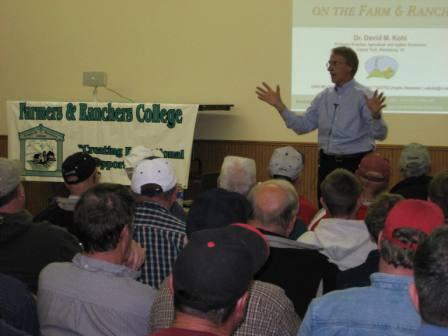
Contributions and support of area businesses allow participants to attend at no cost, however for programs that have meals, it is requested that people RSVP at least a week in advance for an accurate meal count by calling Fillmore County Extension at (402) 759-3712.Kohl2011 Web

The Farmers and Ranchers College Committee consists of Fred Bruning of Bruning, Bryan Dohrman of Grafton, Sarah Miller of Carleton, Jennifer Engle of Fairmont, Ryne Norton of York, Jim Donovan of Geneva, Bryce Kassik of Geneva, Eric Kamler of Geneva, and Brandy VanDeWalle of Ohiowa.

2015-16 Farmers & Ranchers College Programming

  • December 15, 2015 – “Positioning Your Business for Success” Featuring Dr. David Kohl Professor Emeritus, Dept. of AAEC, VA TECH at the Bruning Opera House – Bruning, NE at 1:00 p.m.
  • January 20, 2016 – “Partners In Progress – Beef Seminar” at the U.S. Meat Animal Research Center near Clay Center from 10:00 a.m. to 3:30 p.m., registration at 9:30 a.m. *
  • March 14, 2016 – Overcoming Challenges with Succession Planning for Families with Dr. Ron Hanson, Neal E. Harlan Professor of Agribusiness, Ag Economics Dept., UNL at Stone Creek in McCool Junction with meal starting at 6:00 p.m. and program to follow. Registration starting at 5:30 p.m. *

*Programs are provided at no cost to the public, but registration is appreciated for a meal count. Please call the Fillmore Co. Extension Office at (402) 759-3712 one-week prior to the program.

Programming

State Fair – Fun is in the Fair!

I’d like to wish all 4-H and FFA exhibitors good luck this at the Nebraska State Fair this weekend. If you are able, check out all of the great activities offered. I’d also like to share information about “The Landing Zone” at the State Fair on September 7th from 9:00 a.m. to 5:00 p.m. on the event tent on the south end of the Fairgrounds. The veterans’ community task force needs your help supporting deployed Nebraska military units and Nebraska veterans in need. Their goal is to assemble 146 care packages, representing one package for each year of the Nebraska State Fair. For more information, email thelz.statefair@gmail.com or call 402-460-2130.

Uncategorized

10 Tips for Eating Healthy on a Budget

Great tips from my colleague, Kayla Colgrove!

Kayla Colgrove's avatarmakinghealthierdecisions

Eating healthy is so expensive! Or, so I hear. I’m going to share with you 10 tips to help you eat healthy on a budget. It all starts with remembering the 3 P’s – Plan, Purchase, and Prepare.

10 Tips for Eating Healthy on a Budget Blog Graphic

Plan

Tip #1: Make a Food Budget

Determine your food budget by completing, “Family Budgets: Developing a Spending Plan that Works.” Next, figure out how much money you can spend for each trip to the store. If you shop weekly, then take your monthly food budget and divide by four. Remember to follow your food budget.

Tip #2: Plan Meals

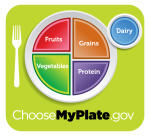
MyPlate, Healthy MyPlate illustrates the five food groups that are the building blocks for a healthy diet using a familiar image—a place setting for a meal. Before you eat, think about what goes on your plate or in your cup or bowl.

Taking the time to plan your meals ahead of time can help you save money and…

View original post 804 more words

Uncategorized

4 tips on finding and reading scientific papers…

A great article to find information from credible sources!

lindsaychichester's avatarAgricultural with Dr. Lindsay

People quote a lot of “research” on the internet, however, the sources are generally not peer reviewed or from reputable resources.

  1. A super handy tip when trying to find peer reviewed or credible information is to type what you want to look up and then follow it with site:edu. For example, this would look like heat stress site:edu. Adding the site:edu ensures that research which has been peer reviewed or research done by a university come up first in your search. These are generally seen as more credible than popular media and various websites. Also, it also puts you in touch with people who are “experts” on a topic, so you could potentially follow up on a topic.
  2. Another fun fact… If Google is your go-to for looking up a topic, then go to Google scholar.Google scholar “provides a simple way to broadly search for scholarly literature…

View original post 236 more words

Programming

Husker Harvest Days

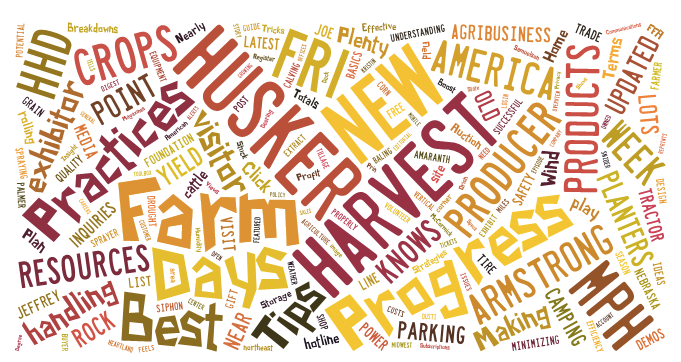
Before you know it, September will be here; for many in agriculture, that means learning about new technologies and services at Husker Harvest Days near Grand Island, NE! As a youth, our FFA Chapter had the opportunity to attend, which was a huge eye-opening experience to the careers available in the agricultural industry. Now, as an extension educator for Nebraska Extension I try and assist by working at the IANR building. It still is an eye-opening experience to learn or experience emerging technologies, etc. This year’s Husker Harvest Days is Sept. 15-17.HHDwordle

“Successfully weathering extremes” is the theme for Nebraska Extension exhibits dealing largely with planning for potential weather extremes from climate change on the farm and ranch, as well as climate change-induced challenges and opportunities in our everyday lives. Ronnie Green, NU Vice President, IANR Harlan Vice Chancellor and Interim Senior Vice Chancellor for Academic Affairs at UNL points out, “This is such an important topic on so many levels that we will examine it from many angles over both this and next year’s Husker Harvest Days shows. It’s part of our focus on critical and groundbreaking research and initiatives that are important not only to all Nebraskans, but nationally and globally, as we enhance our reputation as a leader in critically important research.”

UNL’s Husker Red steel building at Lot 321 will allow participants to receive the latest information on the challenges and opportunities facing the economics of agriculture, including variability and extremes in planning successful agricultural operations. They will view individual exhibits focused on: The Nebraska Climate Report’s take home messages; forage alternatives for improving the resiliency of Nebraska beef systems; planning for climate resilient irrigation systems; designing climate resilient confined livestock systems; perennial forages for biofuels production; use of cover crops to improve resilience to higher intensity precipitation; the role seasonal forecasts will play in future agricultural decisions; and the role of corn yield projections based upon climate/weather in agricultural decisions.

UNL’s adjacent open lots, east of Husker Red building, will feature living exhibits of demonstration cover crops, plantings of switch grass for ethanol production and other uses, technologies for conserving water use in irrigation, and shade systems for reducing heat stress in feedlots. Also inside the Husker Red building, IANR staff will be available to answer questions on a variety of extension and research-related topics, provide copies of helpful NebGuides, and direct those needing further help to extension experts in their local area.

IANR has been part of Husker Harvest Days for nearly 40 years, since the very first show in 1978. “We enjoy the opportunity to bring the University of Nebraska-Lincoln to Husker Harvest Days and seeing all the people that stop in to see us each year,” Green said. “We always appreciate the opportunity to visit with stakeholders about what they see as Nebraska’s main challenges and opportunities. We are your land-grant university,” he said.

Source: Steven W. Ress, communications coordinator, Nebraska Water Center, Robert B. Daugherty Water for Food Institute, (402) 472-3305, sress@nebraska.edu

Uncategorized

Happy Independence Day!

Wishing you and yours a Happy 4th of July weekend!  Here are some interesting facts I found on CNN’s website about Independence Day in the United States.

  • America’s 239th Independence Day will be celebrated on Saturday, July 4, 2015.

  • Fireworks sales by wholesalers totaled $508.1 million and sales by retailers totaled $369.4.(Census, 2012)

  • Of the $3.6 million spent on the purchase of U.S. flags, $3.5 million was spent on U.S. flags made in China. (Census, 2014)
  • The Fourth of July is the most popular holiday for grilling out (68 percent), followed by Memorial Day (52 percent) and Labor Day (51 percent). (Hearth, Patio & Barbecue Association, 2013)
Uncategorized

Yard and Garden: Survey

Area listeners of the Yard and Garden Show, here is your chance to be entered for a drawing to share your evaluation!

Nicole Stoner's avatarPlants and Pests with Nicole

Yard and Garden Green LogoIf you are a listener to the Yard and Garden show on KUTT 99.5 FM or online or if you are an avid reader of the blog Q&A, please fill out the 2015 Yard and Garden Survey. When you fill out the survey and put down contact information, you will be entered into a drawing for a gift of University of Nebraska-Lincoln goodies, including 2 shopping bags. Your information will not be redistributed or used for any other purposes than to improve the show and to pick a winner for the prize and your contact information is not linked to your answers. To complete the survey, go to: go.unl.edu/7cza

View original post

Crops, Programming, Youth

Connecting Youth with Crops

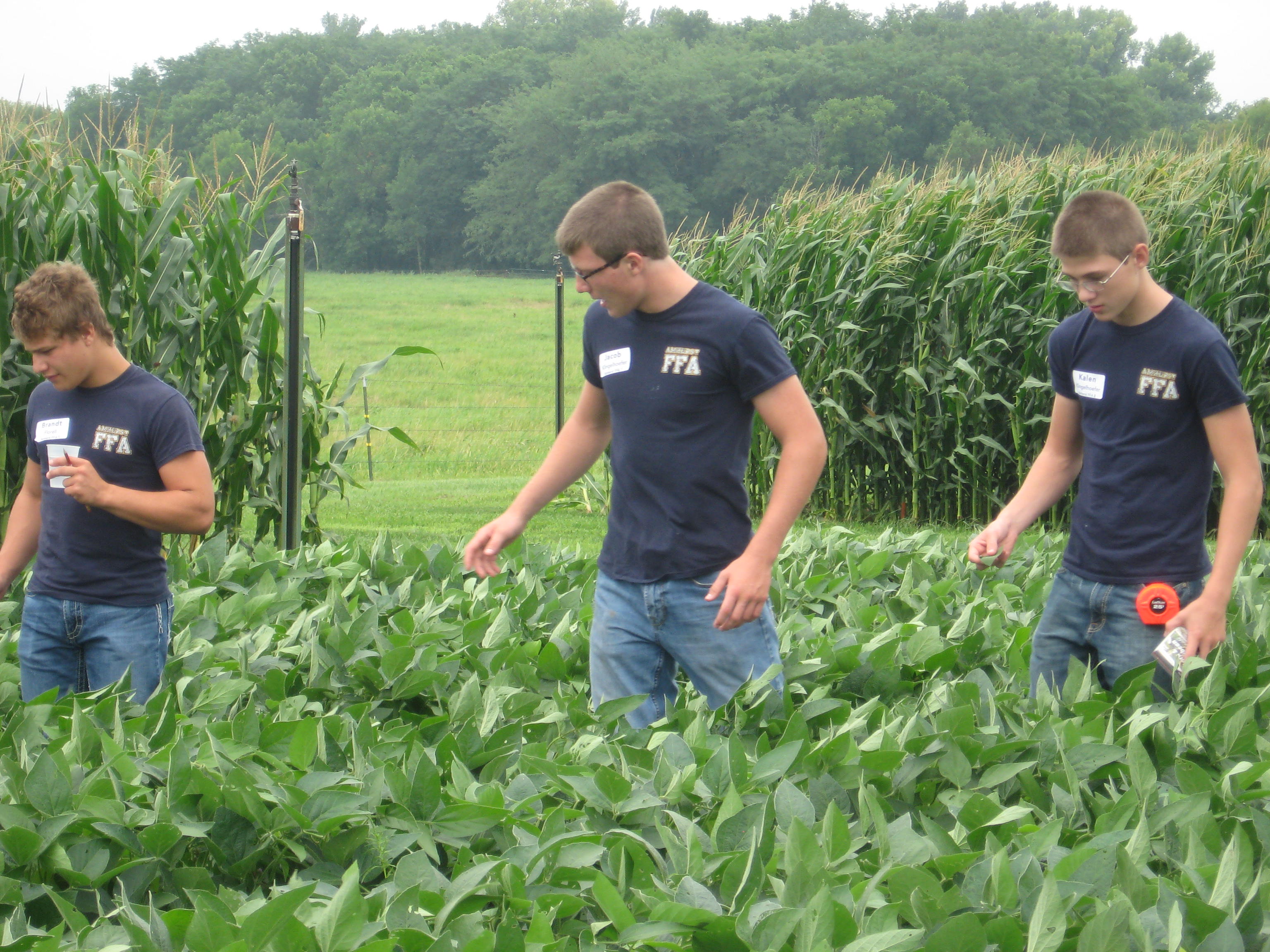
Nebraska Extension is pleased to present the second annual Crop Scouting Competition for Nebraska youth. Youth interested in crops have the opportunity to learn about crop growth & development and basic crop scouting principles.

Don’t know a lot about crops? Ask a local agronomist to assist by providing a short lesson on crop production. You can have the agronomist meet with youth a little during each meeting or outside of the meeting. This is one way to engage those youth interested in crops.IMG_4473

This contest will be held at the ARDC near Mead, Nebraska on August 4, 2015. The event will include both indoor and outdoor events. Teams of junior high and high school students (those completing 7-12th grades) from across Nebraska are invited to participate.

Clubs or other organizations may enter a team composed of three or four participants. An adult team leader must accompany each team of students. Team leaders could be FFA advisors, crop consultants, extension staff, coop employees, etc.

Top-scoring teams win prizes: $500 for first, $300 for second, $250 for third and $100 for fourth place.

Teams will be expected to know the basics of scouting corn and soybean fields. This includes crop staging; looking for patterns of crop injury; disease, insect and weed seedling identification; etc. Other topics many include but are not limited to, pesticide safety, nutrient disorders, and herbicide injury.

More information about the crop scouting competition and instructions on how to register a team are available online at cropwatch.unl.edu/youth. Click on the link that says, “Crop Scouting Competition”.

Teams must be registered by July 15. Registration is $50/team; the fee will be refunded when the team attends the competition. Payment by check is due along with the registration form by July 15. This program is sponsored by DuPont Pioneer, the Nebraska Soybean Board and Nebraska Extension.

Crops, Programming

Weed Control Field Day

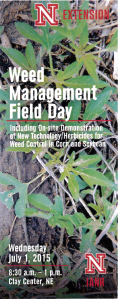
View on-site demonstrations of new weed control technologies and herbicides at the Weed Management Field Day on July 1 at Clay Center. The event, which will be held at the South Central Ag Lab (SCAL), begins at 8:30 and ends at 1 p.m. after a free lunch.

The first morning tour looks at weed control in corn. Demonstrations of new technologies and tours of weed control projects will include:weed field day

  • Comparison of Herbicide Programs for Weed Control in Corn
  • Herbicide Programs in 2,4-D plus Glyphosate-Resistant Corn (Enlist™)
  • Dose Response of Acuron™ Applied PRE for Weed Control in Corn
  • Anthem® Maxx Applied PRE in Corn
  • Evaluate Weed Control and Crop Response of Solstice™
  • Corvus® Followed by DiFlexx™ or Laudis™ plus DiFlexx for Weed Control in Corn

The second tour, starting at 10:30 a.m., includes demonstration of new technologies and herbicides for weed control in soybean, including:

  • Comparison of Herbicide Programs for Weed Control in Soybean
  • Herbicide Programs in Dicamba plus Glyphosate-Resistant Soybean
  • Herbicide Programs in 2,4-D plus Glyphosate-Resistant Soybean (Enlist™)
  • Weed Control in Isoxaflutole-Resistant Soybean (Balance® Bean)
  • Authority®/Anthem®/Marvel™ for Weed Control in Soybean
  • Importance of Soil Residual Herbicides for Weed Contol in Soybean

For more information about this event, see the Program Flyer at cropwatch.unl.edu or contact Amit Jhala , 402-472-1534. Three CEU credits will be awarded. Pre-registrations are requested for a lunch count. Preregister at agronomy.unl.edu/weedresistmgt.