Programming, Youth

Tractor Safety Courses Offered

University of Nebraska-Lincoln Extension Tractor Safety/Hazardous Occupations Courses will be offered at seven locations in Nebraska during May and June.  Any 14 or 15-year-old teen who plans to work on a farm other than their parents’ should plan to attend.  Federal law prohibits youth under 16 years of age from working on a farm for anyone other than their parents.   Certification through the course grants an exemption to the law allowing 14- and 15-year-olds to drive a tractor and to do field work with mechanized equipment.

Harvest

The most common cause of death in agriculture accidents in Nebraska is overturn from tractors and all-terrain-vehicles (ATVs), said Sharry Nielsen, UNL Extension Educator. Tractor and ATV overturn prevention are featured in the class work.  “Instilling an attitude of ‘safety first’ is a primary goal of the course,” Nielsen said. “Where youth have the chance to learn respect for agricultural jobs and the tools involved.”

Classes consist of two days of instruction plus homework assignments. Classes closest to us are from 8 a.m. – 5 p.m. each day. Dates and locations include:

— May 23-24, Fairgrounds, Kearney
— June 10-11, Fairgrounds, Osceola
— June 17-18, College Park, Grand Island

Pre-registration is strongly encouraged at least one week before a location’s start date to the Extension Office at the course site. Cost is $60, which includes educational materials, testing, supplies, lunches and breaks. For more information, contact the Extension Office or Sharry Nielsen at (308) 832-0645, snielsen1@unl.edu.

The first day of class will consist of intensive classroom instruction with hands-on demonstrations, concluding with a written test that must be completed satisfactorily before students may continue driving tests the next day. Classroom instruction will cover the required elements of the National Safe Tractor and Machinery Operation Program. Homework will be assigned to turn in the next day.

The second day will include testing, driving and operating machinery. Students must demonstrate competence in hitching equipment and driving a tractor and trailer through a standardized course as well as hitching PTO and hydraulic systems.

Programming

Keeping Your Farm in the Family for the Next Generation

The final Farmers & Ranchers College program for the 2012-13 programming year will be held on March 14, 2013 starting at 6:00 p.m. with a meal and the program to follow. It will be held at Evening with Friends Restaurant in Milligan and will feature Dr. Ron Hanson, Neal E. Harlan Professor of Agribusiness, Ag Economics Dept., UNL. A description of Hanson’s program is provided below.Logo

The entire process for mapping out a succession plan to transfer the eventual ownership of a family farm from one generation (parents) to the next generation (their adult children) can be an overwhelming task for many families.  Where does this process even begin?  Who makes the final decisions?  Can you be fair to everyone involved?  What if there is not good communications within the family?  How do you keep emotions and personal jealousies from taking over and preventing good decision making?  These are the issues that confront any farm family in determining a succession plan which allows for this successful transfer of farm ownership.

Most farm families would agree that a succession plan needs to be implemented and that any “what if family issues” need to be discussed and eventually resolved.  But this seldom ever happens.  Often farm families never can get past the “family obstacles and personal fears” that can actually become road blocks which prevent a succession plan from being put in place to protect the family farm and to insure that their family farming legacy continues to the next generation.   These obstacles and fears will be identified and discussed with potential solutions so that farm families can move forward in their succession planning process.

This presentation will outline the necessary steps to implement as well as achieve a successful succession plan that hopefully avoids potential misunderstandings between various family members. This lack of clarity and failure to explain specifics by parents when communicating their wishes to their children is often a frequent cause of family conflict/disputes.  Ideas will be shared to work through these emotional and stressful issues in a positive manner.  Parents must embrace a vision for passing on their farm that is shared by all family members involved for this succession process to achieve a successful transition of ownership to their adult children and to insure the next generation of young farm producers.

The Farmers & Ranchers College was formed in January, 2000 with the purpose of providing high quality, dynamic, up to date educational workshops for area agricultural producers in south central Nebraska through a collaborative effort between business, industry and higher education leaders.  The Farmers and Ranchers College Committee consists of Fred Bruning of Bruning, Bryan Dohrman of Grafton, Sarah Miller of Carleton, Eric Milton of Milligan, Jim Donovan of Geneva, Bryce Kassik of Geneva, Gordy Nuss of Sutton, and Brandy VanDeWalle of Ohiowa.

For more information on the various Farmers & Ranchers College programs, please go to the Fillmore Co. Extension website  or call the Fillmore County Extension office at (402) 759-3712.

Crops, Programming

Chemigation Certification Classes

Lately I’ve received several questions from producers wanting to chemigate so this week I’ve shared information from my colleague Randy Pryor in my column. Southeast Nebraska farmers who apply chemicals in irrigation water such as fertilizer or pesticides have an opportunity to certify and obtain a license. According to Saline County Educator Randy Pryor, the meeting is for people who need to renew their chemigation certification or for initial applicants. “The trend has been for more new applicants the past several years,” said Pryor. If you plan to become certified for the first time, please contact the Saline County Extension office (402-821-2151) to pre-register for the training session you plan to attend. We can send study materials prior to the training session which is highly encouraged. All class participants will receive a new chemigation manual and calibration workbook the day of training and should bring a pencil and pocket calculator.

Pivot

There is sometimes confusion what chemigation really means. By definition, chemigation is defined as “any process whereby chemicals are applied to land or crops in or with water through an on-farm irrigation distribution system” (Title 195, Ch. 1, 003). The regulations apply whether the water is from a surface water source, such as a stream or canal, or ground water from an irrigation well.

The Nebraska Chemigation Law does not apply to people in town, however, there are specific rules on backflow prevention for connections to a public drinking water supply system if you are using public water supply to apply chemicals to the lawn. Contact your town w
Pryor stated there can be benefits associated with chemigation or the use of fertilizer or agricultural chemicals in irrigation water through pivot systems when managed properly. Irrigators understand and recognize the importance of the required safety equipment and attend certification classes every four years to comply with state laws and review environmental stewardship. The operators complete a written exam upon completion of the class. Individual site permits are issued by the respective Natural Resources District (NRD) later for more information.

The following are additional meetings that are located in southern Nebraska:

  • March 5, 9:00 AM – 12:30 PM, Gage County Extension Office, Beatrice.
  • March 11, 1:00 PM – 4:30 PM, 4-H Building at the Fairgrounds, York.
  • March 28, 9:00 AM -12:30 PM, Hall County Extension Office, College Park, Grand Island.
  • March 28, 3:00 PM – 6:30 PM, Adams County Extension Office, Hastings.
  • April 11, 1:00 PM – 4:30 PM, 4-H Building at the Fairgrounds, York.

Registration is at the door. For additional information, please contact Extension Educators Randy Pryor at (402) 821-2151 or Gary Zoubek at (402) 362-5508.

Programming

Cornhusker Economics Outlook Program

The 8th annual Cornhusker Economics Outlook meeting series will focus on the ag outlook and management decisions for farmers and ranchers at eight locations across the state in late February. The annual meeting series is offered by University of Nebraska-Lincoln Extension and the Department of Agricultural Economics and is available free to participants with grant support from the Nebraska Corn Board and the generous sponsorship of Great Western Bank.CEOutlook

The outlook meetings are scheduled for a concise, fast-paced discussion of crop, livestock, and policy outlook:

  • Paul Burgener, Market Analyst and writer for Farm Futures Magazine and Farm Progress Companies, will provide the crop outlook for corn, soybean, and wheat producers. Paul writes his marketing columns from Scottsbluff and travels the country to share his marketing expertise. Making crop production and marketing decisions in 2013 will require balancing lingering drought concerns and production risks with market opportunities. Burgener’s insight will help pave the way for making sound production, marketing, and risk management decisions.
  • Kate Brooks, Extension Livestock Economist will provide outlook and analysis for the beef and pork producers. Kate is a new specialist at UNL with a Central Kansas background and experiences in Oklahoma and Texas before coming to UNL in January. Brooks will digest the emerging livestock market fundamentals of shrinking herds, meat supplies, and meat demand along with grain supplies and feed prices to assess producer profit potential and sound marketing and production decisions in 2013.
  • Brad Lubben, UNL Extension Policy Specialist will provide perspectives on the policy environment in Washington and the implications for ag policy and the farm bill. With seemingly ever-growing fiscal challenges in Washington, the road ahead could be even more challenging to get the farm bill done again before the current extension expires in September. In the meantime, producers will need to recall the existing safety net programs of ACRE and DCP for 2013 program participation decisions. Lubben will discuss the policy outlook and program alternatives to help producers effectively combine farm programs, crop insurance, and marketing strategies for success.

This outlook agenda is packaged into a 2 ½ hour format to provide producers the best available information and send them home ready to make 2013 management and marketing decisions. The series runs from February 25 through February 28 and varies in time by location. Locally, a session will be held in Geneva at the Fillmore County Fairgrounds on February 25th from 2:30 to 5:00 p.m.

Although there is no cost to participants, pre-registration is encouraged to plan for facilities, refreshments, and materials.

More information and details on all eight of the meetings is available on the webpage. Register by contacting the local Extension office listed for each location. You can also contact Lubben at 402-472-2235 or our office at (402) 759-3712 or myself at brandy.vandewalle@unl.edu.

Programming

Women in Agriculture Conference

Any successful agricultural operation depends on effective communication with the business partners. Many times, traditional (male) producers might overlook their most important business partner – their wife or significant other. Sometimes women, especially those without an agricultural background might need a little help in understanding issues their husband faces. Cheryl Griffith, UNL Agricultural Economics Public Relations coordinator leads the annual Women in Agriculture Conference which will be held Feb. 21-22 at the Kearney Holiday Inn. Nebraska women will learn how to care and plan for their farms, their communities, their families and themselves. The theme of this year’s conference is “Communicating in Challenging Times,” and it features a variety of workshops, “funshops” and speakers, including renowned animal scientist Temple Grandin.

Grandin, a professor of animal science at Colorado State University, is a world leader in the design of livestock handling and cattle processing facilities. Her designs emphasize reducing animal stress. Grandin also consulted with such companies as McDonald’s, Cargill and Tyson. Along with her research in animal handling, Grandin has both written and spoken about her experience with autism, which she was diagnosed with as a child.

Other speakers include Jolene Brown, a farmer and author from West Branch, Iowa, and Cheryl Burkhart-Kriesel, co-owner of Kriesel Certified Seed and University of Nebraska-Lincoln Extension community development specialist. Brown will be the keynote speaker Thursday morning with her talk, “It’s a Jungle Out There! Blazing New Trails for Agriculture.” Burkhart-Kriesel will speak on how to draw residents to rural Nebraska communities. Grandin will close the conference with her speech at noon Friday.

In between these lectures, conference-goers can choose from more than 30 workshops spread over five sessions during the event. Topics include livestock and grain marketing, crop insurance, family communication, business transition and beef nutrition. R.P. Smith, a cowboy poet from Broken Bow, will entertain for the Thursday evening program, followed by “funshops,” opportunities to network and socialize in a low-pressure setting.

Those interested can register online. They can also register by calling 1-800-535-3456 or by faxing their form to 1-402-472-0776. Hard copy registration forms can be sent to Women in Agriculture, UNL Agricultural Economics, 303 Filley Hall, Lincoln, Neb., 68583. The early-bird fee of $100 per person is due by Feb. 8. Following that date the fee is $120 per person. Fee includes workshop materials, registration and meals.

The conference is sponsored by the Institute of Agriculture and Natural Resources, University of Nebraska-Lincoln Extension and the Department of Agricultural Economics. Lodging is available at the Kearney Holiday Inn, 110 2nd Ave., 308-237-5971.

Crops, Programming

Research Updates to Cover Results from Soybean Management Field Day Trials

Recently I participated in the Crop Production Clinic and heard some interesting results regarding research on soybeans conducted this past growing season. In short, treatments included row spacing/seed rate, fungicides; plant populations/planting date and maturity group interactions. They found narrow row spacing to be the most important practice that growers can adopt to increase yields.

Soon, researchers will be sharing information and yields from the replicated field research conducted at the

2010countyfair-0021.jpg

summer 2012 Soybean Management Field Days. The summer Soybean Management Field Days feature presentations and field trials related to soybean production, marketing, and management. In 2012 arrangements were made with four soybean producers to plant seven replicated trials on each of their center pivot irrigated fields. University of Nebraska faculty will share and discuss yield results at each of the Research Update locations.

Research updates will include:

Quest for the Holy Grail in Soybean Production  with Charles Shapiro, UNL soils scientist – crop nutrition, Evan Sonderegger, UNL graduate student, & Jim Specht, UNL professor of agronomy

  • Soybean Seed Treatments and Foliar Fungicides and Growth Enhancement Interactions with Herbicides with Loren Giesler, UNL plant pathologist & Michael Rethwisch, UNL extension educator
  • Herbicide-Carrier Rate Study with Lowell Sandell, UNL weed science Extension educator, Cody Creech, UNL graduate student, & Greg Kruger, UNL Extension cropping system specialist

For more information contact program coordinator and UNL Extension Educator Keith Glewen at 800-529-8030.

Sessions closest to our area include:

  • Jan. 31 — Columbus, noon – 3 p.m., Wunderlich’s Catering, 304 23rd Street; 402-563-4901
  • Jan. 31 — David City, 6 – 9 p.m., Hruska Memorial Public Library, 399 5th Street; 402-367-7410

Registration

The program includes a complimentary meal. To RSVP or for more information, contact the Nebraska Soybean Board at 800-852-BEAN, UNL Extension at 800-529-8030, or the respective host county Extension office. The Soybean Management Field Days and these follow-up Research Updates are sponsored by the Nebraska Soybean Board and UNL Extension.

(Source, UNL CropWatch

Crops, Programming

Private Pesticide Applicator & Chemigation Certification Dates Set

Dates for both chemigation and private applicator training are out!  Has your certification expired for either of these programs?  Now is the time to check the card that’s in your billfold to know for sure.   If it is expiring this year, you should have received a letter about upcoming training dates, but if it’s been expired, you won’t receive a letter.  You have multiple methods to take these classes that include in person, home study or online. Sessions I will be teaching include

February 11th, 1:30 p.m., Ag Hall – Fillmore County Fairgrounds, Geneva
February 11th, 6:00 p.m., Ag Hall – Fillmore County Fairgrounds, Geneva
February 26th, 1:30 p.m., Grandpa’s Crossing Restaurant, Deshler
February 26th, 6:30 p.m., Opera House, Bruning

You can get a listing of statewide training dates and check on the status of your license or by contacting our office.

For chemigation training dates go this website.  From this location you can click on the NDEQ link to check on the status of your chemigation license.  Training dates set for March 11th and April 11th from 1:00 p.m. – 4:30 p.m. at the 4-H Building in York. My colleague Gary Zoubek who teaches the classes asks that you contact the York Co. Extension Office to pre-register for the training session you plan to attend.  Review of study materials prior to the training session is encouraged.   If you have misplaced your chemigation notebook you may request materials from one of the instructors.  All class participants will receive a new chemigation manual and calibration workbook the day of training.  Individuals attending for the first time are encouraged to request training materials prior to training.  Phone number to register is 402-362-5508 or you can email him.

Programming

Cow/Calf College

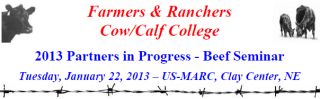
The annual Farmers and Ranchers Cow/Calf College “Partners in Progress – Beef Seminar” will be held at the U.S. Meat Animal Research Center and Great Plains Veterinary Education Center near Clay Center on Tuesday, January 22, 2013 with registration, coffee and donuts starting at 9:00 a.m. and going till 9:45 a.m.  The program will run from 9:50 a.m. until approximately 3:45 p.m. This program is sponsored by the University of Nebraska-Lincoln Extension’s Farmers and Ranchers College and will feature several outstanding speakers discussing issues and management strategies that can affect the profitability of all beef producers.

This year’s theme will center on recovering from the 2012 drought and preparing for the potential of a 2013 drought. There is no cost for the event and the public is invited. It does include a noon meal which means that early registration is necessary to reserve a plate. The seminar is packed with experts in climate, forages, animal nutrition and reproduction and will provide information that should help in planning for the upcoming year.

CowCalfHeading13

The “Cow/Calf College” will kick off at 9:50 a.m. with a welcome by Dr. John Pollak, Director of USMARC. He will also give a short overview on research that is happening at the Meat Animal Research Center. He will be followed by the first speaker, Allan Vyhnalek, UNL Extension Educator who will present: “Hay, Stalks, & Pastures: Costs & Considerations for 2013” which will give information on values, rental rates and considerations for coming out of a drought and possibly going into another. He will be followed by Dr. Bruce Anderson, UNL Extension Forage Specialist, who will give producers information on “Forage Planning for the Possible 2013 Drought”. This could be critical as beef producers face a shortage of pasture and now hay and other forages in 2012 and preparing for 2013.

The afternoon session will be kicked off by Dr. Rick Funston, UNL Beef Reproductive Physiology Specialist. In light of current feed costs many producers are looking at options and strategies for replacement heifer development in the months ahead. It may be advantageous to benefit from what he has learned in research on “Cost Effective Replacement Heifer Development”. He will be followed by Dr. Al Dutcher, UNL State Climatologist, who will give his take on the “Potential for 2013 Drought: Weather Update”. There is no doubt that most producers and especially beef producers are worried about what may be ahead for climate that will affect grass and forage production. We hope that he has good news for us, but must brace for the potential of bad news considering weather conditions ahead.Lunch will be provided and will be handled with a rotation system during two noon sessions featuring Aaron Stalker, UNL Beef Range Systems Specialist, who will provide two concurrent presentations on: “Corn Stalk Grazing: Values to Cattle Producers and Corn Farmers”. Also in the rotation will be a chance to see and hear about the new “New UNL Beef Body Condition Scoring App” developed by Dr. Rick Rasby and ready for distribution.

All presenters will then join on stage to pull everything together, give their final thoughts and considerations and then avail themselves for a coffee-shop style panel discussion during which cattlemen can ask questions and get answers on topic questions that came to them during the day’s sessions. A chance for door prizes will be awarded to those that stay for the entire event.

Any beef producer or other interested individual should pre-register by noon on Friday, January 18th, 2013, at the Webster County Extension Office at (402) 746-3417 to insure a seat, lunch, and proceedings for the day. You may also email your registration to Dewey Lienemann at:  dlienemann2@unl.edu.

Source: Dewey Lienemann, Extension Educator

Crops, Programming

Moving Forward in Agriculture

Those of us in agriculture are no stranger to risks involved with agriculture that are taken every day, whether it is financial, production, legal, price/market or human resources risks.  While we can’t control everything, there are measures that can be taken to protect one’s operation and reduce risk. Each year the Farmers & Ranchers College hosts Dr. David Kohl, Professor Emeritus from Virginia Tech who does an excellent job describing global risks which affect us locally and how those risks will affect the agricultural industry. In my seventh year of Extension, there are several key messages he largely emphasizes which I’ve summarized below.

First of all, “bigger is not better”, rather “better is better”. In other words improve the efficiency of your operation first before expanding. Also, to be successful (in anything really), be proactive and use the “HUT” principle: hear, understand and take action. While attending educational programs and undergoing professional development, unless you use the information and take action, you won’t fully succeed.

Kohl described common characteristics that the last four super cycles of the century possess: each had a rapid global real growth, conflict/geopolitical uncertainty, inflation, significant infrastructure investment, etc. Currently, we are in the longest of those super cycles (2003 – 2012), but one thing that is bound to happen is a crash. Be sure to have an exit strategy when this current super cycle crashes!

As the population increasingly grows more urban based disconnected to today’s production agriculture, there are many misconceptions of agriculture. There will also be a huge transfer of land in the coming years. Kohl warned of the spoiled brats emerging who want a “piece of their parents’ legacy”, thus invoking conflict among families, etc. When I attended Elaine Froese’s presentation she referred to baby-boomers as “waiters”, meaning they are waiting for their parents to collect inheritance because they haven’t prepared for their own retirement and feel entitled. In fact, there is a 500:1 odd that a business will make it to the 5th generation. Transition planning is increasingly important in order to beat the odds!

Kohl described what a “cut above super producer” possess. Among other things, they should follow the 60-30-10 profit plan, where 60% of profit focuses on efficiency first, and then growth. Thirty percent of one’s profit should build working capital and the last 10% is for you to do what you want with it – enjoy life!  Remember to not live above your means.

Finally, he ended with reasons to be optimistic about agriculture. By 2050, we will need 100% more food, fuel and fiber, thus the career opportunities for youth are enormous! One in six jobs is related to agriculture in some way; students taking college courses should remember to not only take the technical classes, but classes in business, science and communication. We need to “think globally and act locally”.

I encourage you to reflect on this past year and create/enhance your business plan for 2013. I wish you all a happy and joyous holiday season!

Programming

Annie’s Project: Risk Management for Women

Soon 2012 will be in the books and with the New Year approaching, what a better time to set resolutions for your business!  Developing management and decision-making skills for farms and ranches is becoming more important than ever before. Today’s volatile agricultural markets can increase your risk if not managed properly. The University of Nebraska-Lincoln Extension is offering a program to address these issues.

Annie’s Project is a six-week course designed especially for farm women to help them develop their management and decision-making skills for their farms. Sessions include brief presentations, discussions focused on the participant’s questions, and computer training to use spreadsheets. Annie’s Project gives farm women the opportunity to learn from agricultural professionals and network with other women in similar situations.

Annie was a woman who grew up in a small town in Northern Illinois. Her goal was to marry a farmer and she did. Annie spent her lifetime learning how to be an involved business partner with her farm husband. Together they did great things, but it wasn’t easy. Annie’s Project was developed to take her experiences and share it with farm women living and working in a complex business

This course will be offered in Geneva, NE at the Fillmore County Extension Office from 6-9:00 p.m. on the following days: January 16, 23, & 30 and February 6, 20 and 27. This program has a $75 registration fee which covers all program materials and a light meal each night.   To facilitate discussion, enrollment is limited to the first 12 participants; pre-registration is due January 11, 2013. For more information, please contact me at brandy.vandewalle@unl.edu or (402)759-3712.