With the government shut-down, the Meat Animal Research Center is closed, thus we are forced to move the Cow/Calf College program to the Clay County Fairgrounds. The Fairgrounds are located on the west side of Clay Center, located off of West Johnson Street. Registration is filling quickly, so if you would like to attend, please register.
The annual Farmers and Ranchers Cow/Calf College “Partners in Progress – Beef Seminar” will be held at the U.S. Meat Animal Research Center and Great Plains Veterinary Education Center near Clay Center on January 14, 2019 with registration, coffee and donuts starting at 9:30 a.m. The program will run from 9:55 a.m. until 3:30 p.m. This program is sponsored by Nebraska Extension’s Farmers and Ranchers College and will feature several outstanding speakers discussing issues and management strategies that can affect the profitability of all beef producers. There is no cost for the event and the public is invited. It does include a noon meal, which means that early registration is necessary to reserve materials and a meal.
The “Cow/Calf College” will begin at 10:00 a.m. with a welcome by Dr. Mark Boggess of USMARC and Dr. Dale Grotelueschen, Director of the Great Plains Veterinary Education Center. Mary Drewnoski, Nebraska Extension Beef Systems Specialist will kick off the presentations with “To Graze or Not to Graze? Factors that Affect Risk Nitrate Toxicity in Annual Forages”. Mary is a cattle nutritionist with expertise in growing calf and cow nutrition, currently focusing on use of cover crops and crop residues as forage sources.
Rick Funston, Nebraska Extension Reproductive Physiologist will present “Increasing Production Efficiency”. Rick has been honored for his beef and heifer management work and has helped provide ranchers new market options and reduced feed costs. He has been a leader in the concept of fetal programming, a concept in the livestock industry based on the notion that the nutrient status of gestating cows has various long-term implications on their offspring.
Lunch is provided and will be handled with a rotation system featuring a session on: “Family Farm Stress” from Nebraska Extension Educator, Brandy VanDeWalle. As margins continue to tighten, there is an additional amount of stress on producers and their families. Strategies for handling stress and open communication among family members is important to address.
The afternoon session will start with Amy Schmidt, Associate Professor with Biological Systems Engineering and Animal Science with “Top 3 Environmental Considerations During Short-Term Cow-Calf Confinement”. Amy’s extension interests include manure management, nutrient management and water quality. Her areas of research and professional interest include nutrients fate and transport, pathogen fate and transport and water quality.
Dr. Kip Lukasiewicz, Production Animal Consultation will lead you through “Animal Husbandry Strategies to Improve One’s Efficiency”. Back by popular demand, Dr. Kip is sure to entertain you while being right on target to address some of critical information on cattle health, antibiotic use and also inform participants on effective animal husbandry and stockmanship techniques. Dr. Kip spends his days working with farmers and ranchers and teaches people to better understand our animals.
All presenters will then pull everything together, give their final thoughts and considerations and provide a coffee-shop style panel discussion during which cattlemen can ask questions and get answers on questions that came to them during the day’s sessions. A chance for door prizes will be awarded to those that stay for the entire event.
Preregistration is preferred by January 8th, to the Nebraska Extension Office in Fillmore County or call (402) 759-3712 to assure a seat and lunch. Walk-ins are accepted, but may not get a lunch. You may also complete your registration online on fillmore.unl.edu or http://go.unl.edu/farmersrancherscollege. Remember, your contact information is required to be on the U.S. MARC property, so pre-registration is helpful and will save you time at the door!
During the holiday season is often a time to reflect on the year. I have many blessings in my life. First and foremost, I would like to thank my family for being understanding with me as I often travel to evening meetings and conferences that pull me away from home. Secondly, I am fortunate to have great colleagues that help me out and work as a team. I’d also like to thank you, my readers, extension supporters, 4-H volunteers and others who have helped in some capacity with an extension or 4-H program. Without amazing Nebraska Extension supporters, programs wouldn’t be as successful as they are.
While I’m not one to boast, I’d like to mention that Nebraska Extension is one of the leading Extension organizations in the country! Utilizing cutting-edge delivery methods and programming ideas, we focus on critical issues identified by Nebraskans through periodic needs assessments. Nebraska Extension is nationally-leading 4-H youth engagement by reaching 1 in 3 youth between the ages of 8-18 and we have extension faculty with national and international reputations. Finally, Nebraska Extension engages a large number of Nebraskans in Extension programming every year – in fact 443,041 in Fiscal Year 2018. These are great accomplishments to look at from a balcony view, but what are some key impacts locally for Clay and Fillmore Counties?
Let’s describe some key accomplishments in Clay County. Nebraska Extension in Clay County (and Fillmore County) reaches 1 out of 2 age-eligible youth. In 2018, the Clay County 4-H program reached 65% of youth in the county. This was accomplished through the use of afterschool, school enrichment and traditional 4-H programs.“4-H involves so many different areas. Through the numerous programs and workshops offered, our family has gained interests in areas we never would have explored” according to a Clay County 4-H Parent. Over 85 youth participated in Shooting Sports training including Archery, BB Gun, and Air Rifle. Clay County has 18 shooting sports leaders, 13 of which are certified. “The 4-H shooting sports program has helped me improve my accuracy in both archery and air rifle. Throughout my years of shooting sports, I’ve made friends with fellow 4-Hers and also with my instructors” according to a youth participant.
Fillmore County Extension completed its fifth year hosting a community garden and raised over 115 pounds of produce in 2018, which was donated to senior citizens. In 2018, a Fillmore County 4-H’er (and parent) in the Nebraska Beekeepers Association youth program engaged Fillmore County 4-H with honeybee production. With support from the Geneva City Council and Fillmore County Supervisors, Fillmore County 4-H’s now have a hive north of the Fillmore County Extension office. The Fillmore County 4-H Council provided funds to start the project which has been able to educate 4-H youth and adult audiences. During honey extraction time, youth from a local childcare center even had the chance to extract honey from the frames. Over 20 frames of honey were extracted for a total of 14 gallons of honey to sell. Proceeds go back into the production of beekeeping so the project will be sustainable for the future.
The Farmers and Ranchers College is a unique opportunity to educate agricultural producers in south central Nebraska. Approximately three hundred producers participated in the 2017-18 Farmers & Ranchers College programs. Producers attending these workshops managed over 155,000 acres and managed nearly 15,000 head of beef animals. Participants surveyed indicated an average of $6.00/acre of knowledge gained from participating for a potential impact of nearly $1 million. The seventeenth annual Partners in Progress- Beef Seminar featured a variety of industry, University and agricultural organization presenters. Ninety-five percent of participants surveyed were very satisfied or satisfied with the program quality and seventy-six percent indicated that previous programming improved their knowledge of making risk management decisions.
Of course, there are numerous more impacts and programming results to report, but these are some that I decided to include this this week’s post.
My colleague, Tyler Williams in Lancaster County is again providing a series of programs for the successful farmer to start in January at the Lancaster County Extension Office or available online. All programs will run from 9-11:30 a.m. and be at the Lancaster Extension Education Center in Lincoln or can be viewed online at Lancaster.unl.edu/ag. A summary of the programs is provided below.
January 4 – Cover Cropping 2.0 taught by Justin McMechan, Extension Cropping Systems Specialist& Paul Jasa, Extension Engineer sponsored by Sustainable Ag Research and Education (SARE). Session Description: Utilizing cover crops has been a popular topic for many workshops and conferences. This session will focus on the next level of cover crops beyond the basics. Justin McMechan will provide an overview of pest and beneficial insects in cover crop systems, as well as strategies and practices for mitigation the risk of pests in cover crops. Paul Jasa will discuss the latest techniques to taking cover crops to the next level on your farm.
January 11 – Alternative Crops taught by Nathan Mueller, Extension Educator& Stephen Baenziger, Professor of Agronomy and sponsored by Farmers Union. Session Description: Winter barley can be used for malting, as a feed grain, for forage, and as a component of a cover crop. Stephen Baenziger will discuss the benefits and needs for each of these uses, as will be the differences between winter wheat and winter barley production systems. Yellow field peas are another alternative crop gaining interest in the area. Nathan Mueller will share his knowledge on adopting this crop into your rotation.
January 18 – Spray Drift Management taught by Greg Kreuger, Associate Professor & sponsored by Nebraska Soybean Board. Session Description: Featuring a mobile lab, this session will provide one of the most complete sessions on pesticide applications that can be found. Information will be given on the major factors influencing drift, an overview on nozzles that are used for broadcast applications, how to utilize the label to maximize pesticide applications, and points to consider when setting up to manage weeds. The session will also cover the latest research at the Pesticide Application Technology Laboratory located at the University of Nebraska-Lincoln’s West Central Research and Extension Center which one of the world’s leading research facilities on pesticide application technology.
January 25 – Changes in Ag taught by Tyler Williams, Extension Educator& Hilary Maricle, Commonground Nebraska with Ag Tech Panel: Joe Luck, Associate Professor, & Kelly Maaske, Midwest Farmers Cooperative, & a local ag producer and sponsored by Midwest Farmers Cooperative. Session Description: One thing that doesn’t change in agriculture is the fact it is constantly changing; however, it is changing faster than ever. Keeping up with the changes can be challenging, but a necessary part of a successful operation. This session will feature speakers talking about changes in our weather and climate, as well as changes in the consumer and their demands. There will also be a panel discussion on changes in ag technology featuring University and industry experts, as well as local producers.
February 1 – Disease and Nutrient Deficiency ID with Kyle Broderick, Coordinator, UNL Plant & Pest Lab& Ellen Paparozzi, Professor of Agronomy & sponsored by Nebraska Corn Board Session Description: What’s wrong with my plants? A new twist on old symptoms. Nutrient deficiency and disease identification is a key component to successfully growing crops in Nebraska and Ellen Paparozzi and Kyle Broderick will cover standard diagnostics and new theories for identification and management of crop disease and nutrient issues.
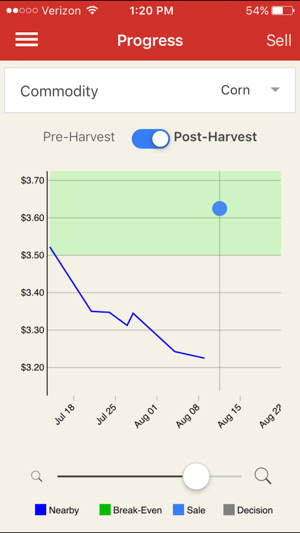
February 8 – Ag Marketing taught by: Austin Duerfeldt, ExtensionEducator& Cory Walters, Associate Professor & sponsored by Farmers Cooperative Session Description: We will discuss how to develop a written marketing plan and understanding basis and carrying charges, using location-and commodity-specific information. The session will also feature the Marketing in a New Era simulator and the Grain Marketing Plan smartphone application. All attendees will be given access to a computer to follow along.
For more information on these programs, call Lancaster County Extension at (402) 441-7180 or go to Lancaster.unl.edu/ag. Cost is $15 for the series or $5/session at the door. Online viewing is free.
Kicking off the 2018-2019 Farmers & Ranchers College programming year with a full house was Dr. David Kohl, Professor Emeritus from Virginia Tech. As usual, he did an excellent job describing global risks which affect us and how those risks will affect the agricultural industry. International trade issues continue to emerge and it will be interesting to see how they play out. One of the things to watch closely is China’s “Belt & Road Initiative” which is an ambitious effort to improve regional cooperation and connectivity on a trans-continental scale with China and approximately 65 other countries. This is important to monitor because countries impacted in this Initiative account for about 30 percent of the global GDP and 60% of the world’s population.
In regards to energy economics, the U.S. is the world’s major energy producer. As there is a continued drive towards efficiency, there is also a push for electric vehicles. In fact, Kohl said that Germany and France plan to eliminate combustible engines by the year 2040 and by 2025, one fourth of cars in China will be electric. Since 80% of ag expenses are energy related, this will be a huge impact on the agricultural industry.
Dr. Kohl also stated that the 2020’s will be a decade with lots of change, not only with emerging technologies, but consumer trends, dietary trends and use of “big data”. In the Ag Commodity Super Cycle of 2007-2012, the approximate net farm income in constant dollars was $125,000 which allowed “anyone” to make it financially. From 2013-2017, during the agricultural economic reset, it was $35,000 forcing producers to tighten family living expenses and cost of production. (Data was taken from the Center for Farm Financial Management at the University of Minnesota.) He provided critical financial performance index for debt and risk and critical questions for critical conversations that should occur with one’s lender.
With my background in leadership studies I found it interesting how more lenders are looking at the character of a client and the role that has in one’s success. Being an honest, ethical and trustworthy client is becoming more important and unfortunately there are character flaws of dishonesty being noticed such as using borrowed money for things not intended to be used for. I like the adage, “It’s not the bad times that get you in trouble; it’s the good times.” With the past super-cycle, it was really easy for one to become complacent and want more things such as that camper or trip to Disney World, etc. but it’s not likely to resurface anytime soon.
Even with all of the challenges facing agriculture, he stated several reasons to be optimistic about agriculture. A diversified agri-entrepreneur can be successful with multiple income streams. Technology allows individuals to multi-task. Those young people who leave the farm/ranch to work in business or industry or on a different operation are better positioned to be successful because of the knowledge gained with a different point of view. Approximately 21% of American farms have no next generation coming back, so young people interested in farming have a chance to get involved. The younger generation is much more apt to collaborate and work as a team allowing them to help each other. Align yourself with positive people, know your purpose, picture where you plan to go, plan with a business & marketing plan and partner with the right people; doing all of that will help one accomplish more. His advice to young farmers is to invest in productive assets and live modestly. While past generations were independent in nature, future generations will be interdependent and work with people.
Contributions and support of area businesses allow Farmers & Ranchers College program participants to attend at no cost. For more information go.unl.edu/farmersrancherscollege.
Just a reminder of the other Farmers & Ranchers College programming:
2018-2019 Program Schedule
January 14, 2019** – “Partners In Progress Beef Seminar” Cow/Calf College at U.S. MARC near Clay Center, NE from 10-3:30 p.m., Registration at 9:30 a.m.
February 12, 2019** – “Managing Ag Land in the 21st Century” with Nebraska Extension Educators, Nebraska Extension at the Fillmore Co. Fairgrounds- Geneva, NE from 9:30- 3:00 p.m., Registration at 9:15 a.m.
March 14, 2019** – “Connecting Gate to Plate” with Michele Payn with Cause Matters, Corp., one of North America’s leading experts in connecting farm and food at Lazy Horse Vineyard near Ohiowa, NE with registration at 6:00 p.m. Light meal and program to follow.
** Programs are free; however registration is appreciated for a meal count. Please call the Fillmore Co. Extension Office at (402) 759-3712 one-week prior to the program to reserve your spot.
Those of us in agriculture are no stranger to risks involved with agriculture that are taken every day, whether it is financial, production, legal, price/market or human resource risks. While we can’t control everything, there are measures that can be taken to protect one’s operation and reduce risk. Each year the Farmers & Ranchers College hosts Dr. David Kohl, Professor Emeritus from Virginia Tech who does an excellent job describing global risks which affect us locally and how those risks will affect the agricultural industry. He will also provide tips for success and explain how past generations were independent but the importance for future generations to be interdependent and work closely with people.
This year, Dr. Kohl’s program is titled Agricultural Update and the Road Ahead. The program will start at 1:00 p.m. on November 27, 2018 at the Opera House in Bruning, Nebraska. Contributions and support of area businesses allow participants to attend at no cost. To save time at the door, feel free to register online.
The Farmers and Ranchers College Committee consists of Fred Bruning of Bruning, Bryan Dohrman of Grafton, Sarah Miller of Carleton, Jennifer Engle of Fairmont, Ryne Norton of York, Jim Donovan of Geneva, Bryce Kassik of Geneva, Eric Kamler of Geneva, and Brandy VanDeWalle of Ohiowa.
January 14, 2019** – “Partners In Progress Beef Seminar” Cow/Calf College at U.S. MARC near Clay Center, NE from 10-3:30 p.m., Registration at 9:30 a.m.
February 12, 2019** – “Managing Ag Land in the 21st Century” with Nebraska Extension Educators, Nebraska Extension at the Fillmore Co. Fairgrounds- Geneva, NE from 9:30- 3:00 p.m., Registration at 9:15 a.m.
March 14, 2019** – “Connecting Gate to Plate” with Michele Payn with Cause Matters, Corp., one of North America’s leading experts in connecting farm and food at Lazy Horse Vineyard near Ohiowa, NE with registration at 6:00 p.m. Light meal and program to follow.
** Programs are free; however registration is appreciated for a meal count. Please call the Fillmore Co. Extension Office at (402) 759-3712 one-week prior to the program to reserve your spot.
Nebraska Extension’s CropWatch recently announced a series of workshops that will help landlords and tenants with common land management questions that are often asked. Both parties want to ensure they are treated fairly and keeping up with market practices. This week, I’ve decided to share upcoming workshops and dates close to the area, including one we will be having in Geneva.
Current and future landowners and tenants should make plans to attend free upcoming land management workshops sponsored by Nebraska Extension. The workshops will be held at nine sites across Nebraska this fall. “Managing Agricultural Land for the 21st Century” will cover current trends in cash rental rates, lease provisions, and crop and grazing land considerations.
Nebraska Extension Educators Allan Vyhnalek, Aaron Nygren, Erin Laborie, Ben Beckman and Jim Jansen conduct research and outreach in land management, agronomy and beef production. They will address common agricultural landlord and tenant questions such as, What does an equitable rental rate look like for my land? How do I manage a farmland lease? What should I expect for communications between the landlord and tenant? What does a soil test tell me? I hear about organic or natural production; how does that vary from what my farmer is currently doing? If corn or soybeans are not making money, should something else be raised on my land? What are key pasture leasing considerations including stocking rates? Who is responsible for cedar tree removal from grazing land?
These workshops will provide participants with up-to-date information so they can be confident about their lease arrangements. To ensure enough handouts please register at go.unl.edu/landlordtenant or call the phone number listed for each location. Lunch arrangements will be handled by each host location.
Registration at each location will start at 9:15 a.m., program starting at 9:30 a.m., and ending by 3:00 p.m.
Workshop dates and locations within our area include:
COLUMBUS: Nov. 20 at the Platte County Extension Office, 2715 13th St., 402-563-4901, attendees will be dismissed to have lunch off site
NORFOLK: Dec. 3 at the Divots Convention Center, 4200 W Norfolk Ave. 402-370-4040, lunch will be sponsored
BEATRICE: Dec. 19 at the Gage County Extension Office, 1115 W Scot St., 402-233-1384, lunch will be sponsored
HASTINGS: Dec. 20 at the Adams County Fairgrounds, 947 S Baltimore Ave, 402-461-7209, lunch will be sponsored
GENEVA: Feb. 12 at the Fillmore County Fairgrounds, Geneva, 402-759-3712, lunch sponsored by the Farmers & Ranchers College
These programs are free and open to the public with funding provided by the North Central Extension Risk Management Education Center and USDA National Institute of Food and Agriculture under award number 2015-49200-24226. For more information or assistance, please contact Allan Vyhnalek at 402-472-1771 or avyhnalek2@unl.edu, or Jim Jansen, at 402-261-7572 or jjansen4@unl.edu.
One of the great things I have the opportunity to observe in my role as a youth development educator is how youth grow and develop from year to year. Youth, just like other living things such as plants need a nourishing, supportive, and protective environment. The 4-H youth development program utilizes the “essential elements” research to ensure that a youth development program is met. This means that each young person needs to:
Know they are cared about by others: that they belong
Feel and believe they are capable and successful: that they have mastery
Know they are able to influence people and events: that they have independence
Practice helping others: that they can demonstrate generosity.
From research, it was concluded that there are eight critical elements that must be present for positive and effective experiences and opportunities benefiting youth. These eight elements are known as the eight essential elements and are summarized below:
A positive relationship with a caring adult.
A safe emotional and physical environment
An inclusive environment
Engagement in learning
Opportunity for mastery
Opportunity to see oneself as an active participant in the future
Opportunity for self-determination
Opportunity to value and practice service for others
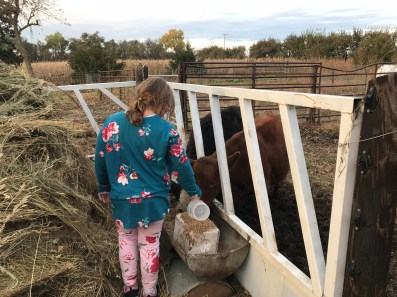
Fair may be over, but chores still need to be done. Here, my daughter McKenzie does chores after school.
The 4-H program uses recognition as one strategy to help youth become more capable and competent, thus creating an opportunity for mastery. In fact, recognition is a huge incentive to promote further learning and can inspire young people to continue participating and learning. 4-H has several ways we recognize youth. One of the most visible is during the county fair, which young receive ribbons and perhaps even trophies. This provides immediate feedback for youth based on the quality of their end product. There is so much more to the 4-H program than the county fair which youth benefit. Youth complete essentially a “record book” which documents the progression of skills and activities youth have learned from completing not only their fair projects, but participation in other 4-H activities throughout the year. Youth also have the opportunity to self-reflect on a variety of accomplishments throughout their 4-H year. The Diamond Clover program’s goal is to provide 4-H members a rich and diverse learning experience and is designed for members of all ages.
It is that time of year, that both the Clay and Fillmore County 4-H programs will be highlighting those 4-H youth who have earned various 4-H awards. If you are in Fillmore County, I encourage you to attend the Amazing Race/4-H Recognition event which will start at 2:00 p.m. on October 28th at the Fillmore County Fairgrounds. Any youth, whether in 4-H or not, will compete in teams of four or less to complete some fun and unique tasks. Following the Amazing Race activity, 4-H’ers will be recognized for their achievements around 3:00 p.m. with an ice cream social. More information can be found at fillmore.unl.edu.
If you are in Clay County, the annual 4-H Achievement Program will be held Friday, November 2, at 7:00pm at the Fairgrounds. 4-Her’s should bring a dessert to share.
For more information on how to get youth involved in America’s largest youth development organization that empowers nearly six million young people across the U.S., you can check out Nebraska 4-H’s website or contact me at brandy.vandewalle@unl.edu.
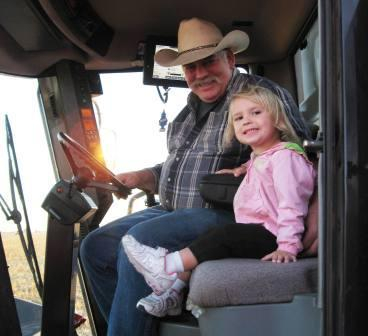
Here is my favorite farmer. Taken a few years ago, my oldest daughter enjoyed riding with “Grandpa Beek” (my Dad) in the combine. So thankful I grew up on a farm!
There are so many “days” such as “national ice cream day”, “national punctuation day”, etc. which I quite honestly don’t pay attention. Today, however I noticed that it is National Farmer’s Day and felt like that is something to spend a little bit of time recognizing. October 12th is a day for us to pay tribute to farmers throughout our great nation.
Have you thanked a farmer lately? Farmers work long and hard hours and there is no guarantee of good yields. As is the case lately, farmers are at the mercy of the weather and waiting to return to harvest due to wet conditions.
Agriculture and farmers are the backbone of our society and economy! Thank you to all of the farmers who feed and clothe us!
The Farmers & Ranchers College was formed in January 2000 with the purpose of providing high quality, dynamic, up to date educational workshops for area agricultural producers in south central Nebraska through a collaborative effort between business, industry and higher education leaders. Furthermore, the Farmers & Ranchers College will provide the tools necessary so that agricultural producers will be able to respond positively to these changes using a profitable decision making process.
The Farmers and Ranchers College is a unique opportunity to educate agricultural producers in south central Nebraska. Approximately three hundred producers participated in the 2017-18 Farmers & Ranchers College programs. Producers attending these workshops managed over 155,000 acres and managed nearly 15,000 head of beef animals. Participants surveyed indicated an average of $6.00/acre of knowledge gained from participating for a potential impact of nearly $1 million. The seventeenth annual Partners in Progress- Beef Seminar featured a variety of industry, University and agricultural organization presenters. Ninety-five percent of participants surveyed were very satisfied or satisfied with the program quality and seventy-six percent indicated that previous programming improved their knowledge of making risk management decisions.
Contributions and support of area businesses allow participants to attend at no cost, however for programs that have meals, it is requested that people RSVP at least a week in advance for an accurate meal count by calling Fillmore County Extension at (402) 759-3712.
The Farmers and Ranchers College Committee consists of Fred Bruning of Bruning, Bryan Dohrman of Grafton, Sarah Miller of Carleton, Jennifer Engle of Fairmont, Ryne Norton of York, Jim Donovan of Geneva, Bryce Kassik of Geneva, Eric Kamler of Geneva, and Brandy VanDeWalle of Ohiowa.
2018-2019 Program Schedule
November 27, 2018 – “Agricultural Update & The Road Ahead” w/ Dr. David Kohl, Professor Emeritus, Dept. of AAEC, VA TECH at the Opera House in Bruning, NE from 1-4:00 pm
January 14, 2019** – “Partners In Progress Beef Seminar” Cow/Calf College at U.S. MARC near Clay Center, NE from 10-3:30 a.m., Registration at 9:30
February 12, 2019** – “Managing Ag Land in the 21st Century” with Nebraska Extension Educators, Nebraska Extension at the Fillmore Co. Fairgrounds- Geneva, NE from 9:30- 3:00 p.m., Registration at 9:15 a.m.
March 14, 2019** – “Connecting Gate to Plate” with Michele Payn with Cause Matters, Corp., one of North America’s leading experts in connecting farm and food at Lazy Horse Vineyard near Ohiowa, NE with registration at 6:00 p.m. Light meal and program to follow.
** Programs are free; however registration is appreciated for a meal count. Please call the Fillmore Co. Extension Office at (402) 759-3712 one-week prior to the program to reserve your spot.




 Kicking off the 2018-2019 Farmers & Ranchers College programming year with a full house was Dr. David Kohl, Professor Emeritus from Virginia Tech. As usual, he did an excellent job describing global risks which affect us and how those risks will affect the agricultural industry. International trade issues continue to emerge and it will be interesting to see how they play out. One of the things to watch closely is China’s “Belt & Road Initiative” which is an ambitious effort to improve regional cooperation and connectivity on a trans-continental scale with China and approximately 65 other countries. This is important to monitor because countries impacted in this Initiative account for about 30 percent of the global GDP and 60% of the world’s population.


 The Farmers & Ranchers College was formed in January 2000 with the purpose of providing high quality, dynamic, up to date educational workshops for area agricultural producers in south central Nebraska through a collaborative effort between business, industry and higher education leaders. Furthermore, the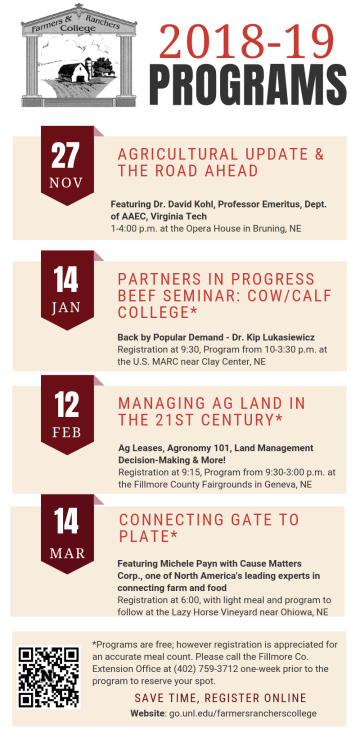
 Views from VanDeWalle