Crops

Sudden Death Syndrome

Several years ago, I was called to a field with some soybean issues and confirmed with the UNL Diagnostic Lab that it was sudden death syndrome, or SDS. SDS was first confirmed in Nebraska in 2004 and often is contained to areas within a field. Brown stem rot has been a disease of Nebraska soybean for many years.

A recent UNL CropWatch article written by Loren Giesler, Extension Plant Pathologist and Kevin Korus, Manager, Plant and Pest Diagnostic Clinic shared some information on sudden death syndrome which I have included in this week’s column. First of all, sudden death syndrome was recently confirmed in soybeans in the southeast, central, and east central districts of Nebraska. A soil-borne fungal disease, SDS produces a very resistant survival structure that is not affected by crop rotation.

Giesler and Korus shared that research at Iowa State University has shown that the SDS pathogen also survives well on corn kernels on the soil surface. This is relevant to Nebraska producers who have had SDS in their fields and this year experienced late season hail with grain loss. These kernels could serve as a site for this and other fungal pathogens to overwinter.

Foliar symptoms of SDS are similar to those of brown stem rot; however, stem damage is different. Split the stem to more closely exam symptoms. With brown stem rot the center of the stem will be discolored and typically will be brown from the soil line upward. With sudden death syndrome discoloration will be confined to the outer layers of the split stem. The center will not be discolored, but the root cortex will be light gray to brown and may extend up the stem

As with many plant diseases, the main management option is to select resistant varieties. Correct diagnosis is important so you’re aware of the pathogens in this year’s crop that may overwinter and cause problems for next year’s harvest. Fields with high SDS should not be planted early in future years and should be managed to reduce any compaction issues. Rotation will not affect SDS. Fields with brown stem rot will benefit from longer rotations. Foliar fungicides are not recommended for managing either disease.

For assistance in correctly identifying these diseases, submit a sample to the UNL Plant and Pest Diagnostic Clinic. This original article with pictures can be viewed at UNL’s CropWatch website.

Crops

Harvest Safety

It is hard to believe that harvest will soon be upon us! With harvest comes more traffic on the county roads and other stresses for farmers. It never fails, that equipment can break, there can be delays at the elevator and those extra-long hours can all add extra stress to farmers. That being said, it is important to carefully slow down and realize the many hazards you are being exposed to during harvest.

An Iowa State Extension publication, Harvest Safety Yields Big Dividends points out that injuries can occur by  taking shortcuts to perform routine tasks, not getting enough sleep or regular breaks, or failing to follow safety practices. Some injuries occur when operators are pulled into the intake area of harvesting machines, such as balers, combines, or corn pickers, and many injuries occur from slips or falls around these machines. Exposure to powerful machinery is highest during the harvest season. The equipment must be powerful to effectively handle large amounts of agricultural commodities. When equipment plugs, NEVER try to unplug it with live equipment, instead always disengage power and turn off the engine before trying to manually clear a plugged machine. Regular maintenance of these machines can also make harvest go smoother. Also, lots of accidents actually happen by the operator slipping and falling off equipment.

Harvest

In the same publication listed above, there are several tips for reducing fall hazards:

  • Always keep all platforms free of tools or other objects.
  • Frequently clean the steps and other areas where workers stand to service, mount and dismount, or operate the machine.
  • Wear well-fitting, comfortable shoes with non-slip soles.
  • Use grab bars when mounting or dismounting machinery.
  • Be sure your position is stable before you work on a machine.
  • Recognize that fatigue, stress, drugs or alcohol, and age may affect stability.

Other helpful tips during harvest are to keep kids away from machinery. Tell them the dangers that can occur and not to play near the equipment, even when it is shut off; you never know when they will be playing in hidden areas of the equipment. Operators should double check where kids are before moving the equipment. Too many accidents can occur when youth are in the path of equipment out of the operator’s view. Operators of all equipment should check in regularly and let someone know where you are. Keep all guards on equipment; it is there for a reason!

It is also important for the public to understand the increased traffic on public roads and be patient. The greatest threat raised between farm equipment and passenger vehicles is the difference in speed. Farm equipment runs at an average speed of 20 miles per hour while passenger vehicles average 60 miles per hour. If the motor vehicle overtakes a tractor, the impact is comparable to a passenger vehicle hitting a brick wall at 40 miles per hour. If the tractor and a car, mini-van or pickup collides head on, the impact is the same as hitting a brick wall at 60 miles per hour. Farmers can reduce the chances of an accident by using warning lights, reflectors and reflective tape on their machinery to keep

Some farm equipment, such as combines, can take up more than half of the road. Even so, it is up to both drivers to be aware of their own limitations and adjust accordingly. Farmers should not take up more space than is needed, but other drivers should try to provide as much room as possible. It is a good idea for passenger vehicles to turn off onto side or field roads until larger machinery has passed. Whenever possible, farmers should use an escort vehicle such as a pickup to precede or follow large machinery and equipment on public roads. More than one escort may be necessary. Ideally, the escort vehicle would have extra warning lights and a sign indicating oversized or slow equipment ahead or following.passenger vehicle operators aware of their presence on roads. Some farmers may choose to install supplemental lights to increase visibility. It also is a good idea for producers to keep off heavily traveled roads as much as possible and avoid moving equipment during the busiest part of the day.

Have a safe harvest!

Source: Harvest Safety Yields Big Dividends, Iowa State University

Crops

Soybean Stem Borer

Several years ago I received a call from a grower who had lots of soybeans that were lodged; it was confirmed their fields had the soybean stem borer, which was one of the first times it was reported in Nebraska in recent years. This year at the Soybean Management Field Day, entomologists reported that it has now moved north of the interstate and into York County as well.MussmanField 003

UNL extension entomologists, Bob Wright and Tom Hunt wrote an article last year on CropWatch providing the following information. This beetle (Dectes texanus texanus) has been moving into Nebraska from north central Kansas over the last decade.

The adult is a gray, elongate beetle about 0.5 inch long with antennae that are longer than the body. Females lay eggs from late June to August on various plants, including cocklebur, giant ragweed, sunflower, and soybean. On soybean, eggs are primarily laid in the leaf petioles. Larvae feed on the pith and tunnel down into the main stem. Each of four larval stages tunnels up and down the stem.

Initial damage is seen when larvae tunnel down the leaf petiole and enter the stem. The leaf tissue above this point wilts and dies. If you split the leaf petiole, you can see the tunneling and may still see the larva. Economic damage is caused primarily by lodging and subsequent harvest difficulties. Girdling is most severe in earlier maturing varieties, and lodging is most severe in earlier planted soybean.

Chemical treatment of larvae is ineffective because the larvae are in the stem; effective chemical control of the adults is difficult due to the extended adult emergence period. Research found that burying borer-infested stubble after harvest can reduce Dectes populations. Entomologists at Kansas State University have been studying this insect as a pest on soybeans for several years. They have not identified resistance in any commercially available soybean cultivars, and labeled planting time and foliar insecticide applications were not effective. KSU has conducted a great deal of research on this insect. Its reports and extension publications are available online.

Fields with a history of injury or with symptoms this year should be carefully watched during August and September. Fields with extensive stalk tunneling by the Dectes stem borer are at risk for lodging and harvest losses, depending on weather conditions. Those fields should be targeted for harvest first to minimize harvest losses due to stem borer injury. In the absence of lodging losses, this insect does not usually cause noticeable yield reductions.

For more information on this soybean pest, see the UNL NebGuide.  

Crops, Irrigation

Final Irrigation

The ETgage reading south of Geneva dropped 0.8 inches for the week of Aug. 9 – 16th. For corn and soybeans in our area it time to start thinking of the last irrigation. Producers with watermark sensors should be checking them to see how many inches they have to carry plants through to physiological maturity.  Corn that hasn’t approached full dent and soybeans in the R5 stage has a coefficient of 1.1. To estimate crop water use we multiply 0.8 times 1.1 for a total crop ET of 0.88 inches a week or about 0.13 inches a day.

As the crop begins to reach maturity, the crop water use slows. For example, corn at ¼ milk line requires 3.75 inches until maturity, while corn at ½ milk line only needs 2.25 inches. Soybeans at R5 (beginning seed enlargement) need 6.5 inches while soybeans at R6 (end of seed enlargement) need 3.5 inches.

Generally speaking, a silt loam soil can hold 2.2 inches per foot or 8.8 inches in the top 4 feet. The target is to have 60% available soil moisture depleted at the end of the season.  My colleague from York, Gary Zoubek provided a good example which relates to most soils in the area. His example uses a silt loam soil. If we draw down the available soil water to 60%, we would have 0.88 inch of water per foot of soil or 3.5 inches remaining in the top four feet of soil. Even though you have 3.5 inches remaining, if you draw the soil water past 60%, it can affect yields; therefore, our target is to have 60% depleted at the end of the season. This will leave room to capture 5.28 inches of water during the off season from rain or snowfall.

For more information on the last irrigation, Predicting the Last Irrigation of the Season is available online.

Horticulture, Youth

Hands to Larger Service

 “I give my head to clearer thinking, my heart to greater loyalty and my hands to larger service and my health to better living….” That is how the 4-H

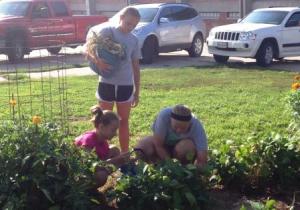
picking2websitePledge starts out and is just what Fillmore County 4-H’ers have done for three years in a row! In collaboration with the Farm Service Agency and Natural Resources Conversation Service offices in Geneva, 4-H’ers planted, cared for and harvested vegetables for those who might not otherwise have access to fresh produce.
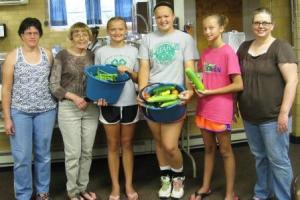
Last year, over 260 pounds of produce was harvested! This year has been a little challenging with the garden due to pests and weather, but we still have harvested approximately 75 pounds of produce with more still to come.  Since the small garden was established three years ago, it has yielded over approximately 400 pounds of produce. Several 4-H youth continued to express an interest this year, so the garden was planted with produce going to the Geneva Senior Center programs.

GardenHarvest13web

Over the summer, 4-H’ers, FSA and NRCS staff took turns caring for the garden, increasing their horticultural skills while learning responsibility, service and other important life skills. This has been a great project allowing youth to not only learn, but fulfill the purpose of 4-H by using their hands for larger service.

If you are interested in contributing or participating in the Fillmore County Community Garden in the future, please contact the Fillmore County Extension Office at 402-759-3712.

Crops, Programming

Soil & Water In-Field Day

Soil & Water In-Field Day

Last year I helped coordinate a soils field day for Nebraska ag teachers which focused on understanding how the overall health of the soil relates to the productivity of the land. This spurred a lot of interest, thus a workshop is now open to the public who want to learn how improving and maintaining soil quality is essential to the productivity of land for current and future use. University of Nebraska-Lincoln Extension‘s physical, chemical, and biological properties of soil and water clinic will provide hands-on training.

2013CMDC-soils

The Aug. 28 workshop will be conducted at the UNL’s Agricultural Research and Development Center near Mead. This training session is conveniently located a short driving distance from Omaha, Lincoln and Wahoo. The coordinator of this event, UNL Extension educator Keith Glewen says the in-field training is ideal for agribusiness professionals and those who work with soil and water management. “The training provides 7.5 total Certified Crop Advisor credits in nutrient management and soil and water management. It can be challenging to find that many credits focusing on these topics. We have a well-versed line up of speakers addressing soil and water topics which, of course, are the cornerstones of our food production system.”

Registration begins at 7:30 a.m. The training begins at 8 a.m. Pre-registration required. All registrants will be sent a confirmation letter, receipt and finalized schedule. Space is limited and registration is not guaranteed unless payment is received. Cancellations received one week before the clinic will receive a full refund.

In the event of program cancellation by UNL, pre-registered participants will be contacted and will receive a full refund. UNL is not responsible for any expenses incurred by registrants.

Registration before Aug. 21 is $160; $210 after. Fees include training, lunch and reference materials.

For more information or to register, contact the ARDC CMDC Programs, 1071 County Road G, Ithaca, NE 68033, call (800) 529-8030, fax (402) 624-8010, e-mail cdunbar2@unl.edu or visit the Web.

Topics include:  Physical, Chemical and Biological Properties of Soil and Water: The Cornerstone of the Human Race; Cover Crops for Improving the Soil; Infiltration Test and Organic Matter; Soil Temp., Electrical Conductivity, pH, N and P tests; Irrigation and Soil Water; Using Solvita Respiration Tests and N Flush; Soil Profile and Positioning of Landscape; and Management Considerations to Improve the Physical, Chemical and Biological Properties of Soil.

Certified Crop Adviser credits of 7.5 (2 in nutrient management and 5.5 water management) have been applied for and are pending approval for this clinic.

 Source: IANR News- July 30, 2013 (Glewen & Karstens)

Programming

After the Fair….

As I write this, the 2013 Fillmore County Fair is in the books! I would like to thank all of the volunteers for making it a success, especially the Fair Board members, 4-H Council, superintendents and extension staff, Linda and Megan. Without the hard work of these people, the fair wouldn’t come together, as it takes a lot of teamwork!  Every year, I enjoy seeing how much youth have grown from year to year and the pride they have in their projects. We were blessed to have decent temperatures this year as well. The county fair is one of the most visible, if not the most visible part of a County Extension Office’s job, but our work is not done. First of all, there is all of the paperwork, etc. for getting things wrapped up and then its “back to the real” world of Extension. People often ask, what do you do now? So this week I’ve decided to share a little bit about some of the programming that resumes after fair.

Within my programming there is the irrigated crops component which involves helping producers with some of the irrigation management equipment they use – the watermark sensors and ET gage. In addition, the past 2-3 years, my role in youth crops education has taken off statewide. Some of those key programs I work with are the statewide conferences – Excellence in Ag Sciences Day which I coordinated and facilitated for Nebraska agricultural education instructors. This past year, I successfully received a $75,000 grant from the Nebraska Environmental Trust which has allowed me to expand the Nebraska Agricultural Water Management Network into the hands of teachers who in turn will teach their students about irrigation management. I continue to work with those teachers as questions, etc. arises as well as creating more online resources and curricula.

Last year, I launched the Nebraska Innovative Youth Corn Challenge which again is being funded by the Nebraska Corn Board. With eight teams participating, youth are implementing their research or demonstration to find economic, environmentally friendly ways to improve corn yields. In addition to this, I coordinate the cropwatch.unl.edu/youth website; more information for teachers, club leaders and youth is posted as it becomes available. The past three years I have worked with and continue to work with the Nebraska Agricultural Education Soils Project and continue to update that website and assist in coordinating curricula development on soils education for Nebraska ag teachers and others needing soils education content.

The Nebraska On-Farm Research Network is a statewide program I also participate in and am working on an app which would complement this program. I work with agricultural producers in other areas as the need arises and also help clients find research-based answers to various questions they might have. During the winter months, I coordinate the Farmers & Ranchers College which is a popular regional program that reaches on average 400 people every year on risk management education. During late summer/early fall, programming plans are underway. In the winter months, I also teach pesticide safety education programs to producers who need to recertify their private pesticide applicator’s license.

Other youth programming in the areas of agricultural literacy are conducted which include, but are not limited to are Progressive Agriculture Safety Day, Ag Venture Day in collaboration with South Central Cattlewomen, local workshops, Water/Earth jamborees, etc.  The Nebraska State Fair and Aksarben are other livestock-related events I assist, but there is more to the 4-H program than showing livestock. Youth who take advantage of the numerous opportunities are actively involved in the program year-round.

There are other components I’m leaving out, but just wanted to give you an idea of some of the key programming that occurs throughout the year; of course this is just programming that I do and doesn’t even get into the programming that occurs from my other colleagues in areas of foods/nutrition, water/climate/environment, livestock, community development, other crops programming, and 4-H youth development. For more information about programs UNL Extension offers, go to extension.unl.edu, locally fillmore.unl.edu, or visit our Extension Facebook pages or for youth programming. You can also follow me on twitter.

Livestock, Youth

Sportsmanship starts with Adults!

Webster’s Third International Dictionary defines sportsmanship as “conduct becoming to an individual involving fair and honest competition, courteous relations and graceful acceptance of results”.  Sportsmanship starts with parents teaching their youth how to accept a win or a loss, although in the 4-H youth development program, even if the youth receives a red ribbon, nothing is lost as long as some basic knowledge and skills were gained. Too often in our society we focus on the tangible results of a ribbon or trophy and don’t think about the process that youth went through to achieve the end results and what was learned from that process.

I often use the example that as a youth, I’ll never forget receiving a red ribbon for a market heifer; I was frustrated, but will never forget my dad asking me, what the judge said in the comments.  After we talked it over, I realized his reasoning and was able to understand the type of animal I should select for the following year. That was a lesson I’ll never forget.  My dad and mom also told my sister and me that if we wanted a trophy that badly, instead of spending a large amount of money on an animal just to win or using unethical practices, they’d go out and buy us our own trophy.  For these reasons, it is really rewarding to work with youth who are happy with any ribbon placing.

Three reasons adults and teen leaders should be concerned with developing sportsmanship are:

1. Youth programs are easier to conduct and are more positive experiences for everyone involved if good sportsmanship is demonstrated.

2. The development of sportsmanship is an important part of youth development. Youth and adults who develop and show good sportsmanship get along better, and are much more successful on a long-term basis in becoming self-directing, productive, contributing, competent, caring, capable adults, than are those whose behavior is un-sportsmanship-like.

3. Sportsmanship is one of the key elements of civilized society. Those who think of the “big picture” know the reasons for developing sportsmanship extend beyond an individual, a community, or a program. When societies allow sportsmanship to decline, their civilizations also decline.

As we get ready for another Fillmore County Fair, let’s be reminded that the end result is not the ribbon placing, but the skills that each youth learned!

Source: Kathryn J. Cox, Ohio Extension 4-H Specialist, Youth Development, Developing Sportsmanship- A Resource For Preparing Youth And Their Families For Participation in Competitive Programs and Events, 2006

Crops

Alfalfa Weevil Adults on Regrowth

Bruce Anderson, UNL Extension Forage Specialist reminds producers that with late first cuttings of alfalfa, alfalfa weevil activity often increases when this occurs.  Anderson says that weevil larvae generally eat small holes in leaves at the growing tip of alfalfa plants.  As larvae grow, damage increases as the holes become larger.  Severely damaged fields have a grayish appearance because of the drying of skeletonized upper leaves and buds.

Most fields have not had enough damage to need spraying before first cutting.  After harvest, many larvae die when exposed to direct sunlight and high temperatures at the soil surface.  But will enough larvae survive to be a problem for regrowth?

Maybe more likely is survival of weevil adults.  These critters can be really hard on alfalfa regrowth by feeding on the developing crown buds, retarding growth and preventing fields from greening up after harvest.

Your first step in controlling weevil adults is removal of windrows and bales as soon as possible to expose these insects.  Then examine stubble frequently to see if adults are delaying greenup by feeding on new buds, especially where the windrow laid.

If damage is noticed, a threshold guideline has been developed that uses insecticide cost, hay value, and harvest management to help you determine when spraying may be desirable.  This guide, along with other tips to manage alfalfa weevil, is available from local extension offices.

Don’t let alfalfa weevil adults delay second growth of your alfalfa.  Keep a watchful eye on the stubble and spray, but only if necessary. Download our UNL Extension NebGuide for more information.

Crops, Irrigation

Crop ET Weekly Report

Hopefully producers won’t have to irrigate as much this year as they did in 2012, but I’d like you to consider joining a program that can not only improve your irrigation efficiency, but reduce nutrient loss and save you money!  I’ve been in Extension for nearly eight years and a program I’ve been involved with that has been a very rewarding program and made a positive impact for many is the Nebraska Agricultural Water Management Network, or NAWMNWatermark Sensors. My colleague, Gary Zoubek tracks the evaluation results and shared that in 2005 only a few producers in the Upper Big Blue NRD, (shortly followed by the Little Blue NRD) were participating, but this program has now grown to over 800 producers across the state and I’m sure we’ll add another 100 or 200 more this season!

A couple of the tools we use are ETgages® or Atmometers which mimic crop evapotranspiration or ET and Watermark soil matrix sensors which measure soil matric potential or the energy required to remove water from the soil. These two tools have really worked well and have made irrigation management much easier than those gut feelings.  The more information you have the better decisions you can make!

If you would like to participate in this dynamic program, let me know and I’d be happy to help and get you started! If you are in the NAWMN, consider installing your ETgage soon and once done with planting, start the soaking/drying cycle on your Watermark sensors to be sure they work! It’s also important to replace the #54 alfalfa canvas covers and wafers on a regular basis at the start of each season.

As I have done the past couple of years, I plan to report the weekly ET in my weekly columns. The ETgage I check is in the center of the county, just south of Geneva; hopefully it will help others become aware or have an idea what the local ET is.

The ETgage I check outside of Geneva changed 1.4 inches for the week of May 31-June 7th. Corn in the V-4 stage has a coefficient of .18”. To calculate how much water, corn at V-4 stage used you simply multiply .18” x 1.4” for a weekly use of .25” or .04 inches/day. Corn approaching V-6 would have used .49”/week or .07” per day.

Producers with Watermark sensors, which monitor the amount of water available in the soil profile should get them installed soon. Watermark sensors are installed early in the growing season at 1’, 2’, 3’ and in some case 4’ depths!

For more information about ETgages and Watermark sensors, check out the NAWMN website.