Programming, Youth

Tractor Safety Courses Offered

University of Nebraska-Lincoln Extension Tractor Safety/Hazardous Occupations Courses will be offered at seven locations in Nebraska during May and June.  Any 14 or 15-year-old teen who plans to work on a farm other than their parents’ should plan to attend.  Federal law prohibits youth under 16 years of age from working on a farm for anyone other than their parents.   Certification through the course grants an exemption to the law allowing 14- and 15-year-olds to drive a tractor and to do field work with mechanized equipment.

Harvest

The most common cause of death in agriculture accidents in Nebraska is overturn from tractors and all-terrain-vehicles (ATVs), said Sharry Nielsen, UNL Extension Educator. Tractor and ATV overturn prevention are featured in the class work.  “Instilling an attitude of ‘safety first’ is a primary goal of the course,” Nielsen said. “Where youth have the chance to learn respect for agricultural jobs and the tools involved.”

Classes consist of two days of instruction plus homework assignments. Classes closest to us are from 8 a.m. – 5 p.m. each day. Dates and locations include:

— May 23-24, Fairgrounds, Kearney
— June 10-11, Fairgrounds, Osceola
— June 17-18, College Park, Grand Island

Pre-registration is strongly encouraged at least one week before a location’s start date to the Extension Office at the course site. Cost is $60, which includes educational materials, testing, supplies, lunches and breaks. For more information, contact the Extension Office or Sharry Nielsen at (308) 832-0645, snielsen1@unl.edu.

The first day of class will consist of intensive classroom instruction with hands-on demonstrations, concluding with a written test that must be completed satisfactorily before students may continue driving tests the next day. Classroom instruction will cover the required elements of the National Safe Tractor and Machinery Operation Program. Homework will be assigned to turn in the next day.

The second day will include testing, driving and operating machinery. Students must demonstrate competence in hitching equipment and driving a tractor and trailer through a standardized course as well as hitching PTO and hydraulic systems.

Crops, Youth

Youth Discover Crop Science

Are you interested in science, agriculture, plants, crops, insects, or diseases? If so, join our team of detectives to solve crop-related problems in the Crop Science Investigation (CSI) Big Red Camp! Become a detective while participating in hands-on sessions to learn about and increase your knowledge of crops, science, and agricultural careers. Youth detectives will interact with agronomic professionals across Nebraska to solve experiments in: nutrient management; managing disease, insect and weed problems; water management; crop production, and much more! Do you have what it takes to become a CSI detective?

Logo

There are a variety of careers related to plant sciences such as: Agricultural Communicator; Agronomist; Crop Consultant; Crop Insurance Adjuster; Educator; Co-op Manager; Farmer or Rancher; Farm Credit Banker; Field or Lab Researcher; Plant Breeder; Soil or Water Conservationist; Seed, Fertilizer, or Chemical Sales; or Technical Representative.

Scholarships are available in the amount of $300 to participants who enroll in the Crop Science focus area and submit the following:

  • A short (< 300 words) essay that highlights past crop or plant science related experience and/or interest in pursuing a degree in agronomy or plant-science related areas.
  • A brief essay (< 100 words) on the topic, “What do I hope to learn in the Crop Science Investigation camp?” application can be found at bigredcamps.unl.edu.

To apply for a scholarship, complete the 2013 Big Red Summer Academic Camp Scholarship Application and submit it along with your completed registration materials and a check for the full registration fee, postmarked by April 1, 2013. Winners will be notified by April 19 and will receive a refund when they arrive at camp this summer. Scholarships are for camp registration fees only and do not cover the cost of transportation or other expenses.

Last year, seven youth participated in the camp and one participant said, “It (the camp) let me see all of what an agronomy career is made up of.” All youth said they would recommend this camp to their friends. As I write this, there are several spots already taken, so be sure and get your registration form in soon to ensure a spot at this year’s camp.

To register or download a camp brochure, visit the Big Red Camps site. If you have questions about the camp or the required essays, please feel free to contact Brandy VanDeWalle at brandy.vandewalle@unl.edu or 402-759-3712.

Youth

Innovative Youth Corn Challenge

Today’s agricultural world faces several challenges, one of them being the decline of our most valuable resource, the future workforce. Keeping youth in rural communities and involved in production agriculture is important to the agricultural industry. With the global population expected to reach 9 billion by 2050, there is and will be the need for more young people to engage in agricultural careers to feed the world.

CornYieldChallenge

The University of Nebraska-Lincoln Extension and the Nebraska Corn Board have teamed up to offer the second Innovative Youth Corn Challenge contest. This contest, open to 4-H members (age 10 & older as of Jan. 1st) or FFA members (in-school members), will guide youth through all aspects of corn production, as well as agricultural careers related to corn production.  As a team, youth will be challenged to implement a production practice different than normal to determine if they increased their yield. Economics and sustainability of the practice will also be considered. Yields, cropping history, and production information will be collected in the Corn Yield Challenge management sum

Goals of the contest are:achieve new, innovative, and economically feasible crop production methods to improve yields; provide research data for producers to implement in their operations; distribute data to corn producers, researchers, and agri-businesses for decision making purposes; introduce youth to a variety of agronomic professionals, including corn producers. mary.

As a team, youth will work with an adult mentor throughout the process. Mentors can be extension faculty, ag teachers, or other qualified agronomy professionals.  Cash prizes and plaques will be given to the first, second, and third place teams. First place will receive $1,000, second place will receive $500, and third place will receive $250.  A data completion and innovation award will also be given. Faced with a persistent drought, an addition this year will be a “limited resource” award which will be based on participants achieving a higher yield with limited inputs. This could be limited water, management practices, fertilizer, other inputs, etc.

To participate, youth must complete and return an entry form by March 1st to the Fillmore County Extension Office in Geneva, NE. For more information, contact me at brandy.vandewalle@unl.edu.

Crops, Youth

Innovative Youth Corn Challenge Banquet

Today’s agricultural world faces several challenges, one of them being the decline of our most valuable resource, the future workforce. Rural communities, including agricultural producers, can benefit from expanding youth into leadership opportunities, therefore mentoring youth leaders.   With this in mind, the Innovative Youth Corn Challenge was born which involves 4-H or FFA members, challenging them to produce the most economical, highest yielding corn. The team with the highest percent yield increase over their local county average is eligible for cash awards to further their 4-H or FFA plant science or leadership based programs. Both irrigated and dryland fields are eligible and will be scored accordingly. In addition awards are given to the team who has completed excellent production and economic records and an innovation award.

The Innovative Corn Challenge is designed to encourage youth to pursue an agricultural career and return to rural Nebraska. This program is implemented through UNL Extension with financial assistance from the Nebraska Corn Board. Extension faculty, agriculture education instructors and crop consultants may serve as harvest supervisors and assist with data collection.

 In 2012, the pilot year, ten teams signed up with six completing the project proposal and five completing the program.  Each team received $50 for their efforts and a copy of the Hybrid Maize CD, which is a computer program that simulates the growth of a corn crop under non-limiting or water-limited (rainfed or irrigated) conditions based on daily weather data.

The participants and their sponsors are listed below:
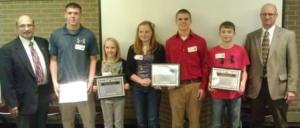
Banquet12WebPic

Super Strong H’s from Osceola consisted of Rob Buhl and Bennett Nelson with Tim Pallas as their supervisor. This team focused on planting populations in dryland conditions with populations at 26K and 30K. Yields of 49.05 bushels/acre with 30K and 52.65 bushels with the 26K respectively. This team did well on explaining the importance of increased yield to feed our growing population and also explained the important role of drought tolerant hybrid technology.

Humphrey FFA members, Spencer Beller and Lynn Slama tested strip till with a starter and nitrogen in the furrow vs. a perplant application of starter and nitrogen 15” from the row. They exceled with crop scouting records and their rainfall report. Their challenge plot yield was 217.5 bushels. Their project sponsor was Robyn Graham, FFA Advisor.

The Wranglers 4-H Club from Platte County tested the use of a foliar fungicide to early-stage corn (V5) to help corn reach its yield potential by protecting the corn plant from early-season diseases. Their challenge plot using Headline was 250 bushels and without was 254.8 bushels. Detailed crop scouting reports were completed with production information and a very complete budget. Their sponsor was Alex Labenz.

Austin Tatro and Trevor Birky, members of the Strang 4-Bar-H club in Fillmore County tested planting populations. On irrigated

ground they tested 34K and 30K per acre compared to a check plot of 32K seeds per acre. Their economic analysis was complete and showed the difference in costs between treatments. Planting population at 30K yielded 223 bushels, while 34K yielded 216 bushels and their check was 226 bushels/acre. Project sponsor was Brandy VanDeWalle.

The Pioneers 4-H Club from Madison County consisted of Kaylyn Kucera, Sidney Kucera, and Andy Zessin. They tested a higher population (30 vs. 38K), increased nitrogen rate (200 vs. 250# N) and a biological growth enhancer. Their challenge plot yielded 249.1 bushels while their check yielded 237.5 bushels. In addition to great production records, they documented visual differences in their report. Regan Kucera was their sponsor.

AWARDS

The data completion award was awarded to the team who demonstrated excellent record-keeping. The 2012 Data completion award went to the Strang 4-Bar-H club from Fillmore County with Austin Tatro and Trevor Birky. They received $200 for their efforts.

The Innovation Award was given to the team with the most innovative challenge plot and thorough explanation why it was innovative. This team also received $200 and went to the Super Strong H’s 4-H Club of Polk County with Rob Buhl and Bennett Nelson.

The teams with the highest percent yield increase over their local county average were the winners of the 1st, 2nd and 3rd place awards. The winning teams also completed their harvest report form and were presented to:

1st Place Corn Challenge Team receiving $1,000 was the Wrangler’s 4-H Club from Platte County with Elizabeth Blaser & Reid Fullner.
2nd Place Corn Challenge and receiving $500 was the Pioneers 4-H Club of Madison County with Sidney Kucera, Kaylyn Kucera, and Andy Zessin3rd Place Corn Challenge with $250 was Humphrey FFA with Spencer Beller & Lynn Slama

Project coordinators were Brandy VanDeWalle and Aaron Nygren, UNL Extension Educators. The 2nd Annual Innovative Youth Corn Challenge is planned for 2013 with the addition of another award. The limited resources award will be given to the team that achieved the highest yield per inch of water. Entry forms to participate in this program  are due March 1st. For more information, contact Brandy VanDeWalle at brandy.vandewalle@unl.edu or (402)759-3712.
Youth

Celebrate National 4-H Week October 7-13

October 7-13 is National 4-H Week, and Fillmore County is celebrating the 4-H youth who have made an impact on the community, and are stepping up to the challenges of a complex and changing world.  4-H youth are a living breathing, culture-changing revolution for doing the right thing, breaking through obstacles and pushing our country forward by making a measurable difference right where they live.

During 4-H Week  in Fillmore County youth will be participating in fun events:

Monday through Friday of 4-H Week, youth who guess the correct number of candy in a jar will win up to $25 gift certificate to purchase anything of their choosing in our 4-H Source Catalog!

Tuesday youth are encouraged to wear their 4-H shirts to school and eligible for a prize.

-Hundreds of thousands of youth from all around the nation will complete an innovative experiment on 4-H National Youth Science Day, which will be held on Wednesday, Oct. 10, 2012. The 2012 National Science Experiment, 4-H Eco-Bot Challenge, explores how robots can be used to preserve and protect the environment, while offering a glimpse into the future of science, technology, engineering and math. Locally, youth can participate in National Youth Science Day at the Extension Office from 4-6:00 p.m. Please register by Oct. 8th.

Thursday, past and current 4-Her’s are encouraged to share how 4-H has made an impact in their life on the Fillmore County 4-H FaceBook page. Person’s story with the most likes, is eligible for a prize as well.

Friday, spread the word about 4-H to your friends at Friday night football games or around town by handing out green and white mints to others, etc.

Learn how you can Join the Revolution of Responsibility, or contact your local Extension office. In Fillmore County, you can call (402) 759-3712 or email me at brandy.vandewalle@unl.edu

Youth

County Fair Reflection

As I reflect from last week’s county fair I was reminded about the great volunteers we have that make the 4-H youth development program a success! There are many details and behind the scene tasks that must be completed to make a fair run smoothly and it is incredible how effective teamwork accomplishes them. It takes many people to make a fair work, before the fair and the “clean-up” details after the fair, including members of the Ag Society (Fair Board), 4-H Council, Extension staff, superintendents and other volunteers.  It is always great to see people with diverse backgrounds and talents come together to make the each event a success!  Whenever a task needed to be done or I needed some help, volunteers stepped up to the plate and assisted.

A team or group of people that is able to communicate effectively as a team can achieve better results than individuals working alone. The amount of teamwork witnessed last week proved that “two heads are better than one”!  When all of the 4-H leaders, members, parents, etc. come together and build a sense of commitment, trust and support for one another, it allows them to develop and accomplish the desired results – a fun and educational experience for all involved.  As I stated in my weekly column after my first Fillmore County fair in 2006, “It doesn’t matter what ribbon placing you receive, but the learning experience and enjoyable time you had with your 4-H projects.”

Various committees and groups came together with a well-defined purpose and vision of the 4-H program and carry out their duties and responsibilities. Other characteristics that make teams successful are:

  • Having a positive attitude towards change and are willing to accept and allow necessary change to occur to accomplish desired results
  • Understanding patience that is required to achieve not only the anticipated results for the present, but understanding how decisions will affect the future.
  • Having teams which all members feel a sense of duty and obligation and everyone is able to commit time and resources in accomplishing these tasks.

Finally, it is important that a well functioning team support each other. Team leaders and members that make a conscious, sustained effort to make these characteristics a part of their mind set will find that both creativity and accomplishment of desired results will be much higher than it would be otherwise.

In conclusion, I would like to thank all of the 4-H members, leaders, parents, community members, and anyone else that helped contribute to the success of the 2012 Fillmore County Fair!  It takes a dedicated and hard-working group of people to make things run smoothly.  Again, thanks for the support of the 4-H and FFA programs, and most of all for remembering that “character counts” and those valuable skills (trustworthiness, respect, responsibility, fairness, caring and citizenship) which are learned at an early age will pay off with all of life’s endeavors.

SOURCE: UNL Extension publication: Team Building: Developing a Productive Team written by Arnold Bateman. 

Crops, Youth

Shorter than Normal Corn?

Crop ET Weekly Report
The ETgage I outside of Geneva changed 2.0 inches for the week of June 29 – July 6th. Corn in the reproductive stages has a coefficient of 1.1 inches so corn in the area used 2.2 inches or .31 inches per day.

Have you noticed shorter than normal corn?

One thing many have either noticed or heard is how unique this growing season is from most others. From various crop professionals to horticulturists, this year has definitely been different from other years I’ve experienced since in Extension with plants progressed earlier than normal. It has also been a drier than in recent years. With that in mind, I’ve had several questions which were recently addressed on UNL Extension’s CropWatch website which I’m summarizing below.

In many areas of the state we’re seeing shorter than normal corn this year, leading to the question, “Why this year?” To explain this, Keith Glewen, UNL Extension consulted with two top corn physiology experts — Bob Nielsen, extension corn specialist at Purdue University, and Tom Hoegemeyer, professor of practice in the UNL Department of Agronomy and Horticulture. His CropWatch article depicts the following information.

Nielsen and Hoegemeyer explain that a variety of interacting factors can lead to shorter than normal corn. First, let’s look at this corn crop to date. We planted most of the crop much earlier than normal, which led to corn plants developing during a period when in most years, the seed would still be in the bag. After planting, we experienced warm daytime growing conditions and cool, almost cold nighttime temperatures.

The mature corn plant height depends on three factors: amount of solar radiation on the top leaves during growth, water, and temperature. We usually don’t have issues with solar radiation limitations in the western Corn Belt; this year water was more of a factor. Much of the young corn plant’s development was in drier than normal growing conditions. There was adequate moisture for growth but nothing like we have experienced in recent years.

Water availability and temperature impact growth rate. Cell division is affected much less than cell expansion, and slower growth rates lead to slower root development, further limiting water uptake and nutrients. Slower cell expansion leads to shorter internodes and smaller leaves, and this leads to less water uptake and light interception, CO2 uptake, further impacting growth. Because of these changes, we have less internode elongation and thus early planted corn tends to be shorter than later planted corn.

Will conditions leading to shorter corn impact yield? Not necessarily. More important to the final yield of this year’s crop is the heat and moisture stress that the crop is now experiencing as it moves into pollination.  With the high heat we experienced this week, it will be a concern.

Fillmore County Fair

Fillmore County 4-Her’s will be showcasing their projects July 14-19th at the Fillmore County Fair.  As we prepare for this event, it is important to emphasize that 4-H youth are more important than 4-H projects, learning how to do a project is more important than the project itself, competition is a natural human trait and should be recognized as such in 4-H work; it should be given no more emphasis than other 4-H fundamentals. And one of my favorite points is that, “a blue ribbon 4-H’er with a red ribbon entry is more desirable than a red ribbon 4-H’er with a blue ribbon entry.”

Come and support 4-H’ers with fair activities as listed below:

Saturday, July 14 

9 a.m. Horse Show

Sunday, July 15
4:30 p.m. 4-H/FFA Youth Livestock Judging Contest

Monday, July 16

Check out the 4-H/FFA Static Exhibits, Ag Hall

8:00 a.m. Sheep Show, Goats following

3:00 p.m. Rabbit & Poultry Show

Tuesday, July 17

6:30-8:30 a.m. 4-H Breakfast, Ag Hall

8:00 a.m. Swine Show

6:30 p.m. Cake Auction

7:00 p.m. 4-H Awards Night

Wednesday, July 18

Prior to Beef Show Feeder calves, check-in

8:00 a.m. Beef Show

Thursday, July 19

8:00 – 10:30 a.m. Round Robin Showmanship  

Noon 4-H Picnic, Ag Hall

1:30 p.m. Livestock Sale

Crops, Irrigation, Youth

Tree Health & Other Updates

Crop ET Weekly Report

The ETgage I check outside of Geneva changed 1.7 inches for the week of June 16-22nd.   Corn at V-10 would have used 1.23”/week or .18” per day and corn at V-12 used 1.5”/week or .21 inches/day. We were fortunate to receive .80” of rainfall. There have been some producers who use watermark sensors concerned they aren’t working or getting a good enough seal. If that is the case, get another one to place next to the one in question, but remember for most pivot systems in our county, waiting until the sensors average 90-100 for readings is the trigger point.  

 Tree Health

In Nebraska, trees can have a tough time staying healthy. Drought, storm damage, insects and diseases often damage and shorten the life of valuable shade trees. Along with natural stressors, there is man-made damage that can be avoided. Most common is lawn mower and weed trimmer damage to tree trunks. Trees add so much economic and environmental value to our landscapes that care should be taken to prevent trunk damage. It’s easy to do. Just don’t hit trees when mowing the lawn. To prevent this, and improve tree health, remove sod from around a tree trunk and replace it with organic mulch. This will eliminate the need to trim grass around tree trunks. If this is not desirable in a landscape, then hand trim the grass around trees instead of mowing close to the trunk or using a weed trimmer.  Reducing this man-made stress will greatly improve the vigor and life span of valuable trees vigor.

(Source: Kelly Feehan, UNL Extension , 2012)

 Fillmore County 4-H Pre-Fair Events

The Fillmore County Fair is quickly approaching. While county fair is the most visible part of the 4-H program, don’t forget that some 4-H’ers have been hard at work participating in multiple workshops, other contests and practicing community service and leadership projects.

Come and support 4-H’ers with some pre-fair activities  as listed below:
July 10th – Fillmore Co. 4-H Clothing Day, 8:30 a.m. – Ag Hall
July11th – Fillmore Co. 4-H Small Animal Pet Show, 9 a.m. – Ag Hall
July 11th – 4-H Dog Skillathon, following pet show – Ag Hall
July 11th – Horticulture Contest, 1 p.m. – Ag Hall
July 12th – Public Style Review & Talent Show, 7 p.m. – Rialto Theater, Geneva
July 11th – Fair Clean-Up Day, 9 a.m. – Fillmore Co. Fairgrounds
July 14-19th –Fillmore County Fair!

Programming, Youth

UNL Extension Tractor Safety Courses

 University of Nebraska-Lincoln Extension Tractor Safety/Hazardous Occupations Courses will be offered at seven locations in Nebraska during May and June.

Federal law prohibits youth under 16 years of age from working on a farm other than their parents’. Certification through the course grants an exemption to the law allowing 14- and 15-year-olds to drive a tractor and to do field work with mechanized equipment. The most common cause of death in agriculture accidents in Nebraska is overturn from tractors and all-terrain-vehicles (ATV), said Sharry Nielsen, UNL Extension Educator and course instructor, and are topics covered in-depth in the class work.

Classes consist of two days of instruction plus homework assignments. Classes are from 8 a.m.- 5 p.m. each day. Dates and locations closest to our area include:

— May 24-25, Fairgrounds, Kearney 
— June 14-15, Fairgrounds, Beatrice
— June 18-19, College Park, Grand Island

Pre-registration is strongly encouraged at least one week before a location’s start date to site coordinator’s Extension office. Cost is $60, which includes educational materials, testing, supplies, lunches and breaks. For more information, contact the Extension Office or Sharry Nielsen at (308) 832-0645, snielsen1@unl.edu.

The first day of class will consist of intensive classroom instruction with hands-on demonstrations, concluding with a written test that must be completed satisfactorily before the student may continue driving tests the next day. Classroom instruction will cover the required elements of the National Safe Tractor and Machinery Operation Program. Homework will be assigned to turn in the next day.

The second day will consist of testing, driving and operating machinery. Students must demonstrate competence in hitching equipment and driving a tractor and trailer through a standardized course as well as hitching PTO and hydraulic systems.

Programming, Youth

Progressive Agriculture Safety Day

Each year, many children are killed or injured on America’s farms and ranches. This summer, safety days such as the one being conducted on May 30, 2012 in Geneva, are being held in many locations across the United States and Canada.  These events teach rural children how to prevent injuries and reduce the risk of farm incidents. During safety days, children participate in interactive activities that reinforce the importance of taking responsibility for their own safety, respecting parents’ safety rules and sharing safety tips with their friends and family. 

Any youth who will be completing 3rd through 6th grade is invited to attend Progressive Agriculture Safety Day on Wednesday, May 30, 2012 at the Fillmore County Fairgrounds. This event is hosted by UNL Extension in Fillmore County, Shickley and Fillmore Central FFA chapters, 4-H and W.I.F.E.

Specifically at this year’s event, youth will participate in a variety of events designed to help them be aware of safety in potentially hazardous situations such as being on a farm or living in rural communities, severe weather, bike riding, etc. Youth will also enjoy sessions such as pedestrian bingo, seatbelt safety, assemble first aid kits to take home, learn more about where their food comes from and even receive a FREE bicycle helmet!  This year’s premier event will feature a mock accident conducted by local emergency responders.

Local agribusiness professionals, merchants, and community members donate their time and resources to ensure this event is a day of fun as well as a valuable learning experience. April 23rd is the deadline for early bird registration which is only $3.00 and includes lunch, snacks, a t-shirt and “goodie bag” with lots of fun materials. Youth are still able to register after April 23rd for a $5 registration fee. Registration forms can be found on the Fillmore County Extension website   For more information or to register, call 402-759-3712 or email bvandewalle2@unl.edu.