Programming

Leadership Education/Action Development

Several years ago I met twenty-nine talented individuals with a passion of agriculture through the Nebraska LEAD program. To date, I remain friends with many of them and the networking opportunities have been tremendous. The in-state seminars challenged me to think outside of the box and remain an advocate for agriculture. I could go on and on about the excellent opportunities the LEAD program has provided, but I challenge you to experience it yourself! The Nebraska LEAD program is accepting applications for LEAD Group 33.

My LEAD group XXVII went to China, South Korea and Hong Kong for our International Study Travel Seminar.

Terry Hejny, director of the Nebraska LEAD program announced that “Up to 30 motivated men and women with demonstrated leadership potential will be selected from five geographic districts across our state. Fellowship applications for Nebraska LEAD (Leadership Education/Action Development) Group 33 are available for men and women involved in production agriculture or agribusiness.

In addition to monthly three-day seminars throughout Nebraska from mid-September through early April each year, Nebraska LEAD Fellows also participate in a 10-day National Study/Travel Seminar and a two week International Study/Travel Seminar.

Seminar themes include leadership assessment and potential, natural resources and energy, agricultural policy, leadership through communication, our political process, global perspectives, nuclear energy, social issues, understanding and developing leadership skills, agribusiness and marketing, advances in health care and the resources and people of Nebraska’s Panhandle, Hejny said.

The Nebraska LEAD Program is designed to prepare the spokespersons, problem-solvers and decision makers for Nebraska and its agricultural industry.

In its 32nd year, the program is operated by the Nebraska Agricultural Leadership Council, a nonprofit organization, in collaboration with the University of Nebraska’s Institute of Agriculture and Natural Resources and in cooperation with Nebraska colleges and universities, business and industry, and individuals throughout the state.

Applications are due no later than June 15 and are available via e-mail from the Nebraska LEAD Program. Please contact Shana at sgerdes2@unl.edu.  You can also request an application by writing Room 318 Biochemistry Hall, University of Nebraska-Lincoln, 68583-0763 or by calling 402-472-6810. You can visit the LEAD website for information about the selection process.

Nebraska LEAD Program offices are in the Institute of Agriculture and Natural Resources at the University of Nebraska-Lincoln.

 Source: Terry Hejny, Ph.D., director, Nebraska LEAD Program

Crops

Cash Rental Rates

Each year in March, the UNL Extension Land Value and Cash Rental Rate publication is printed. Many people use this publication which is helpful in getting rental rate discussions started, but should be used as such – a guideline and place to start. I caution all clients who want a magic number that for some, the number reported for our district might be high and for others might be low.  Ultimately it is best for both parties to discuss their own situation.

That being said, in a recent report by Bruce Johnson, UNL ag economist who publishes the survey, he reported the following for a brief summary.  Despite an extreme drought and indicators of weaker agricultural earnings on the horizon, Nebraska’s agricultural land markets remain strong, with an overall increase of 25 percent in the last year. Following the advances of 22 and 32 percent in the previous two years, the 2013 all-land value of $3,040 per acre is more than double the value in early 2010. Survey reporters across the state reported percentage gains for all the farmland classes for the period from Feb. 1, 2012 to Feb. 1, 2013, but “the variation across the classes as well as across sub-state regions was extreme,” Johnson said. Drought conditions in 2012 lifted market demand for irrigated cropland, as irrigated land classes had the largest percentage value gains across the state. In the southern parts of Nebraska (Southwest, South, and Southeast districts) the percentage value advances for irrigated land were particularly strong over the past year.

Johnson went on to explain that survey reporters “frequently commented that current land prices being paid seem over-optimistic.” When asked what they expected land value movements to be for the remainder of 2013 as well as out three to five years, the vast majority of reporters saw a market which had topped out with little if any upward movement in the near future. In fact, a sizable number of reporters thought values could weaken somewhat in the next few years. Johnson points out that, “At some point, the implied economic returns to land as a percent of value can fall to a point where market participants say ‘enough’ and no longer bid values higher.”

The findings in this report are preliminary. A final report will be released this summer.   More information, including tables showing details of average land values for all classes of land. Click on the March 21 Cornhusker Economics.

(Source: Bruce Johnson, Ph.D. & Dan Mosier, Ed Media)

Programming, Youth

Tractor Safety Courses Offered

University of Nebraska-Lincoln Extension Tractor Safety/Hazardous Occupations Courses will be offered at seven locations in Nebraska during May and June.  Any 14 or 15-year-old teen who plans to work on a farm other than their parents’ should plan to attend.  Federal law prohibits youth under 16 years of age from working on a farm for anyone other than their parents.   Certification through the course grants an exemption to the law allowing 14- and 15-year-olds to drive a tractor and to do field work with mechanized equipment.

Harvest

The most common cause of death in agriculture accidents in Nebraska is overturn from tractors and all-terrain-vehicles (ATVs), said Sharry Nielsen, UNL Extension Educator. Tractor and ATV overturn prevention are featured in the class work.  “Instilling an attitude of ‘safety first’ is a primary goal of the course,” Nielsen said. “Where youth have the chance to learn respect for agricultural jobs and the tools involved.”

Classes consist of two days of instruction plus homework assignments. Classes closest to us are from 8 a.m. – 5 p.m. each day. Dates and locations include:

— May 23-24, Fairgrounds, Kearney
— June 10-11, Fairgrounds, Osceola
— June 17-18, College Park, Grand Island

Pre-registration is strongly encouraged at least one week before a location’s start date to the Extension Office at the course site. Cost is $60, which includes educational materials, testing, supplies, lunches and breaks. For more information, contact the Extension Office or Sharry Nielsen at (308) 832-0645, snielsen1@unl.edu.

The first day of class will consist of intensive classroom instruction with hands-on demonstrations, concluding with a written test that must be completed satisfactorily before students may continue driving tests the next day. Classroom instruction will cover the required elements of the National Safe Tractor and Machinery Operation Program. Homework will be assigned to turn in the next day.

The second day will include testing, driving and operating machinery. Students must demonstrate competence in hitching equipment and driving a tractor and trailer through a standardized course as well as hitching PTO and hydraulic systems.

Crops, Youth

Youth Discover Crop Science

Are you interested in science, agriculture, plants, crops, insects, or diseases? If so, join our team of detectives to solve crop-related problems in the Crop Science Investigation (CSI) Big Red Camp! Become a detective while participating in hands-on sessions to learn about and increase your knowledge of crops, science, and agricultural careers. Youth detectives will interact with agronomic professionals across Nebraska to solve experiments in: nutrient management; managing disease, insect and weed problems; water management; crop production, and much more! Do you have what it takes to become a CSI detective?

Logo

There are a variety of careers related to plant sciences such as: Agricultural Communicator; Agronomist; Crop Consultant; Crop Insurance Adjuster; Educator; Co-op Manager; Farmer or Rancher; Farm Credit Banker; Field or Lab Researcher; Plant Breeder; Soil or Water Conservationist; Seed, Fertilizer, or Chemical Sales; or Technical Representative.

Scholarships are available in the amount of $300 to participants who enroll in the Crop Science focus area and submit the following:

  • A short (< 300 words) essay that highlights past crop or plant science related experience and/or interest in pursuing a degree in agronomy or plant-science related areas.
  • A brief essay (< 100 words) on the topic, “What do I hope to learn in the Crop Science Investigation camp?” application can be found at bigredcamps.unl.edu.

To apply for a scholarship, complete the 2013 Big Red Summer Academic Camp Scholarship Application and submit it along with your completed registration materials and a check for the full registration fee, postmarked by April 1, 2013. Winners will be notified by April 19 and will receive a refund when they arrive at camp this summer. Scholarships are for camp registration fees only and do not cover the cost of transportation or other expenses.

Last year, seven youth participated in the camp and one participant said, “It (the camp) let me see all of what an agronomy career is made up of.” All youth said they would recommend this camp to their friends. As I write this, there are several spots already taken, so be sure and get your registration form in soon to ensure a spot at this year’s camp.

To register or download a camp brochure, visit the Big Red Camps site. If you have questions about the camp or the required essays, please feel free to contact Brandy VanDeWalle at brandy.vandewalle@unl.edu or 402-759-3712.

Programming

Keeping Your Farm in the Family for the Next Generation

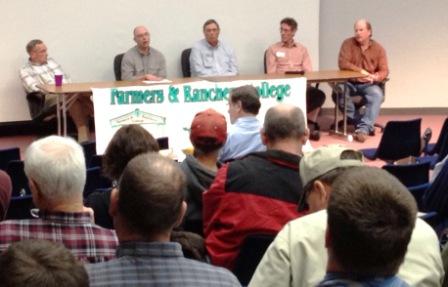
The final Farmers & Ranchers College program for the 2012-13 programming year will be held on March 14, 2013 starting at 6:00 p.m. with a meal and the program to follow. It will be held at Evening with Friends Restaurant in Milligan and will feature Dr. Ron Hanson, Neal E. Harlan Professor of Agribusiness, Ag Economics Dept., UNL. A description of Hanson’s program is provided below.Logo

The entire process for mapping out a succession plan to transfer the eventual ownership of a family farm from one generation (parents) to the next generation (their adult children) can be an overwhelming task for many families.  Where does this process even begin?  Who makes the final decisions?  Can you be fair to everyone involved?  What if there is not good communications within the family?  How do you keep emotions and personal jealousies from taking over and preventing good decision making?  These are the issues that confront any farm family in determining a succession plan which allows for this successful transfer of farm ownership.

Most farm families would agree that a succession plan needs to be implemented and that any “what if family issues” need to be discussed and eventually resolved.  But this seldom ever happens.  Often farm families never can get past the “family obstacles and personal fears” that can actually become road blocks which prevent a succession plan from being put in place to protect the family farm and to insure that their family farming legacy continues to the next generation.   These obstacles and fears will be identified and discussed with potential solutions so that farm families can move forward in their succession planning process.

This presentation will outline the necessary steps to implement as well as achieve a successful succession plan that hopefully avoids potential misunderstandings between various family members. This lack of clarity and failure to explain specifics by parents when communicating their wishes to their children is often a frequent cause of family conflict/disputes.  Ideas will be shared to work through these emotional and stressful issues in a positive manner.  Parents must embrace a vision for passing on their farm that is shared by all family members involved for this succession process to achieve a successful transition of ownership to their adult children and to insure the next generation of young farm producers.

The Farmers & Ranchers College was formed in January, 2000 with the purpose of providing high quality, dynamic, up to date educational workshops for area agricultural producers in south central Nebraska through a collaborative effort between business, industry and higher education leaders.  The Farmers and Ranchers College Committee consists of Fred Bruning of Bruning, Bryan Dohrman of Grafton, Sarah Miller of Carleton, Eric Milton of Milligan, Jim Donovan of Geneva, Bryce Kassik of Geneva, Gordy Nuss of Sutton, and Brandy VanDeWalle of Ohiowa.

For more information on the various Farmers & Ranchers College programs, please go to the Fillmore Co. Extension website  or call the Fillmore County Extension office at (402) 759-3712.

Crops, Programming

Chemigation Certification Classes

Lately I’ve received several questions from producers wanting to chemigate so this week I’ve shared information from my colleague Randy Pryor in my column. Southeast Nebraska farmers who apply chemicals in irrigation water such as fertilizer or pesticides have an opportunity to certify and obtain a license. According to Saline County Educator Randy Pryor, the meeting is for people who need to renew their chemigation certification or for initial applicants. “The trend has been for more new applicants the past several years,” said Pryor. If you plan to become certified for the first time, please contact the Saline County Extension office (402-821-2151) to pre-register for the training session you plan to attend. We can send study materials prior to the training session which is highly encouraged. All class participants will receive a new chemigation manual and calibration workbook the day of training and should bring a pencil and pocket calculator.

Pivot

There is sometimes confusion what chemigation really means. By definition, chemigation is defined as “any process whereby chemicals are applied to land or crops in or with water through an on-farm irrigation distribution system” (Title 195, Ch. 1, 003). The regulations apply whether the water is from a surface water source, such as a stream or canal, or ground water from an irrigation well.

The Nebraska Chemigation Law does not apply to people in town, however, there are specific rules on backflow prevention for connections to a public drinking water supply system if you are using public water supply to apply chemicals to the lawn. Contact your town w
Pryor stated there can be benefits associated with chemigation or the use of fertilizer or agricultural chemicals in irrigation water through pivot systems when managed properly. Irrigators understand and recognize the importance of the required safety equipment and attend certification classes every four years to comply with state laws and review environmental stewardship. The operators complete a written exam upon completion of the class. Individual site permits are issued by the respective Natural Resources District (NRD) later for more information.

The following are additional meetings that are located in southern Nebraska:

  • March 5, 9:00 AM – 12:30 PM, Gage County Extension Office, Beatrice.
  • March 11, 1:00 PM – 4:30 PM, 4-H Building at the Fairgrounds, York.
  • March 28, 9:00 AM -12:30 PM, Hall County Extension Office, College Park, Grand Island.
  • March 28, 3:00 PM – 6:30 PM, Adams County Extension Office, Hastings.
  • April 11, 1:00 PM – 4:30 PM, 4-H Building at the Fairgrounds, York.

Registration is at the door. For additional information, please contact Extension Educators Randy Pryor at (402) 821-2151 or Gary Zoubek at (402) 362-5508.

Youth

Innovative Youth Corn Challenge

Today’s agricultural world faces several challenges, one of them being the decline of our most valuable resource, the future workforce. Keeping youth in rural communities and involved in production agriculture is important to the agricultural industry. With the global population expected to reach 9 billion by 2050, there is and will be the need for more young people to engage in agricultural careers to feed the world.

CornYieldChallenge

The University of Nebraska-Lincoln Extension and the Nebraska Corn Board have teamed up to offer the second Innovative Youth Corn Challenge contest. This contest, open to 4-H members (age 10 & older as of Jan. 1st) or FFA members (in-school members), will guide youth through all aspects of corn production, as well as agricultural careers related to corn production.  As a team, youth will be challenged to implement a production practice different than normal to determine if they increased their yield. Economics and sustainability of the practice will also be considered. Yields, cropping history, and production information will be collected in the Corn Yield Challenge management sum

Goals of the contest are:achieve new, innovative, and economically feasible crop production methods to improve yields; provide research data for producers to implement in their operations; distribute data to corn producers, researchers, and agri-businesses for decision making purposes; introduce youth to a variety of agronomic professionals, including corn producers. mary.

As a team, youth will work with an adult mentor throughout the process. Mentors can be extension faculty, ag teachers, or other qualified agronomy professionals.  Cash prizes and plaques will be given to the first, second, and third place teams. First place will receive $1,000, second place will receive $500, and third place will receive $250.  A data completion and innovation award will also be given. Faced with a persistent drought, an addition this year will be a “limited resource” award which will be based on participants achieving a higher yield with limited inputs. This could be limited water, management practices, fertilizer, other inputs, etc.

To participate, youth must complete and return an entry form by March 1st to the Fillmore County Extension Office in Geneva, NE. For more information, contact me at brandy.vandewalle@unl.edu.

Programming

Cornhusker Economics Outlook Program

The 8th annual Cornhusker Economics Outlook meeting series will focus on the ag outlook and management decisions for farmers and ranchers at eight locations across the state in late February. The annual meeting series is offered by University of Nebraska-Lincoln Extension and the Department of Agricultural Economics and is available free to participants with grant support from the Nebraska Corn Board and the generous sponsorship of Great Western Bank.CEOutlook

The outlook meetings are scheduled for a concise, fast-paced discussion of crop, livestock, and policy outlook:

  • Paul Burgener, Market Analyst and writer for Farm Futures Magazine and Farm Progress Companies, will provide the crop outlook for corn, soybean, and wheat producers. Paul writes his marketing columns from Scottsbluff and travels the country to share his marketing expertise. Making crop production and marketing decisions in 2013 will require balancing lingering drought concerns and production risks with market opportunities. Burgener’s insight will help pave the way for making sound production, marketing, and risk management decisions.
  • Kate Brooks, Extension Livestock Economist will provide outlook and analysis for the beef and pork producers. Kate is a new specialist at UNL with a Central Kansas background and experiences in Oklahoma and Texas before coming to UNL in January. Brooks will digest the emerging livestock market fundamentals of shrinking herds, meat supplies, and meat demand along with grain supplies and feed prices to assess producer profit potential and sound marketing and production decisions in 2013.
  • Brad Lubben, UNL Extension Policy Specialist will provide perspectives on the policy environment in Washington and the implications for ag policy and the farm bill. With seemingly ever-growing fiscal challenges in Washington, the road ahead could be even more challenging to get the farm bill done again before the current extension expires in September. In the meantime, producers will need to recall the existing safety net programs of ACRE and DCP for 2013 program participation decisions. Lubben will discuss the policy outlook and program alternatives to help producers effectively combine farm programs, crop insurance, and marketing strategies for success.

This outlook agenda is packaged into a 2 ½ hour format to provide producers the best available information and send them home ready to make 2013 management and marketing decisions. The series runs from February 25 through February 28 and varies in time by location. Locally, a session will be held in Geneva at the Fillmore County Fairgrounds on February 25th from 2:30 to 5:00 p.m.

Although there is no cost to participants, pre-registration is encouraged to plan for facilities, refreshments, and materials.

More information and details on all eight of the meetings is available on the webpage. Register by contacting the local Extension office listed for each location. You can also contact Lubben at 402-472-2235 or our office at (402) 759-3712 or myself at brandy.vandewalle@unl.edu.

Programming

Women in Agriculture Conference

Any successful agricultural operation depends on effective communication with the business partners. Many times, traditional (male) producers might overlook their most important business partner – their wife or significant other. Sometimes women, especially those without an agricultural background might need a little help in understanding issues their husband faces. Cheryl Griffith, UNL Agricultural Economics Public Relations coordinator leads the annual Women in Agriculture Conference which will be held Feb. 21-22 at the Kearney Holiday Inn. Nebraska women will learn how to care and plan for their farms, their communities, their families and themselves. The theme of this year’s conference is “Communicating in Challenging Times,” and it features a variety of workshops, “funshops” and speakers, including renowned animal scientist Temple Grandin.

Grandin, a professor of animal science at Colorado State University, is a world leader in the design of livestock handling and cattle processing facilities. Her designs emphasize reducing animal stress. Grandin also consulted with such companies as McDonald’s, Cargill and Tyson. Along with her research in animal handling, Grandin has both written and spoken about her experience with autism, which she was diagnosed with as a child.

Other speakers include Jolene Brown, a farmer and author from West Branch, Iowa, and Cheryl Burkhart-Kriesel, co-owner of Kriesel Certified Seed and University of Nebraska-Lincoln Extension community development specialist. Brown will be the keynote speaker Thursday morning with her talk, “It’s a Jungle Out There! Blazing New Trails for Agriculture.” Burkhart-Kriesel will speak on how to draw residents to rural Nebraska communities. Grandin will close the conference with her speech at noon Friday.

In between these lectures, conference-goers can choose from more than 30 workshops spread over five sessions during the event. Topics include livestock and grain marketing, crop insurance, family communication, business transition and beef nutrition. R.P. Smith, a cowboy poet from Broken Bow, will entertain for the Thursday evening program, followed by “funshops,” opportunities to network and socialize in a low-pressure setting.

Those interested can register online. They can also register by calling 1-800-535-3456 or by faxing their form to 1-402-472-0776. Hard copy registration forms can be sent to Women in Agriculture, UNL Agricultural Economics, 303 Filley Hall, Lincoln, Neb., 68583. The early-bird fee of $100 per person is due by Feb. 8. Following that date the fee is $120 per person. Fee includes workshop materials, registration and meals.

The conference is sponsored by the Institute of Agriculture and Natural Resources, University of Nebraska-Lincoln Extension and the Department of Agricultural Economics. Lodging is available at the Kearney Holiday Inn, 110 2nd Ave., 308-237-5971.

Livestock

Drought Preparation Tips for Livestock Producers

After attending the Farmers & Ranchers College Cow/Calf College, there was lots of discussion on preparing and managing the current drought. First of all, Al Dutcher, our state climatologist drove home the fact that most likely the drought will continue in 2013 based on models and other predictions. That being said, what does this mean for agricultural producers?  Bruce Anderson, UNL Extension Forage Specialist spoke on forage planning for the anticipated drought. Current pastures have weak pasture plants, therefore it will be important to delay the start of spring grazing by 10-14 days, use long recovery periods, resist temptation to restock (too soon) and consider annual crops/pastures to reduce pressure and stress on current pastures. Bruce reminded cattle producers to consider planting small grains in the spring, summer forages such as sorghums, sudans and millets and in the fall consider oats and brassicas such as turnips. He reminded producers to adjust the animal demand, pointing out that 75% of the normal stocking rate could even be an aggressive rate in some situations. With the potential for weeds to come up after a spring rain, proper weed management should be considered as well.WebPicpanel13.2

One grazing source that should be utilized right now is cornstalks. Aaron Stalker, UNL Specialist reminded participants that Nebraska corn residue is in abundance; in fact beef animals graze only 25% of corn! Aaron stressed that the stocking rate is very important in allowing the cattle to effectively graze the stalks. Cows are selective grazers on stalk fields. They will select the corn first, followed by the husks which are the highest in quality of diet. Then they will select leaves which are medium quality and finally the cob and stem last which is lowest in quality. In all the years UNL has conducted research on the agronomic yields associated with cattle grazing, it has shown no decrease in yields, so utilizing these stalks, especially in times when forage is short is very important.

Another important discussion for drought preparation is pasture rental rates which was presented by Allan Vyhnalek, Extension Educator in Platte County. As with anything communication is critical to success for both the tenant and the landlord! While pasture rental rates might be set already between both parties, it is important to consider adjustments based on the 2012 drought and the expected 2013 drought BEFORE the cattle are out on the pasture. Adjustments should consider if there will be a shortened grazing season – how will that change the lease payment? In case of a weed flush, who will pay for the weed control?  If a pond or creek usually used for water is dry, how will the water bill be split? During the growing season, both parties should communicate and provide each other updates.

In conclusion, there are many important considerations when caring for livestock during drought conditions. Taking appropriate planning and management steps now can reduce problems and your risk later.